|
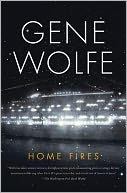
Miles Vorkosigan once accused his cousin Ivan Vorpatril of generating a stupidity field that affected everyone who got close to him; Gene Wolfe does just the opposite. Or, to put it another way, if you took Weird Al Yankovic, kicked up his IQ by about 121 points, and applied the result, not to popular music but to social trends and what if? scenarios, you’d get a Gene Wolfe novel.
Home Fires is a heady mixture of the effects traveling at near light speed has on romantic relationships, how we interact with our parents (even after one of them has had her brain special-order uploaded into a younger body), the consequences of a population outstripping its resources, a war with aliens over habitable planets, and the conflicts between loyalty and self-preservation.
Chelle Sea Blue was in her early twenties when she decided to enlist in the Army and go off-planet; athletic and fiercely independent, she could spend twenty years embroiled in warfare and politics and come back only 2 years older. In that time, her contracted lover Webster Grison could mature, practice law, earn lots of money, and age normally. When and if she returned, between her combat pay and his savings, they could have the sort of life most of Earth’s billions could only dream of. Chelle does return, albeit with injuries that required massive surgical intervention.
After Grison researches what returning soldiers most want, he proceeds to have Chelle’s dead mother, Vanessa, brain-revived as a welcome home present.
What he had forgotten, or never known, was that Chelle had divorced her parents, primarily because of her love-hate relationship with her manipulative mom.
And Vanessa is a piece of work, all right. Between attempts to seduce Grisom and dodging the body-reclaimers, she seems to manage to wrap just about everyone round her fingers, including her enigmatic ex-husband.
To complicate matters, Chelle has made the wrong kind of enemies in her military career. Alongside the threat of retaliation by a vengeful spy ring, a personality overlay just may have invaded her mind, a sort of ghost in the machine riding the replacement arm she got. And even if it hasn’t, her enemies think it has….
Deviously engaging as the plot is, what makes this book so rewarding are the character perspectives, like Grisom’s Reflections on love (p 38), the ironic chapter title “When Janie Comes Marching Home” – when you read the book you’ll understand the irony – and Chelle’s description of her parents: “Before I went into the Army, Vanessa was a bitch with stardrive. God knows my father had his faults, he drank too much and he cheated on her, but he never molested me and he was semi-nice. Vanessa should have been a Halloween costume.”
The science fiction is top flight as well, with self-aware automatons serving as jurors, draconian energy-rationing, brain scans and brain rentals a thriving business, and exposition like the following, by the defense lawyer Webster “Skip” Grisom: “…This country has far too many people, or thinks it does. The result is that the government kills as many as the politicians can justify. Murder means execution, and quickly. The murderer dies; so does everybody they can convict as an accessory.” (p 64.)
Will our protagonists survive the forces, internal and external, arrayed against them? Chelle is adroit, and utterly ruthless; Skip Grisom is an extremely good lawyer, with a knack for recruiting talent and making allies. But will that be enough to wring any kind of happy ending out of the mess? The answer’s a question of perspective. – Chris R. Paige
For more books by Gene Wolfe click here
|
|