|
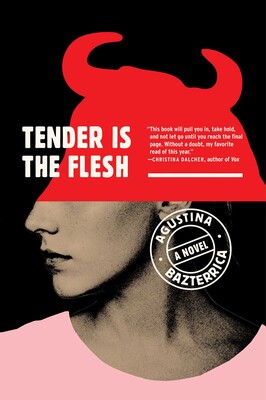
I knew the Go To List I put together of the most frequently brought up books in the Books of Horror Facebook group was going to be wild, but they keep throwing me curveballs. 'Tampa' was a perfect example, being a horror novel that really isn't a horror novel, but ought to achieve the same goal, and here's another one, because, while this absolutely is a horror novel, it's far from just that and it's impressive in whatever category we throw it into. It won the Premio Clarín de Novela in 2017, a prestigious literary prize for unpublished works written in Spanish.
For a start, it's really speculative fiction because its starting point is a near future dystopia that's been changed from the world we know after a virus. As is so often the case, it infected animals first and, when we realised that it was deadly when transmitted to human beings, we chose to sacrifice the animals to keep us safe. All the animals. And without animals, there's no meat, which left us a few choices. Is it better to go vegetarian or dream up an alternative to meat? And, if the latter, are we going to perfect some sort of artificial meat, made from plants, or are we, well, are we going to legalise cannibalism?
Take a wild stab in the dark as to which option 'Tender is the Flesh' took! Yes, cannibalism is now an entirely normal and accepted approach to food. However, don't think of this like some Italian video nasty. It's all very civilised, with breeding centres and supply chains and processing plants. Slavery is still forbidden and aberrant, because we've gone to extra trouble to euphemise the product that we eat, as indeed we do with many animal meats. That's not cow or pig, it's "beef" or "pork". Thus the product processed is just "head", never "people", and what we serve up is "special meat".
Because of this, Augustina Bazterrica, who's an Argentinean author, chose to downplay everything as routine, except perhaps to our protagonist, Marcos Teja, who works at a processing plant. While the world collectively breaks one of our chief taboos, he's our reminder of humanity. Sure, he eats "special meat" too, though he's cutting down, but he's racked with trauma and guilt. Notably, that guilt isn't mostly for being a cog in a cannibalism machine, but for the loss of his only son, Leo and the condition of his father, Don Armando.
Now, he wasn't the cause of Leo's death or Armando's mental breakdown, but he continues to live where Leo lived and dwells on it, although his wife Cecilia left to spend time with her parents, and he continues to visit his father in an expensive nursing home he's paying for. We feel his pain. As he transfers this into his work, apparently starting to question what he's doing, he remains a human face to the novel. As we move into the second half and a breeding program gifts him a female, his relationship with it grows until it becomes a her and then a Jasmine. He even knocks her up, which is an act akin in this world to bestiality and punishable by death.
He's also more human than those around him. His sister's worthless, playing for sympathy when it might come but never actually helping any situation. His bosses aren't remotely tormented by the things they do. It's clear that some are thriving in this environment, the Transition allowing them a safe space for their brand of sadistic perversion. Against Marcos's growing humanity, Bazterrica doesn't hold back in the slightest with detail about the logistics of this world. She hurls us in there quickly and emphatically and keeps us there for the entire book. What's more, it's all told in the present tense, so we're there throughout, not even an appropriately safe distance away in time.
We start out by following Marcos on a meat run, visiting breeding programs, where a stock is kept naked, with vocal cords removed because, after all, meat doesn't talk. Impregnated females have no arms or legs because they don't need to move. Some are milked with industrial machines. Then he gives a couple of job applicants a tour of the plant to watch them react as they watch how head are moved through the process, from killing to flaying. Leather goes to tanneries. Of course, they are all bred for taste and genetically modified to grow faster. It's all about efficiency.
It's also brutally horrific, because, unending euphemisms aside, this is about murdering people for food. It's often suggested that most people who eat meat, myself included, are happy avoiding the truth about how that meat got to our plates. We don't want to see animals slaughtered and we're unwilling to watch the process. When George Franju made Blood of the Beasts in 1949, he chose to make it in black and white because "if it were in colour, it'd be repulsive". Now double down to see the cows gone and silenced human beings in their place. It's even more repulsive.
But it's also routine and Bazterrica explores other possibilities. Sure, the legal system does what it can to delineate head from people, but there's always a black market. There are gourmets keen on eating their flesh live, like Japanese do with certain fish dishes. Foetuses are prized. We're shown a game reserve late in the book, where celebrities can attempt to clear substantial debts by being hunted: stay alive for five days and your debts are forgiven, but get caught and you'll be served up on a platter to those who caught you, quite literally. We learn about Club Lulú where you can sleep with a woman and then eat her and the Church of the Immolation where members can choose as a religious sacrament to give their body for others to eat just like Jesus did. There are ways around every law and those are ways explored best by speculative fiction.
There's so much that can be said about this book. It clearly works on the obvious level of eliciting a response from us about people that we might not provide about cows or pigs. That conversation is a valid one. However, this is more, I think, about the ruthless efficiency of capitalism. After all, we become cannibals because of a shift in the market. Without this product, we need a new one and a huge amount of effort is put into spinning this new product to the consumer. That's especially clear in the scenes at Dr. Valka's Laboratory, which is a litany of cruelty, all with the goal of keeping us in meat. We're complicit.
I refuse to spoil where Bazterrica takes us, but she set us up well and then pulled out the rug from under us in stellar fashion. It's a peach of an ending that makes us reevaluate much of what we've just read, which, given the subject matter, isn't necessarily something we want to do. It's certainly not for lightweights, which may be why it's done so well with horror readers. Arguably, its primary genre would be speculative fiction, fitting easily alongside dystopian science fiction. However, it's also literary fiction, framing taboo breaking firmly as metaphors. It's the sort of book we expect to win prestigious awards, as it did. It's horror after all these, but that doesn't stop it being far more horrific than most horror novels. ~~ Hal C F Astell
|
|