|
Oh, there's a lot to unpack here, much of it kept very subtle indeed. Not being female, I'm sure I'm missing plenty but I caught plenty more anyway.
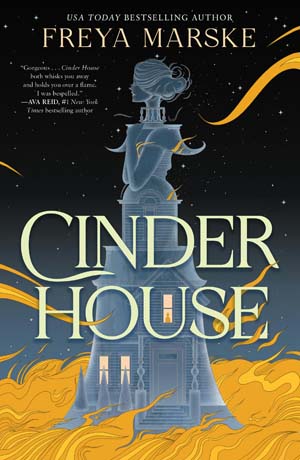
On the face of it, it's 'Cinderella', the fairy tale, retold as a ghost story and published as a novella by TorDotCom. That's an intriguing idea and many of my favourite books lately are novellas from TorDotCom, so I'm eager to dive in. Only slowly did I realise the depth of the structure that Freya Marske built onto her initial idea and I'd love to discuss it with actual women, for whom the fairy tale was written and who will feel these themes a lot deeper than I do.
The setup is that Ella has a stepmother, Patrice, who's wicked because she poisoned her husband and, perhaps accidentally, took Ella out too. She certainly meant to kill her husband, but Ella, in a weakened state from a lesser dose of poison, fell down the stairs and died on the seventh step. In relatively short time, she returns as a ghost, figures out how to manifest a human form and starts to haunt the place. It seems like a great idea to torment Patrice and her stepsisters, the twisted Greta and the more neutral Danica, the only people who can see her. After all, she's untouchable as a ghost, right?
Well, wrong, as she quickly finds. The grudge has bound her to the house, which has a whole bunch of ramifications. For one, she can't leave. She's stuck inside with these relatives she despises. For another, they put her to work because they quickly realise that Ella is compelled to obey an order that involves the house itself. And, when she ignores orders that don't, they realise that they can bend her to their will by threatening it in their stead. If they cut into its wood or dig into its stone, she feels it as pain. And, to make it even worse, she can't touch them.
I should add that there's magic in this world. We hear about royal sorcerers and drowning spirits, but Ella can't leave so we can't either. We're stuck in the house with her, which is little weird given that, in some ways, she is the house now. She was sixteen when she died, as she was beginning to awaken sexually, and that brings a whole new element to the bond. If she can feel pain, then she can also feel pleasure. I presume she remains sixteen in manifested form, but time passes and we don't get to the prince part of the fairy tale until she's more like twenty.
And here I have to pause, because there's so much going on behind that foreground story. Women back in the day—and no, I don't know when this is set, other than "once upon a time"—were there for men. The prince, the only prominent man in the fairy tale, can have whoever he wants, which is a pretty nice perk as they go, but the women are reliant on him for any way out of their drudgery. Ella, in particular, slaves away in the house in any version of the story, but the others aren't free to do anything they like. That's why they all want the hand of the prince when it becomes available.
To women, a hand and a house often went together. Even though they didn't own houses, because their husbands did, they kept them and transformed them into extensions of themselves, whether they did that literally through hard work or, at a higher societal level, through having others do it for them. Ella's grudge here isn't merely that her stepmother took her life, it's that she took her house too; only to ironically become the house when death binds her to it. I won't spoil where this goes but, late in the book, Greta certainly tries the same thing in a very different way.
The obvious way out, because we've all encountered 'Cinderella' in some way or other, is to marry the prince and, in so doing, move to the biggest house of all, the royal castle. Of course, Ella finds a way to go to the balls, because by the time we get that far, she's figured out that carrying a tiny part of the house with her allows her to leave the grounds; she makes a friend of sorts in Quaint, a fairy charm seller; and a neat piece of magic allows her to feel again, albeit with major limitations that abide to the rules of the fairy tale very cleverly. Notably, she just wants to be there, to feel the occasion. She's a ghost and has absolutely no intention of landing a prince, even if that were a possibility. Marske cunningly shoots that down too.
However, she can't avoid the ending and the best thing about this book, above a lot of very good things, is that she fashions one that works on a bunch of levels. It works from the point of view of the fairy tale in a number of ways. It works from the point of view of this ghost story, with all the rules and restrictions that she's built around that. And it works from the point of view of depth, a woman gaining a believable level of freedom that feels utterly empowering. I won't spoil how but it's a lot more than a hand or a house. In fact, it goes beyond the physical.
It's a novella, so there aren't a huge amount of characters. However, Ella is a delightful lead, well-drawn and notably defined by her restrictions until she isn't with emphasis. I know I'm supposed to like the Cinderella character but I don't always, because they're so often annoying. I liked this one. I don't ever recall liking the prince before, but Crown Prince Jule is a worthy character on his own merits, gleaming with privilege but also bound by a set of rules and restrictions, some societal but others magical. His fairy gift turned out to be a curse. I also liked Quaint, as sneaky as she should be as a fairy charm seller, and Scholar Mazamire, also trying to escape her own restrictions.
All that means that this works as a fairy tale, endowed with substantial depth. It can be read just as a story, of course, but reading it from the perspectives of feminism and sexual awakening adds so much more. Also, there's so much here about the need to escape, far beyond Ella and her daily drudgery. The most emotional moments for me weren't grandiose ones at the ball, or even when pivotal things happen. They were the ones where Ella goes to the university to hear lectures on magic and to the Royal Theatre to enjoy the ballets and observe the other patrons. And let's not forget the one where Prince Jule dances in front of someone without worrying about the result.
It also works at the most basic level a book can, simply as words strung together. This isn't one of the rare books I felt compelled to read aloud to myself just to hear the words spoken, but it came close. Marske simply revels in the moments when Ella feels and her prose comes alive along with her senses. It's there when she gets her magic shoes from Quaint. Everything's a new experience and it's appropriately rushed because, now she can feel, she wants to feel everything all at once. It's there later when Prince Jule dances for Ella, a special moment told in special lyrical prose.
All in all, this is another huge success for TorDotCom's novella line, however weird the ménage à trois at its heart gets. There's a whole sequel waiting to be written but that would veer into smut very quickly and is best left to our imaginations. This one hints at it at points but never chooses to actually go there. It has other jobs to do and, double entendre very much not intended, it nails them all. ~~ Hal C F Astell
For more titles by Freya Marske click here
|
|