|
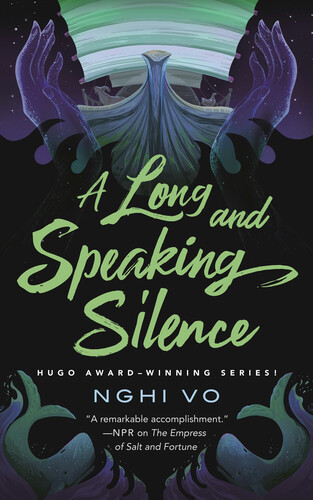
At this point, I believe I'd read a collection of shopping lists by Nghi Vo because she's that good a writer. This is the seventh novella in her 'Singing Hills Cycle' and it's as accessible as the previous one, 'A Mouthful of Dust', because these novellas can be read in any order. In fact, this is an early story for Cleric Chih, who's still green and this time out as a newly formed cleric, just ten months past their novitiate. They make a number of mistakes by asking questions that they shouldn't. Almost Brilliant helps them not do that. They're still learning.
I should point out that Cleric Chih is a wandering monk from the abbey at Singing Hills and Almost Brilliant is a talking hoopoe bird and neixin or memory spirit. Together, their mission is to "mark down the stories of the world, to hear and to remember and to witness". They're travelling from their home in the Anh Empire to the kingdom of Feiyu but they've got stuck in the city of Luntien after Chih's purse was stolen. To make ends meet, they're waiting on tables in a restaurant called Certain Compassion, home to excellent dumpling soup.
Luntien is a busy city anyway but it's especially busy right now, because there's war in the Verdant Islands and seemingly endless boats are bringing in a flood of refugees. As Almost Brilliant points out, there are too many of them here, not as a judgement but as a warning. A few families would be tolerated and ignored. In these numbers, tensions will inevitably boil over into violence and it doesn't look very far away when we show up. Of course, they're not there by choice and Cleric Chih's reply is simply, "Where are they supposed to be then?" Home is a huge theme here.
Luntien is a different city by night and the temple to the Lady of a Thousand Hands is another. It's packed with refugees now because its monks are duty-bound to feed them and it's a shelter from an increasingly unwelcoming city. It's also where Chih finds purpose because nobody has recorded the names of the refugees passing through, important information to families split up in flight. It falls to Chih to take on that task, talking to each refugee, taking down their names and lineages, details of who lived, who left and who didn't do either. It's tireless work but it's appreciated by all but the most orthodox of the Verdant Islanders.
In fact, he eventually learns that they don't think of themselves as Verdant Islanders at all. They are Muyese, from the islands of Muyi, which leads us into a story. Everywhere in the 'Singing Hills' novellas, there are stories, somewhat inevitably because Chih and Almost Brilliant is tasked with documenting them, but once they hear one, a dozen more flow into the cracks behind it. Muyi, it seems, was a god before she was an island, a fourth generation god who wandered the world and became so lonely that she eventually plunged into the ocean and swam out as far as she could, to become the islands named for her.
While the spark for this novella is Chih, in search for stories, finding themself an integral part of one, it soon becomes a story about refugees, not just these but any. The Muyese are no different from any other swathe of refugees and, given that we live in a world that simultaneously abhors them and continues to create more of them, that's an acutely topical subject. We meet a few and they're as varied as any population, even if they have a shared trauma. Some are grateful, others not so much and old-line Muyese who won't talk. The most obvious refugee here is Ha Beili, who's a teenage girl Chih encounters at the temple and many times thereafter. Her story is that of the Muyese in microcosm.
There's another character who's crucial to this story too, though she's dead before it begins. She hovers over everything like a blinking light, even though she's rarely mentioned, both because of the legacy she's created for the children and grandchildren she left behind and because of a firm possibility that Chih can't ignore. They first harbour suspicions at Certain Compassion, when they hear glimpses of stories from various family members of Sovann, who owns the restaurant. Those suspicions grow and eventually take us to a particularly emotional ending. I liked this strand a lot.
While Chih is younger here so not quite as composed as in 'A Mouthful of Dust', this is as powerful a story. I'd suggest that it's not quite as dark, because its predecessor certainly dipped a toe into horror, but then famine and war are always joined at the hip as two of the four horsemen. There's horror here too, but in a more topical and dramatic sense. While that morphed from fantasy into horror, this never leaves fantasy but still carries a serious punch. Like that book, its impact comes through a clever weaving of stories, not just those of leading and featured characters but those a number of others tell, all of which coalesce into the one Nghi Vo wrote down.
Like every book of hers I've read but especially these 'Singing Hills' novellas, she packs a heck of a lot into a very small space and it unpacks with effortless wonder. She seems incapable of telling a merely good story. I'm five in and they're all outstanding. ~~ Hal C F Astell
For more titles by Nghi Vo click here
|
|