|
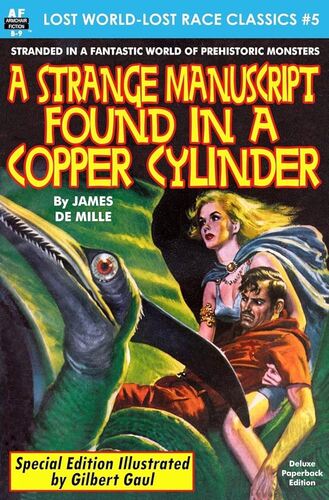
Armchair Fiction's 'Lost World-Lost Race Classics' series, which has been mostly milking the teens thus far, dips back into the nineteenth century for the first time. This expansively titled novel was written during the 1860s but not published until eight years after its author's death in 1880, when it was accused of plaguarising H. Rider Haggard novels like 'King Solomon's Mines' and 'She' even though it technically predates them both. 'She' will follow in this series at #11 and, to date, is the only book in it to be published before this one.
I had a blast with it, for reasons I didn't expect going in. Of course, the core of the story unfolds in the strange manuscript of the title, but it's read aloud in turns by four shipmates on the 'Falcon', the yacht of Lord Featherstone, that starts out becalmed somewhere between the Canaries and Madeira. To pass the time, they race paper boats to an object in the water that turns out to be a cylinder. When the force it open, they find a few pages written on some sort of vegetable product rather than paper and in three languages, apparently penned by Adam More, son of Henry More of Keswick. He's trying to get word home.
Adam is a sailor, who was serving as first mate on the 'Trevelyan' as it transported convicts to Van Diemen's Land in 1843. It was a British colony back then but it's now the island state of Tasmania, part of Australia. As the vessel skirted Antarctica on their way back, More and the second mate, Agnew, decide to row ashore to shoot seal for supplies. A storm rages up and they can't reach the ship, which leaves without them. They drift, eat seal and find a dead British sailor who they bury.
Eventually they encounter a race of men who are small, thin and black, worse than the "wretched aborigines" of Van Diemen's Land. More is horrified by them, but Agnew makes friends, and that isn't a great idea given that they turn out to be cannibals. And that means that it's just More who finds his way into a subterranean cavern and, after an encounter with a sea monster, wakes up at the South Pole, which is populated by a civilised race who pilot oared galleys but have weak eyes that keep them away from the light whenever possible. There are giant ferns in this land and cars are pulled by huge birds. It's a strange but welcoming place.
I should point out here that More is reminded of lost world books that he read as a kid and I can't help but wonder which, given everything I said in my opening paragraph. I can only presume that he's referring to 'The Narrative of Arthur Gordon Pym of Nantucket', Edgar Allan Poe's one novel, though this also predates Jules Verne's sequel, 'The Sphinx of the Ice-Fields'. I wonder why these two classics haven't been included in this series yet. I should pull them down off the shelf to check them out. I'm not sure I've ever read them.
And, because Otto Melick can only read so much, we hop back to the 'Falcon' so that the four folk on Lord Featherstone's yacht can start discussing what they've just heard. It's Dr. Oxenden who's dominant at this point, as he's a gentleman scientist with the sort of detailed memory we're used to in Jules Verne's novels. He explains how every fantastic detail More detailed can be backed up by scientific and observed fact. Melick, on the other hand, offers literary criticism that isn't often positive. That's shockingly meta for a nineteenth-century novel!
Of course, we quickly return to the Antarctic with Adam More who's about to be dubbed Atam-or by the local population, who call themselves the Kosekin. They seem to be incredibly friendly folk but there's a serious dark side that only gradually emerges. Adam meets Almah, who's not of his race but also not of theirs, with a lighter skin and no problem with the light. They still struggle to communicate, because they don't share any common languages, Arabic seeming the closest. The pole, it seems, isn't always bathed in light; the Kosekin endure six months of constant sun before it finally sets and ushers in six months of blessed darkness. To Almah, of course, it's the other way around.
The first signs of the dark side of the Kosekin come when Adam accompanies Almah to the cheder nebilin to place flowers on the corpses of the most recent human sacrifices. Then there's a sacred hunt in which they pursue a sea serpent at great cost, losing nineteen men. Another twenty-eight are wounded but they promptly kill them too because they deserve death in action. Death to the Kosekin is the Lord of Joy. Those human sacrifices were volunteers. What's more, self-denial rules and they avoid light and love and wealth and everything else we seek. Everything's backwards.
And so back to the Falcon so that the nineteenth-century equivalent of 'Herman's Head' can take everything we've read apart. As much as I enjoyed the sheer fantasy adventure of the manuscript, I adored these intermissions more each time. By the end, Melick is deconstructing the novel he's in; while Oxenden compares it to Tacitus's 'Germania', he sees it as satirical fiction along the lines of 'Gulliver's Travels'. Dr. Congreve dips deep into linguistics and explains how the Kosekin surely have to be the Ten Tribes of Israel. After all, after Almah, More spends most time with the Kohen, which is a title not a name. I merely wondered how many of those tribes were lost.
In reality, of course, it's all these things. This works as sheer adventure on the level of Edgar Rice Burroughs who, of course, hadn't started writing yet. He was thirteen when this was published. It also works as a satire. Some of the best passages in the manuscript come late when Atam-or finds himself in a bizarre love triangle with a woman he loves and who loves him and another who aims to marry him to save him from love, which is the worst thing in the world to her. He finds it rather impossible to counter her twisted logic, reminding me of 'Life of Brian' when the title character is worshipped as the Messiah whether he says he is or isn't.
This series really is the gift that keeps on giving. I'm five books into a series that's constructed on a shared genre and yet none of them have been remotely like each other. I'm all the more eager to dive into the next five, which include books by H. Rider Haggard, fantasy legend A. Merritt and the creator of 'Nero Wolfe', Rex Stout. Next up, though: John Taine's 'The Purple Sapphire'. ~~ Hal C F Astell
For more titles in this series click here
|
|