|
I seem to have got behind. It's easy to do, especially with authors who are as ruthlessly prolific as Seanan McGuire and especially when you're focused on submissions and the publisher alters their promotional strategies during COVID. I'd got thirteen volumes into her 'October Daye' series and nine into her 'Incryptid' books, before running out of the next ones to read, which means that I'm currently half a dozen titles behind on each of them. Now, her new publisher—she switched from DAW to Tor in the meantime—has sent me a bunch of her latest for review and they're not going to make sense until I close those gaps. So here goes.
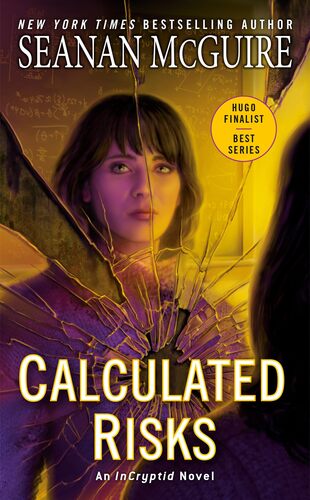
This is the tenth book in the 'Incryptid' series and it's the second half of a duology with 'Imaginary Numbers', literally starting half an hour or so after that one ends. I reviewed that back in 2020 as COVID was descending upon us, so it's far from fresh in mind, and I'm very thankful that I returned to it before diving into this one. I'd remembered a good chunk of it but I'd forgotten just how vast the cliffhanger was that ended it. Most of 'Imaginary Numbers' was spent in Portland, Oregon, as Sarah Zellaby, very possibly the only decent cuckoo in the world, attempts to prove she can travel on her own after the serious damage she did to her brain in an earlier book. This one is not spent in Portland, in Oregon or even on the planet Earth. We're in another dimension.
And, while I did have some problems with this book, I found this new dimension fascinating for the things it does to the genre McGuire is working in. This series has been urban fantasy from its very beginnings, with a thoroughly unusual family, the Prices, who left their cryptid hunting world as a part of the Covenant of St. George, to help out the same cryptids they'd hunted. It gave McGuire a seriously good opportunity to have fun with the biology she loves but in a fantasy framework. She also wisely swapped out lead characters to serve the series progression, from Verity through Alex and Antimony to Sarah. As different as this series is from the 'Toby Daye' books, it's still obviously urban fantasy.
However, can you still call it urban fantasy when there aren't any towns or cities? Can you still call it urban fantasy when it's in another dimension, one we don't even have a name for? I'm not sure we can. Certainly, there are still cryptids here, because when Sarah used insanely complex maths to carve a hole in the space time continuum, she didn't just bring herself; she also brought a host of others along for the ride.
There are her cousins Annie and Artie, from different parts of the family, plus James, who'd only just joined the family during Annie's three books, and Mark, the one cuckoo who took the side of good late in the previous book, not to forget a handful of Aeslin mice, who I will never stop loving to bits. There are also thirty or so students at the University of Iowa in Ames, who were inside its buildings when she brought the buildings. There are a few bogeymen in the tunnels, a chupacabra and a cornwife. And a bunch of cuckoos, but they're zombies here after Sarah fried their brains to enable the journey. So yeah, if cryptids mean urban fantasy, that's what this is.
However, we're not in Kansas anymore, Toto. Or indeed Iowa. The sky is orange, there are three suns blaring down and plenty of giant flying millipedes floating by. That feels like science fiction. All the background we learn about the Johrlac, the usual technical name for cuckoos, and indeed the Johrlar, who kicked the Jorhlac out of their dimension for reasons unknown, changing them in the process so they couldn't return home from exile, plays into both. I treasured the background, as I have throughout the series, but there's too much repetition as it unfolds, woven so tightly as it is into all the interpersonal relationship stuff.
There's clearly some survival horror in play too, not only in dealing with hordes of zombie cuckoos, which perhaps inevitably starts to feel like a videogame. Most of these characters generate some sort of angst, drama or outright conflict, but the zombies remain stubbornly the same braindead horde at the end of the book that they are at the beginning. Character is inherently denied them. There's horror in the giant bugs too, though a biologist like McGuire won't read that the way that many of her readers will, not just giant millipedes but praying mantises and spiders as well. Sarah adopts a giant spider called Greg, who's an absolute joy, short on brain but long on loyalty.
But wait, there's more! When we meet the sentient bipedal part of the local population, who put saddles on the millipedes and mantises to ride them through the sky, the feel becomes planetary fantasy. Fortunately for us and for the human characters here, some of them speak English, with shared heritage from our dimension. There's not a lot of effort expended here on dot connecting, but it's made very clear that dimensional travel happens a lot more than we might expect. Given that Annie and Artie's grandma, Alice Healy-Price has been searching the dimensions for her lost husband for half a century and it's her turn in the spotlight in the next couple of books, this would seem to be pivotal groundwork.
In short, there's an awful lot here. It's dimension-ripping maths. It's survival horror. It's planetary romance. And it's all wrapped up in urban fantasy sticky tape. It's also an emotional human story because there's a crucial detail I haven't told you yet, one that's made manifest the moment the first chapter begins. That's that Annie, Artie, James and Mark have absolutely no idea who Sarah is. She blanked out the brains of the cuckoos to use for raw processing power, but she also needed more and so removed herself from her compatriots to make that possible. That's especially tough given that she and Artie had finally got to the point of saying that they loved each other. Now it's all gone.
I have no problem with that and it's a fantastic, if highly unusual, way to start the second half of a duology. However, the worst aspect of this book is that the repetition in background also extends to repetition in intercharacter relationships. I've read Seanan McGuire novels, in this series even, that had five hundred pages of story in three hundred pages of book. This one feels more like the other way around. To be fair, some of it's inevitable. You can't just tell the people who don't know who you are that you're their cousin and you grew up together and expect everything to be great. Of course, it takes time. Of course, it takes repetition. Of course, it takes effort, which they might not want to make, given that they don't know who you are. The catch is that we have to read it.
So to Alice, who's floated around a number of these books deep into their backdrops, to see what happens with her dimensional exploits. Does she find Thomas Price, her long lost husband? Let's find out next month when I dive into 'Spelunking Through Hell'. Or maybe not, because maybe it'll take until the book after that, 'Backpacking Through Bedlam' to actually get to that point. I'm up for finding out. ~~ Hal C F Astell
For more titles in this series click here
For more titles by Seanan McGuire click here
|
|