|
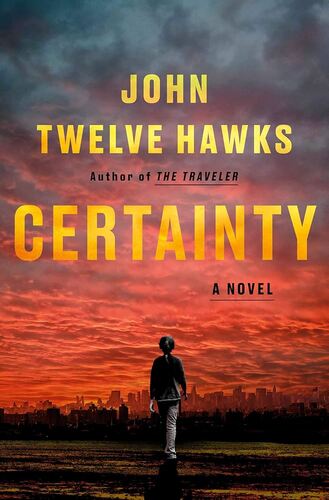
Here's something exquisitely topical, set in a near future dystopia that feels extrapolated from a thousand different details in our present. Right now it feels pretty accurate, if a little pessimistic, but there's so much here that it's going to change over the next decade or so. It could well become incredibly prescient, its predictions coming frustratingly true, or it could suffer from guessing the wrong directions that we'll take in the future in ways that only become embarrassing in hindsight, like the inclusion of payphones in 'Neuromancer'. I should set an alarm to re-read it in 2036.
It's a complex story of intrigue that feels even more complex because of how deeply it's imagined. John Twelve Hawks may well have a manifesto, given his bio on the rear jacket flap, but he treats his sociological and technological changes with an even hand, so characters see them as good, bad or neither, depending on who they are, and others have wildly different takes on exactly the same thing. There's so much here that someone could provide an annotated edition that's twice as long as this one, even avoiding the literary structure that unfolds in a set of entirely separate threads that only gradually start to merge.
We meet Kate first and she's given a fantastic opening line: "Kate was playing chess with her harp seal friend when men with guns entered the house." She's an orphan living in Scarborough, Maine with her foster parents and she's only ten-years-old. So when NPS officers show up with huge guns, augmented reality glasses and no need for a warrant, citing a Nifti with a MAP score of 94/100, it's fair to say that the Nolands are rather confused. Why would an AI think that Kate is really close to guaranteed to either kill someone or be killed herself within the next thirty days? Fortunately for her, that harp seal, Zeno by name, which is her IT, tells her to run and she does.
There are a lot of abbreviations there that I should talk through. You know AI, I hope, because it's one of the biggest themes of this book. As that advances, how can we tell the difference between an honest-to-goodness human being and an artificial version? As the latter gradually take over an awful lot of our decisions, how does that affect our concept of identity? When the things that lend us meaning cease to be our responsibility any more, how and where will we find new purpose? And if we scale that up from the micro to the macro scale, how does that affect humanity as a whole?
NPS is National Public Safety, which is suitably friendly but vague. These cops do the bidding of AI, which monitors everything. When it detects risk, it assigns a MAP score, or Mortality Assessment Probability, the likelihood of someone's death. A Nifti is a Necessary Force Terminal Incident, the virtual piece of paper that allows these cops to show up unannounced and uninvited and inject an RFID into the bloodstream of the subject in order to help protect them and those around them. In Kate's case, that'll be a Safe Kids ID chip. Oh, and IT in this context is Interactive Toy, an internet-connected AI in the plush body of a harp seal.
All this unfolds in a mere couple of pages, so you can see the level of detail that the author threw into this novel to make it feel believable. Of course, there's story behind it. Why would a ten-year-old girl be either in danger or a danger to others? Why does Zeno make the decision it does? Who gave her Zeno to begin with and why? We have no idea about any of this, but as it guides her away from the cops, especially by getting inside an Autonomous Transport Vehicle, or unmanned truck, we start to finesse those questions ahead of any answers being forthcoming.
Meanwhile, behind this near future technothriller subplot, there's a murder mystery to contend with. Wilson Talley is a Trigon data analyst with a shadow based on his younger self. He used to be a journalist for a couple of decades but he was replaced by AI, so he's found a new line of work and that involves investigating things that might be of interest to incredibly rich people. At this point, that means the death of Terry Greene, who built sophisticated nubots in his basement workshop, because he may well have been killed by one. This works rather like a detective story but with new mission parameters. It's never really about solving a crime and bringing justice to a victim, it's all about whatever Wilson's bosses care about, which could well end up being nothing.
A third plot strand explores a detective story in a different way. It's about the search for Bennett Schroeder, a twenty-year-old who's vanished but whose parents are rich enough to pay for quality help to find him and bring him back to them. That means Julia Lau and Daniel Blake, because he's not likely to be in our reality, which is a statement I need to seriously explain. Our reality, analog reality, where the Schroeders live, is only one of four in this near future. Augmented reality isn't much of a stretch, a headset adding layered data to what's around us. Virtual reality isn't either, being an imaginary world we can explore through other hardware. Julia is a guide in what's called Parallel Reality, which combines all these and generally means the Over World.
We've already visited the Over World with Julia, as she guided a teenager through a simulation of a Ukrainian warzone that exists in our world and theirs but here only in an immaculately scanned and recreated simulation, one that involves all senses, not just sight. Bennett was obsessed with a legendary location in the Over World, Dragon Lair, so is likely to have checked himself into a travel center that can take care of all his bodily functions for the extended period he needs to explore it to his satisfaction. Julia can find him in the Over World while liaising with Daniel in analog reality, combining to get the job done.
If that sounds like I've dived in far deeper than needed, I should emphasise that I've just scratched the surface of this novel. Each of these threads is a journey of its own, with its primary characters encountering a swathe of others, most of whom bring entirely new extrapolations to light, as they struggle to understand what's going on and why and who's behind it all. The locations are varied, too, and often involve organised groups that attempt to answer that question about identity that I raised earlier, at least to those who are attracted to their answers. And, of course, eventually it ceases to be three stories by gradually providing connections between them that make more and more sense until they coalesce into just one.
So I could have talked about Kate getting food by joining a film crew shooting a segment for 'Kiko World', a high AQ (Attention Quotient) show about the top half of a nubot that's written by an AI in Tokyo with lyrics by an AI in Mumbai. I could have talked about Elysian Fields, a living assistance facility that's populated by Social Assistive Robots called Friendlies, there to be companions and assistants to the elderly but also spies for the staff. I could have talked about E-Volve, a collective of augmented humans who like the idea of enhancing their bodies through better mechanics but violently oppose the trend of machines looking human.
And that still wouldn't cover a fraction of what's going on in this book. There are AI enhanced sex bots, Red Blister Disease and VR boyfriends. There are e-masks to defeat facial recognition from smart billboards and kill airborne viruses. There are Kafka deaths, people erroneously identified as dead by the system who effectively become that because bureaucracy can't accept that sort of mistake. And there are Death Catchers, prisoners seconded into fatality removal programs after the global stem-flu pandemic that wiped out half of New York City. I could keep going.
A lot of this probably counts as cyberpunk, given its focus on technology as a primary driving force for sociological change. Certainly the Over World feels like a modern day take on VR structures in books by William Gibson. The blur between human and machine intelligence echoes what Philip K. Dick wrote about it decades ago but with a more contemporary aspect. I have to assume that the unicorn motif that shows up in the form of a narwhal horn late in the novel has to be a deliberate nod to 'Blade Runner'. I don't have the background in technothrillers to cite influences there, but I have no doubt that some exist.
And through all of this, there are very few details that don't ring true to me. Perhaps the biggest problem I had was that Kate remains calm beyond what I would expect even for a special ten-year-old who's gone through what she has. That goes double for what goes down when she finds herself stuck in between the Guardians and the Pledged. Surely some of this would be enough to shatter her sense of calm, even with Zeno everpresent to keep her grounded. But hey, that's all I can hurl out as negative. Ask me again after I re-read in five or ten years. I may have more to add to that, but it will depend on how our analog reality changes in that time. That's telling. ~~ Hal C F Astell
|
|