|
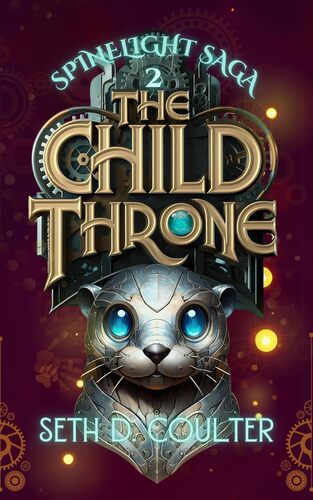
I read and reviewed 'The Bronze Age' last month, the first book in Seth Coulter's 'Spinelight Saga', and it's stayed fresh in my mind. There's a perky optimism to it that's present while reading but only grows with time. The reality of our world right now is pretty depressing and it's trivial for writers to translate that into fiction. What we really need, of course, is a healthy dose of optimism to see us through the dark times and point towards a way out of them, as long as we don't simply escape from the clouds by hiding our heads in the sand. This series finds a good balance.
If you'll recall from my first review, the Burly family live on a floating island called Tiber, home to a sprawling city, and they work in what I presume we can call annimatonnics, with all those double Ns. Annimatonns are mechanical creations, but Ren's are advanced, able to speak and reason and, well, transform into hats or wrist mounted blasters. This is steampunk, after all. Ren is the genius inventor of the family and he relies on the metal that his wife Penelope spins using light. It would seem that, in her speciality, she's as notable as he is in his. They have three children now, not only Athena and Thaddeus but young Roland, who's eighteen months when this second book begins.
We begin with a reminder that annimatonnics doesn't necessarily translate to standalone animal robots creations. A farmer called Appleton has an artificial arm and that relies on the same tech. Ren's having to work on it not because he created it but because Appleton skimped on the needed maintenance by going with someone cheaper. He's paying the price now as Ren restores it to full functionality. Also in this introductory section is Gerald Graft, who wants Ren to replace his arms with similar technology, even though there's absolutely nothing wrong with them. Ren refuses on the spot. He'll replace a missing arm or an arm so broken it can't be fixed otherwise, but he won't replace a healthy one, let alone two. He's clearly not a transhumanist.
This gets us settled so that we can be promptly jostled, quite literally, by another floating island that literally crashes into them. This one has steel spider annimatonns and a striking woman on a glass swan, which really makes for a great entrance. Ren has a history with her; he and Aphrodite Carver were an item, long ago, as apprentices together at the College of Bronto. She works in the same field of work, of course, but on the island of Carthage, which is therefore what just hit Tiber. Penelope isn't remotely convinced by this coincidence and we already know from the first volume that she isn't anyone to be trifled with.
Frankly, they'd just ignore this new turn of events and wait for it to go away again, because there are officials to handle all the red tape that would surely be generated by an accident of this scale of magnitude. However, one of those officials happens to be Lucian Scratch, one of the obnoxious suitors in the first book and a cousin to the Governor of Tiber. He pops round to specifically invite them to meet the Throne at the Crashing Ball, to be held in the Kundry Palace on Carthage. They still don't want to go but it simply wouldn't do to upset the governor and they reluctantly agree. That, of course, is their first mistake.
Thus far, this is all incredibly welcome. While we haven't learned much about life on Tiber yet, it's never a bad thing when the second volume in a series expands the known universe, as it were, by introducing us to new territory. It doesn't usually bring that new territory to the old with collision but it's an entirely appropriate way to do it when territories are floating cities. Coulter reminds us of our regular characters, then introduces new ones, not merely Aphrodite but her apprentice, Gunther Biggs, and promise of many more at the ball. We're about to visit a new island, with new people and a new society, backdrop and form of governance.
The downside at this point is rather annoying, given that these books are generally stylishly laid out with good font choices, good headers and footers and good artwork introducing each chapter. They're well-proofed as well, with only occasional typos and those being for more unusual words, like "cumberbund" for "cummerbund". I'd have called out "jerry-rig" for "jury rig" too, but that's apparently valid nowadays. It must be a sign that I'm getting old when gradual language change happens around me!
All that said, there are instances of a bizarre issue in this volume that I don't understand; it seems to be a combination of problematic margins and justification, but not in places where we'd expect anything to be isolated. In other words, if this was to happen at all, it ought to have been a bigger problem. That it isn't makes me wonder how and why. It's rare enough, at least, that I'd bet most people will just look right past it, but it's hard for my proofreader brain to not catch this when the first instance is in the very first line of the very first page and there's another only four pages on.
Back to the story, though, and everything kicks off when we get to Carthage. It initially seems like a glorious place, with Dite's annimatonns impressive in different ways to Ren's. Visitors to the ball are greeted by a titanic annimatonn chimera, a swarm of hundreds of annimatonn hummingbirds and even an annimatonn giraffe working hat check. Dite clearly does very good work, even if she's way behind Ren when it comes to sentience. She and Gunther are frankly gobsmacked by his much more subtle work with characters we've got to know, like Socks his bronze otter.
However, there are clear signs that not all is well on Carthage. The annimatonn spiders only have three legs each, leading to them being called triders, because, by decree, no creation is allowed to have more legs than the Throne. This Throne is an absolute monarch, meaning that anything it wants goes and all of its subjects are painfully aware of that little detail. And there are titles like Chief Serenity Officer and Sincerity Enforcement Minister. We haven't even met the Throne yet, but we can be pretty sure that Carthage is a dystopia.
We learn plenty at the Crashing Ball, none of which is particularly surprising except in degree. We learn about Ren and Dite's history at college and of course Penelope was there at the same time. We meet the Throne, Darius Sphinx, and realise in the process just what a nightmare Carthage is. It isn't that he's an absolute monarch, it's that he's a spoiled brat who's an absolute monarch, the island of Carthage ruled effectively by tantrum. These are recent books, the first two in the series coming out in 2024, so it isn't hard to see the most obvious influence on Darius. However, he isn't orange, he speaks in actual sentences and his most obvious physical characteristic is one that was neatly telegraphed early in this book rather than something easily translated into our reality.
While the first book was a quest, Athena and Thaddeus going down to the surface of the planet to rescue their father, this one is a mystery, with Penelope clearly set up for murder at the ball and the rest of her family up against the clock to clear her name before she's executed. It isn't a deep mystery, because there aren't many viable suspects and even fewer reasons behind the crime, so there's less fun in figuring out whodunit and a lot more in figuring out how to prove it and in such a way that an absolute monarch who acts like a toddler will go along with justice rather than what might be in it for him. The traitor, in particular, was immediately obvious and I'm not sorry to see him vanish from the series.
It's impossible to not like these books. They have a charm to them as well as that perky optimism I mentioned earlier. The human characters may be mostly archetypes but they're fun ones. We can care for the Burlys, Dite makes for a delicious villain, and Darius is as memorable as he is spoiled. I enjoyed certain wins not just because they were right but because of who got their comeuppance out of it. The mystery isn't deep but it takes hard work to find the proof necessary to right wrong, even if parts of that work benefit from conveniences. I did like the Order of Undertakers, however much of a deus ex machina shortcut they count as.
When I started this series last month, I had these first two books already in hand, but I found Seth Coulter at Phoenix Fan Fusion last month and discovered that he has the third out, so I'll be diving into 'The Giant's Back' next month. ~~ Hal C F Astell
For more titles by Seth D Coulter click here
|
|