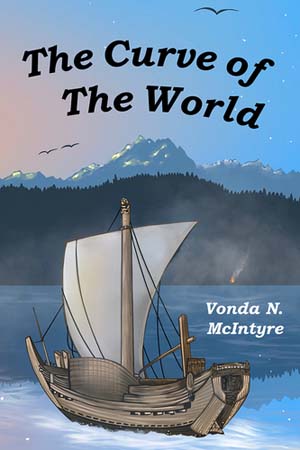
|
Vonda N. McIntyre was a pivotal writer of science fiction and fantasy and I haven't remotely read enough of her work. In fact, the only original work of hers that I've read thus far—in addition to a few of her novelisations of 'Star Trek' movies—is 'Dreamsnake', which deservedly won a Hugo for Best Novel in 1979. As I understand it, many of her books are technically seen as standalones but share some details that suggest a common universe. The new Eldest Daughter of the Idaea has a snake very early in this book, suggesting a link that isn't otherwise explored. Characters here are descendants of Sea People, who apparently play a role in other books. I could easily imagine that there are further connections here of which I'm blissfully unaware.
This is McIntyre's final novel, which she completed shortly before her death in 2019. As it was most of the way through the editorial process, it's fundamentally hers, but that process was completed by Nisi Shawl and the editor of Aqueduct Press, L. Timmel Duchamp. While there are elements of fantasy in it—not least the inclusion of a gryphon's skull—it plays out as alternate history, which plays more with cultures than with people. It's mostly focused on the Idaean people, traders who have established sprawling trade routes aided by a sort of exchange program for children that I found fascinating.
With many of the cultures they encounter, they leave one of their own behind as a given child, so that they can learn the applicable language and way of life as if they were part of that culture. In return, they receive a child of theirs to do the same in return. When these children come of age, they're returned to their own cultures and are given the choice of which they would stay with. It's an important part of the Idaean trade network and it surely increases genetic diversity as well as sharing crucial knowledge. As we later learn, the Idaeans are a free people and they have a habit of acquiring people from other cultures, in a slew of ways. This book could be seen as something of a manifesto for cultural diversity.
Many of these cultures are matriarchal, including the Idaean. We realise quickly that the primary character is Iakinthu Gephyra, the former being her name and the latter her position: Gephyra is a sort of chief diplomat. She doesn't rule in Idaea, that role given to the Eldest Daughter, at this point in time Marinti, who isn't remotely old. The plot-to-be soon firms up to be the return of the given child Rhenthizu to his mother. The problem is that he wasn't given in a traditional way; he's more of a rescue and his people aren't known, just believed to be half a world away on the other side of the Untamable Ocean. It's clearly going to be quite the voyage.
What we don't do quickly is start that voyage. Instead, we're immersed in Idaean culture, rituals and structures and families. We meet countless Idaeans with little idea of who will join the voyage and become important to the story and who will remain in Idaea as minor supporting characters we've left behind. Iakinthu and Rhenthizu are the only safe bets. Are we going to see more of the Eldest Daughter, who's taken a serious fancy to Rhenthizu? Aranthau, Iakinthu's lover, seems likely as he captains her vessel, 'Flying Fish'. But what about her daughter Omempau; her former lover Nessu; her given daughter and numerator Kikinkizu; her distant cousin Psarau? We have no idea. Twenty percent of the book gone and we still haven't set sail, instead we’re visiting family at home.
I liked these early chapters for their worldbuilding, but I also struggled to get through them. The details are there for a reason and I valued them more from the standpoint of hindsight later but, while reading them, I wondered at what McIntyre focused on. There's a huge amount of ritual, an obvious thing to include because it tells us what a culture values most. There's a huge amount of casual nudity, mostly unrelated to sex; even the ewers have nipples and the sheep are naked too, shorn of their fleece. There's a huge amount of oil, perfumed and warmed and scented. There's a huge amount of sensory data too, McIntyre keen on detailing colour and taste and odour.
Eventually, when we reach the second part, we finally leave Idaea and the core story, as episodic as it has to be, can start to take form. Few names here correspond to those we know today, as the story is based in the distant past, even if we can't put a date on it because of McIntyre's blurring of real history. However, Idaea is presumably Crete, its city Kunusu obviously Knossos. The 'Flying Fish' travels west, through the Sunset Sea, or Mediterranean, to reach the Untamable Ocean, or Atlantic. Presumably Hind is India and Kinuku is the Chinook people, indigenous Americans of the Pacific Northwest, while Nipunu is certainly Japan.
I'm not sure what Lady Jaguar's land is called, but I'm guessing that it's Aztec, just as the nomadic People are surely Amazons. Only the Pharaoh and Egypt have precise names we recognise, though there are a pair of Japanese characters whose names spark recognition. They're noble sons of an important lord, rescued by the Idaeans when seeking fresh water, Genji and Murusaki by name. It would appear that these are nods to 'The Tale of Genji', probably because the oldest known novel was written by a woman in a script traditionally reserved for such. Gender is very important here, with many matriarchal cultures but a few patriarchal ones too. Each has different expectations of gender roles. At least two characters present as a different gender to their bodies, for different reasons.
Needless to say, a lot happens on this journey west and the population of the 'Flying Fish' changes accordingly. They leave Issiia with the nomadic People as a given child and retrieve Uinthi, one of theirs left previously. They return Kilinkuzu but she elects to remain with the Idaeans, angering a dangerous old friend. In the first of a number of plot conveniences, they acquire a boy from a ship they defeat in battle. It's one of theirs but it was taken over by Northerners and they take it back. The child is Kilinkuzu's son, though he's a brat of a boy conditioned by a patriarchal society to look down on women. They're there to be stolen and conquered, just like everything else.
At each stop, Iakanthu effectively leads a diplomatic mission to a new and vibrant culture, with a proliferation of gift-giving to accompany polite kindness and subtle wariness. She's well-aware of potential danger and navigates its currents with political savvy. The most dangerous stop, as well as the place with the wildest customs, is Lady Jaguar's land in Central America. She's daughter to Queen Blood Jaguar and King Jade Stingray, both of whom preside together over their kingdom, even though the latter is dead and mummified. It's there that they acquire one of my favourites among the ensemble cast of characters, a translator slave called Bridges Words. When he isn't in translator mode, most of his dialogue begins "Tomorrow I may be killed, but today..."
I enjoyed this novel more and more as it ran on. This epic journey of the 'Flying Fish' is inherently episodic but increasingly fascinating. I appreciated the travelogue and the endless nations that a trading vessel experiences, even when embarking on a different mission. The encounters can get a little repetitive and more plot conveniences creep into the latter chapters, which unfold with a faster pace, leaving the book a little out of balance. Perhaps the first part could have been much shorter and the last a little longer to restore that balance. It ends well, though, with both happy endings and ones not so much. A couple of plot strands are left unresolved too, as if McIntyre had intended to tackle them in a sequel.
After all, there's still a voyage home to make, one that will perhaps follow a different route, but which we'll never read. And that's fine. "Tomorrow I may be killed, but today was a good day." ~~ Hal C F Astell
For more titles by Vonda N McIntyre click here
|
|