|
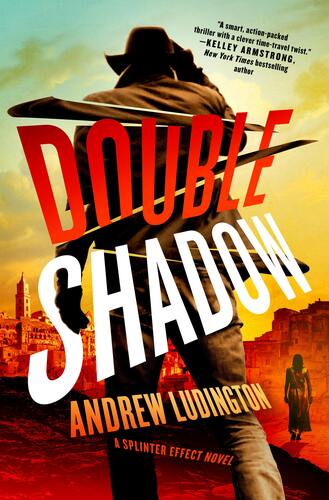
I enjoyed 'Splinter Effect', the first in this series of novels by Andrew Ludington, and I enjoyed this second episode even more. It's just as quick a read, even though it immerses us in classical history with what feels like more detail than previously. Unlike the first book, I have a little grounding in the setting, which is primarily Judaea in 68 CE. I certainly don't have enough to fact-check the book but I have enough to see at least some of the places where the author is taking facts that we know for sure and making intuitive leaps for the benefit of the story.
What's important is that they're good leaps and entirely justified in fiction. It's not too far adrift from what Graham Hancock writes but has the gall to label non-fiction. Perhaps most importantly, aren't these leaps rather the point of Ludington's core idea? We have a collection of artefacts and documents and whatnot that prove X, Y and Z, but there are gaps that we simply can't explain. So hey, let's have the Smithsonian send a classically trained historian back in time to observe things happening and then report back. And if he can retrieve something tangible to back up his story, then all the better. Just bury it somewhere that will remain untouched over the centuries, then dig it up in the future. I do like this idea.
When this second book kicks off, Rabbit Ward, who's that classically trained Smithsonian historian, is in Rome in 64 CE. The city is burning and Nero may or may not be fiddling, but Rabbit has picked up some scrolls written by Emperor Claudius from the Porticus Octaviae, including a rare Etruscan dictionary. That's very cool indeed. What isn't cool is the unusual crime scene that he discovers. A man has been eviscerated and his attacker escapes. Rabbit gets out too, only just, and has to talk to the Italian police about it. Yeah, I stumbled onto a murder. Where? By the Forum Boarium. Did you tell the police? In 64 CE. Ah. Oh, and he spoke English.
It isn't hard to guess how this murderer got there, because, on his return to now, Rabbit sees the news about Alexi Misherenko and how he's been selling time tours on the black market for a cool million euros a pop. He's asked if he recognises anyone suspected of being associated with Time X and he does, because there's Helen, who he encountered in the first book. He doesn't identify her as they have a rather personal relationship; both helping and hindering each other and, it seems, falling in love in the process. What drives this book is the text that she sends him at this point, an acute plea to find Einar Eshek, whoever he is. In Judaea in 68 CE.
He finagles a way there and finds Helen almost immediately, but she's younger and doesn't know him. Such are the perils of time travel! Off they go to Qumran, then known as Secacah, which is an important site to us today as the location of the Dead Sea Scrolls. Back then it was home to a sect of Jews located outside of the turmoil then going on in the region with revolts and Nero's suicide and the Year of the Four Emperors. Rabbit and Helen can't avoid all that and get firmly caught up in it, not least by being accused of murder, committed in precisely the same way as the one Rabbit stumbled onto in Rome, and thus sentenced to imminent death.
However, they do bump into the MacGuffin of the story, which turns out to be one of those scrolls. It's the Copper Scroll, which is real and an absolute gift to conspiracy theorists and time travelling novelists. Unlike every other scroll found at Qumran, which are written on parchment or papyrus and are primarily religious in nature, the Copper Scroll, as you might expect written on copper, is effectively a treasure map. It details substantial caches of gold and silver and where they can be located. Ludington's suggestion is that this is the treasury of Herod's Temple, potentially valued in our time at billions of dollars. And so the search is on.
What follows is very consistent with the first book. To echo my notes on that one, it feels less like an 'Indiana Jones' movie and more like a Clive Cussler novel starring 'The Librarians'. Where the 'Indiana Jones' comparisons come in happen when Rabbit encounters real historical figures, this time those caught up in the First Jewish-Roman War, people like Zealot leader Eleazar ben Simon, rebel leader John of Gischala and the historian Josephus. It's also relatively family-friendly action with a few darker moments, my favourite here occurring during a crucial escape from the Temple on the Mount. Maybe "Like a cork from a champagne bottle, he shot down the slick stone tube on a frothing column of gore" isn't family-friendly but I enjoyed it immensely.
And, against that historical backdrop, there's plenty more to enjoy. The relationship that Rabbit and Helen have developed is established for him but not for her, so the dynamic between the two is fascinating to watch. Neither of them knows who Einar Eshek is but they have to locate him and also figure out why. There are more murders and a number of suspects, death not being unusual during a time of war but highly unusual in this particular manner. Surely there's a reason for that too and that's another detail that they have to figure out. And, of course, they're on timeframes because, if they don't get to their return points at the appropriate times, they'll be forever stuck in the past.
I liked the first book and wanted more. I like this second book even more and want a lot more. The bedrock that Ludington has built to support these stories is glorious and firm enough to support a long run of Rabbit Ward novels. In fact, it's so solid that I fully expect these books to be adapted in some fashion. The only catch is that the historical settings mean that the languages being spoken are generally not English. To be authentic, the bulk of a film or TV show would unfold in subtitled Latin, Hebrew and whatever else, and that's just never going to happen. They'd be shot in English and we'd have to accept that.
The good news is that Ludington, having debuted last March, has followed that book with another just over a year later and that bodes well for an annual Rabbit Ward adventure. I look forward to this time next year. ~~ Hal C F Astell
For more titles by Andrew Ludington click here
|
|