|
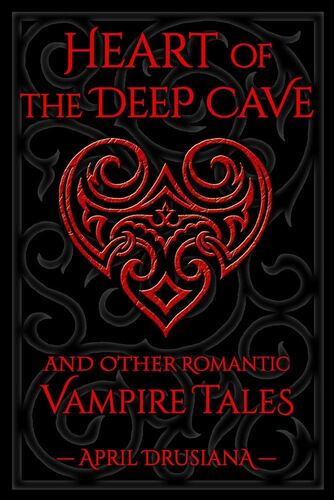
This isn't technically a submission, because I swapped one of my own books for a copy last TusCon, but I wanted to take a look at it relatively soon because it intrigued me. The author, whose name isn't either April or Drusiana, two separate pseudonyms she often uses for short stories that she combined here, writes scholarly papers on gothic and Romantic literature—with a capital R—and seems to have quite an involvement in vampire subculture. That fits because the stories here are varied considerably in tone and length but maintain a relatively consistent outlook on lore.
There are five stories on offer, but their lengths are so varied that 'Away from the Light' probably counts as a novella, 'Heart of the Deep Cave' a novelette and the other three truer short stories. 'The Call of Destiny' is over in eleven pages, making it a short story indeed but it's also mirrored in 'Moonlight Meeting', which runs double that and serves as a retelling from the perspective of another character and as a sequel to both. I'd call them companion pieces, because they elevate each other but would both feel lesser in isolation. At the other end of the length spectrum, 'Away from the Light' takes up almost half the book with its hundred and twenty pages.
I found it a consistently fascinating book, because there's a heck of a lot here, much of it unfolding without any apparent effort. However, the individual stories succeed to different degrees. When we swapped books, the author suggested that some readers found the title story problematic, an awkward situation given that it shows up first. I do too, but I seem to remember her saying that it was something to do with the ending, which I had no problem with at all. In fact, I'd suggest that it ends perfectly well, unlike both 'The Call of Destiny', which requires its companion, and 'A Vampire in Auschwitz', which doesn't seem to end at all. Certainly the title story begins well, with its initial sentence worthy of a textbook:
"When Bettina Lauren Anderson, assistant professor of microbiology at the University of New Mexico, made her second sojourn into Lechuguilla—the deepest cave in the United States—she did not expect to find a dead man lying in a newly-discovered chamber."
That's pristine. We know who and where, both of which are intriguing, and we have a mystery that we simply have to read on to solve, even though we can assume from the book's subtitle that he's not really dead at all. Lechuguilla is a fantastic location, located in New Mexico and discovered as recently as 1986. Even though the Tears of the Turtle Cave in Montana is now acknowledged as the deepest in the nation, Bettina and her six colleagues have to descend a hundred-and-fifty-foot cliff and hike eight miles before they reach the Second Ballroom, newly discovered and still uncharted. They're a mile down when they find the body.
Sure enough, he's "awoken" by a tear to reveal that he's Antonin before vanishing into the night. It's here that the problems creep in because these microbiologists leap to the conclusion that he must be a vampire—well, that or a created superman in a mad Nazi experiment—far too quickly. Bettina, which is an excellent gothic name, is far too desperate as well, even before the return of Antonin and the advent of their psychic rapport. Yes, he's a vampire. Yes, this is a romance. That's fine, but the excellent buildup quickly turns into kiss, bite, orgasm. This is love on day one, destiny on day two and that's all a little romance novel for me.
Maybe those other readers had a problem with the tonal shift, given that Antonin helps out with lizard crawling up across the ceiling to collect microbes; to me, that's a fantastic juxtaposition of traditional, hearkening back to Stoker's 'Dracula', with contemporary urban fantasy. Maybe they didn't like the skinny dipping scene. Sure, there are reasons, but it gets kinkier than that. Maybe it's just how broad Antonin's mood swings are, but that's Romantic with that capital R. Back then, it would have been called brooding. I didn't have problems with all of those and not at all with the ending, but this certainly wasn't my favourite story.
Maybe it's that it wasn't anybody's, because I could easily see why any of the other stories would be. 'The Call of Destiny' and 'Moonlight Meeting' are surely the most traditionally velvet gothic, which would appeal to many. It's 1192 and we're in the eastern European village of Vasaria. Brom, who's a crusader, is close to death when arrives but he's nursed back to health by the smitten and dedicated Rianna. They marry, through personal commitment if not ceremony, and he leaves her pregnant when he pays his perceived debt to the village by riding to the Dark Tower to rid it of its long-standing curse. He wins, it seems, but he doesn't come back to her.
This is highly visual stuff, almost a mood painting, and it's exquisitely gothic. It doesn't remotely surprise to find that it was inspired by artwork, though not Brom's; even if that's surely why that character is so named. It's Joseph Vargo, an artist I know more as a musician, the primary talent behind Nox Arcana. I don't believe I've seen his 'Dark Tower' paintings, though I have heard that album, but I can imagine them surely enough from these two stories, even with aphantasia. They feel that archetypal. The only problem here is that 'The Call of Destiny' ends without resolution, but that's okay when 'Moonlight Meeting' is waiting in the wings to continue.
Rather bizarrely, they're separated by a very different story indeed, 'A Vampire in Auschwitz'. It follows Shoshana Goldstein—Jewish, divorced from an abuser, almost twenty-two—as she's taken to a "family camp" by the ruling Nazis. Before that happens, though, her friend Lena comes back from such a camp, reporting genocide, and letting her in on a secret. She's an estrie, a vampire in Jewish culture, where they're typically female, and she turns Shoshana, teaching her the spells of cloaking and sleeping that she'll need. And then to the family camp, which, as the title suggests, is quite the euphemism. Yes, it's Auschwitz/Birkenau.
This is the other story without an ending, which is a problem, but otherwise it's a haunting piece indeed. It's philosophical, horrific and traumatising, but never really romantic. It fits here with a shared take on lore—those spells return in 'Away from the Light', with zero estries in sight—but it has none of the romance of 'Heart of the Deep Cave' or the Visaria stories. Instead, it outlines an effective if unusual set of rules for vampires that both aid and hinder an estrie in a place like this. At another time and in another place, as in 'Away from the Light', they have different impacts.
On one side, the little blood needed to survive makes Shoshana stand out from her peers for not becoming skeletal and the contracted vagina caused by it having no further functional purpose is a great way to avoid being raped. If they can't even get it in, then they can't do anything with it. However, on the other side, a heightened sense of smell is really not a good thing to have when a crematorium is running 24/7 within spitting distance. Any sense of romance is replaced by sadism, but the overall mindset is survival, appropriately so. Maybe that's why there's no ending; survival doesn't have one.
And to 'Away from the Light', which to me feels like the most complete and apparently effortless story here as well as the longest. Once more, there's a female lead, Felicia Rodriguez, who works as a medical assistant in a birth centre in Tucson. Initially, she's just a regular human being with a husband, a job and three kids. Life is good to her because even bad situations seem to turn out to be good ones when they apply to her. In many ways, the story is how the latest such follows suit.
She's giving a patient a jab to suppress menstrual problems when she accidentally pricks herself, which is awkward but hardly the end of the world. However, as part of a particular combination of circumstances, it leads to her waking up unexpectedly in the morgue, having been declared dead after being hit by a driver high on meth. Fortunately, some of those particular circumstances also mean that help is right there because we weren't reading something into nothing and two people around her are indeed vampires. That Felicia's one too was an accident but they can still help.
Much of the lore that's imparted to her now that she has a need to know is lore that we've picked up in earlier stories, especially 'A Vampire in Auschwitz' but others too. This is compatible with all that's gone before, even though these stories otherwise occupy four different fictional universes. However, because it has a lot more room to breathe, rather ironically, it also has a lot more room to develop through character and situation.
This story deepens that lore, introducing us to vampire papermakers and the need for gardener's thermomenters that go below 94°. It teaches us the importance of compassion and a replacement for sex, given that while females dry up and shrivel, males can't get it up. It digs deep into family trauma, handled simply but carefully and with highly appropriate grounding, taking that into joy and grief in equal measure. It also posits feeding choices based on what prospective victims have eaten. I haven't seen that before, at least not outlined so clearly, but it makes total sense. It also floats the idea that religious symbols only hurt if you're feeling unholy for some reason.
Perhaps most importantly, given some of the stories before it, it wraps up very well indeed. It's a fully inclusive story of how someone becomes a vampire, learns what that means and moves from horror to acceptance, eventually coming to terms with it as a life choice, even if, in her case, that choice was made for her by a confluence of factors nobody intended. It does a lot and, even with a much larger page count than anything else here, it's still not a huge amount of space. I've read an awful lot of vampire novels that don't do as much.
And so, this is a fascinating book. The opening story may be the weakest, but not for the reasons I remember the author telling me. Many would choose the tales from Visaria as their favourites, for reasons I can understand, but it's 'A Vampire in Auschwitz' and especially 'Away from the Light' for me. They do so many of the same things, but they do it in wildly different situations with very different outcomes, finding notably different tones in the process. Thanks for the swap, April! ~~ Hal C F Astell
|
|