|
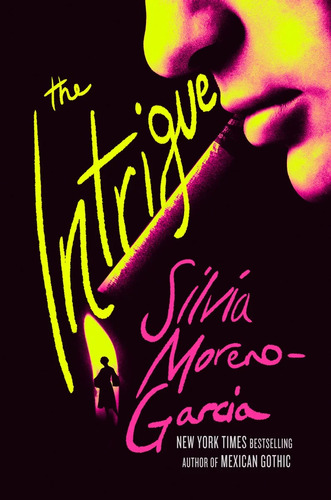
One thing I've noticed about Silvia Moreno-Garcia is that she never writes the same novel twice. I can call up similarities between 'Gods of Jade and Shadow', 'The Daughter of Doctor Moreau' and 'Mexican Gothic', but they're completely different books in tone and mood and style and this one continues that trend. Sure, it's set in Mexico, as all three of those other books were, but that may be about it. They're arguably four books from four different genres too, the others each fantastic fiction in different subgenres but this one not at all. In fact, I'm surprised it's not called 'Mexican Noir', not just because that's what it is but because it's a natural match with 'Mexican Gothic' and 'The Intrigue' is needlessly generic.
Fortunately, the title is the worst thing about it, because it does everything we ought to expect a Mexican noir to do. Some may feel cheated out of a more cinematic finalé but I rather like the one it has. It represents continuity, not necessarily into a sequel, as one isn't needed, but in more of a philosophical sense. Noir is all about shadows and the shadows should never end. There's always a new con, a new secret, a new player, even in an unusual noir setting like Puerco Ahogoda, a small Veracruz mountain town that's fictional but based on Xalapa.
And an aside, before I start into this review proper; I've never been to Mexico, though I don't live that far from the border in a Hispanic neighbourhood of Phoenix. However, I know exactly how to pronounce "Xalapa, Veracruz, Mexico", as that's where two of my favourite luchadores, Fénix and Pentagon Jr. are often billed from. I'm sure Moreno-Garcia doesn't conjure up her locations from luchador billings—and her notes explain that she chose Veracruz because Rafael Delgado, author of famous novelas costumbristas, is from Córdoba, Veracruz—but then 'Gods of Jade and Shadow' does chalk off the most unexpected wrestling billing, "from Inframundo".
I hadn't heard of "novelas costumbristas", but Moreno-Garcia defines them as "Mexican novels that offer a close look at the customs, habits and idiosyncrasies of a particular society, especially rural ones". That makes this a novela costumbrista, as the time and the place are characters, too. It's wartime, meaning World War II, and Puerco Ahogoda is located in fog-drenched mountains, a decaying small town that suffered in the revolution, with pride maintained but wealth lost and a gradual malaise setting in because of that. That's reflected in the guesthouse of Perla Inclán, its furnishings older than the fashion, resisting change just as its owner resists it, clinging to the old ways.
Old ways here mean respectability, tradition and etiquette, which drive obligations, expectations and perceptions. Perla is unmarried at forty-three and relies on her niece, Inés, who feels trapped not just in this house but in this town. Enter Ulises Linares, to use his current name, who has been corresponding with Perla through the classified ads in 'Conmovedor' and plans her as his next job. He's a conman who needs out of Mexico City, partly because he's running low on funds, though he would never appear anything less than sparkling, and partly because an earlier job in Jalisco went horribly wrong and the sons of the widow Aguirre are looking for him. So now we swing into fraud, intrigue and blackmail.
Moreno-Garcia introduces us to a number of local characters, each of whom stands out from their peers in some idiosyncratic fashion but all of whom fit the general temperament of the town. As such, they're all stuck just as Perla and Puerco Ahogado are stuck, in entropy as much as time, the world gradually moving past them blissfully ignorant of why they think they are, or at least were, important. While Ulises certainly stirs some things up, he's realistically just as stuck in his own rut and that's another reason why I like the ending. Things happen, things change and, most of all, an awful lot of secrets are exposed, but ruts in film noir tend to end only in death.
Initially, of course, the secrets belong to Ulises. Perla doesn't know that she's invited a conman in to fleece her of whatever he can find, but her patient suitor (and lawyer) Cándido Sotomayor has his suspicions from the outset and Inés discovers proof early in the novel. Instead of exposing him, as she naturally threatens to do, she teams up with him, figuring that they can split her apparent ninety thousand pesos and both move onto new, more comfortable lives away from here. If you've ever seen film noir, you won't be too surprised at how this dynamic evolves, but it's done well. It's clear that Ulises is a cheap conman and he doesn't grow much at all, but Inés leaps headlong into her femme fatale role, finding enthusiasm for the first time in years.
Inés has secrets too, but they're mostly open ones at this point, the ones that truly matter being the ones she's forging right now with Ulises. It's Perla who has the most secrets and the author is happy to dole those out with a vicious patience. She grows immensely as a character, initially just a stuffy woman older than her years but soon much more than that, worthy of being the lead in a noir, even though she was initially painted with the mask of victim. While her secrets are exposed in turn to characters in the story, they're exposed to us sooner through the quintessential device of noir, the flashback. Noir wouldn't exist without flashbacks and Perla likewise.
I lapped this up, but then I'm a big fan of film noir. I understand the dynamics and I also get how it plays better in the black and white of shadows, while sometimes managing to update to a palette of colour. This plays with both, the timeframe nailing it as noir over neo-noir. However, there's an element of fading here too, that only works in colour. In a film, you can show how faded wallpaper and furniture are by muting colours, which is extremely difficult to do in monochrome, where the fading is more successful in dreams, because that shows on faces all the more clearly in black and white. I imagined Inés in crisp black and white and Ulises in a lower resolution, but Perla and the guesthouse in colour, albeit a colour mostly drained by decades of resignation.
The other factor that's neo-noir over noir is the tone. In a novel, characters can be just as rude or crude as they want without us thinking it out of time. In a film, however, there are words we know can't be used, acts that can't be seen. They have to be worked around, with dry humour or closed doors. This adheres to that mindset for the most part, all monochrome and Production Code but a scene here and there leaps forward to New Hollywood with a burst of crudeness, vivid in colour, a lot more modern in feel. It works, I think, because it shocks all the more because of the context. If you never swear, people pay attention when you do.
Another note I should make is that I found this highly accessible, even though it's Mexican all the way down to its very essence, and rural Mexican too, with only brief moments in the big city. The language used is universal, the vocabulary evocative but not cryptic. Occasionally, there's a word I'd never heard, because of the language difference, but most are immediately clear in context. I looked up a few, most of them from later in the book, like "kermés", "ratoncitos" or "novenario". None of them got in the way of my enjoyment.
So that's four novels by Silvia Moreno-Garcia for me. I could easily rank them, so they're not all on a par, but they're all very good books that I'd happily recommend and, as I mentioned at the start, none of them are truly like each other. This novel is her twelfth in twelve years, though they came out with a little less regularity than that suggests. Unfortunately, I've read all I own, so I ought to keep my eyes open for the others. ~~ Hal C F Astell
For more titles by Sylvia Moreno-Garcia click here
|
|