|
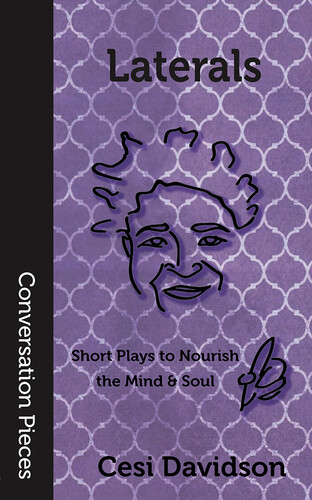
This is Cesi Davidson's fifth collection of plays for the 'Conversation Pieces' series, but it's only my first. All are named for terms used with speech therapy: 'Articulation', 'Fricatives', 'Bilabials' and 'Stop Plosive', though I tend to hear them used more by YouTube reaction videos by vocal coaches. Davidson has a doctorate in speech language hearing sciences, so these are things that will come up for her all the time and likely have deeper meaning to her than to the rest of us. All have also borne a subtitle of 'Short Plays to Nourish the Mind & Soul', as that's the name of the free public theatre that she founded and runs in New York City.
I was surprised to find that these short plays are really short, because, while this may well be the longest volume I've read in this series thus far, it's still only a hundred and fifty pages but boasts fifteen pieces in its contents. However, five are poems, like the first, 'Contemplations in the Oral Cavity,’ which is indeed contemplative and would likely make more sense to me had I earned that same doctorate as Davidson. Poetry is a very personal thing and I found these poems to be lesser to the plays, but 'Run Mammy Run' is a dance routine with a message, while the prose poem, 'The Queen on the Sidewalk', is an interesting look back at a life by dying actress Butterfly McQueen.
The first play runs fifteen pages, which certainly makes it short, but it's an interesting one, doing rather a lot with its timeframe. If each of Davidson's plays are this interesting, I've been seriously missing out. It's written for two young women, Nell and Anne, the former blind but the latter not. The phrasing used here is that Nell is a woman with blindness and Anne a woman with sight, thus levelling their playing field linguistically. As you might imagine, much of what follows ties to their most obvious difference, but it's done in the run up to surgery that will provide Nell with sight.
That side of things is well-written, which shouldn't surprise when the playwright is this prolific, but it's well-ended, too; which has to be a constant challenge to someone working with such condensed timeframes. What surprised me is that the majority of the play is acted out by the characters, as Nell becomes western characters Nelly Nook and Anne Annie Cranny, perhaps as imagined by the former who's a fan of the genre. It's a quirky and creative approach and, while it reads well on the page, I can easily imagine it getting quite the reaction from an audience watching it on stage.
Daringly, Davidson admits to only one theme in her introduction, to bring the past forward, using imagination to fill in gaps in stories where historical detail is lost. That's not obvious at all in 'The Misadventures of Nook & Cranny' or indeed the next couple of plays. It arguably kicks in with 'The Queen of the Sidewalk', at number eight, and certainly by 'Miss Grier Rises', the play that follows it, after which it continues on to 'Madame Abomah: One Night Only' and 'The Limitations of Sin'. All three, along with the poem, are biographical plays about real people and Davidson adds some notes to make sure we realise that.
'Miss Grier Rises' is about Eliza Ann Grier, who we encounter in a Tennessee cotton field writing a letter. She's picking cotton to earn money but, unlike Albert and Mandy, the married couple with her, she's had some education, having obtained a teaching degree. Now she's planning to attend medical school to become a doctor and that prompts very different reactions from the other two. Albert sees her as like them, so she should know her place; if the white man thought she could be like them, he'd have made it happen. On the other hand, Mandy sees her as a huge step forward (maybe two, as Eliza is an emancipated slave). She's a lady deserving of respect and who ought to be emulated, because if she can do it, then so can others.
It's a powerful piece, straight-forward compared to the couple before it that I've skipped past for now but with quite a punch. And, of course, it's true, in keeping with Davidson's admitted theme. I hadn't heard of Eliza Ann Grier, but she graduated from a Pennsylvania medical school in 1897 and became the first African American woman to be licensed for medicine in Georgia. She worked for a year in the cotton fields to earn the needed funds to pay for a year of study, rinsing and repeating until she graduated after seven years. Sadly she died only five years later.
I had heard of Ella Williams, at least under her stage name of Madame Abomah, but didn't know much about her. Her play is a one-woman performance ostensibly in an alternative 1915 New York City where the audience can be of mixed race. It's about her life, skipped through in glimpses and frequently accompanied by songs and a lot of supporting work for Rosita, an unusually busy stage manager. It was a hard life early on, as she talks and sings about surviving malaria and getting far from the Ku Klux Klan, but she's eventually persuaded onto the stage by Frank C. Bostock, as he's taken by her beauty rather than just her height.
It's a fascinating piece and it would be a memorable one to see live, if the right actress could be found. Madame Abomah wasn't eight feet tall, as is suggested in the play, but she may well have been seven but with a body that was entirely proportional. She didn't suffer from acromegaly or other growth disorder; it seems likely that the malaria she survived made some sort of change in her body and she simply grew further than most, especially at the time. However, the actress who took this role on wouldn't only need to be tall (or believably so, through machination) but also an impressive singer. The songs here are varied indeed.
The other biographical play is 'The Limitations of Sin' and it's given quite the framework, because Davidson is highly varied in how she structures these works. There are two characters. One is Don Pedro Montes, a wealthy nineteenth century Cuban plantation owner. The other is the concept of sin personified into a game show host. Yes, you read that right. We're in the Redemption Realm, a setting which compresses all time into now, and Sin is hosting 'Redemption or Not?' Don Pedro is our contestant but that translates here into defendant, as he's effectively on trial for his part in the slave trade. If you think you know the name, it's in connection with the slave ship 'La Amistad', which became the base for the Steven Spielberg movie 'Amistad'.
It's a fascinating piece, highly dramatic in an idiosyncratic way, with both characters memorable. For a while, Sin asks the questions and Don Pedro evades the answers, but when we reach a rapid fire round, he gives the answers, truthfully, and so condemns himself. It's all about morality and time, the core of Don Pedro's defence being that everything he did was legal, in full accordance with the laws of his day. After all, it's not like slaves are people. Sin, however, takes the argument that evil is absolute and can't be excused by social norms. Man might find him innocent, but God might not. It's framed simply, but it's impeccably deep.
Unusual framework extends to 'Serenade for Dead Sperm' and 'Pregnant Pauses'. The latter is a similarly dynamic performance piece, science fiction from the outset, the characters five fembods who are seriously pregnant with genetic quintuplets implanted through IVF and a doula who leads them through yoga, aerobics and a fashion runway, before shifting into what feels like an improv performance and ending in childbirth. That describes the structure but it doesn't come anywhere near the depth of the piece. It's unlike 'The Limitations of Sin' in so many ways but I could see it as a companion piece on stage.
Its futuristic look at pregnancy ties it to 'Serenade for Dead Sperm' and 'Genetic Human', though the latter two also share a more topical focus on how laws are being leveraged against women. I like the surreality of the former, which is staged in at the Spermsodial Community Sperm Bank in a world where there are strict laws for sperm sanctuary and sperm abortion. Susan Crawley shows up at the age of ninety-three wanting to make a very large deposit, for very strange reasons. The sperm she has with her also include a super sperm who talks. Did I mention surreality? The other customer, Barbara Jenkins, is college age and very different.
'Genetic Human' isn't unusual in staging, taking place at a medical facility in the "present future day", but it throws everything but the kitchen sink at the characters and dialogue, so much and so quickly that it's hard to keep up. Cynthia and Tom have become the "proud caregivers of a healthy human person", while Imani and Babatunde are welcoming a son. That's pretty much it from the standpoint of story, but Davidson layers on so much commentary about American healthcare, new age liberals and white privilege that there's probably more in this play than the rest of the book combined. We just have to extract and quantify it all.
While I've found some themes and connections beyond bringing the past forward, the remaining three plays have nothing in common in the slightest. 'A Day without Rain' unfolds on Isla Bonita in the southern Atlantic and focuses on a generational clash between Melissa, who I presume has to be an alcoholic young lady from Manhattan and her thoroughly grounded abuela, Maria. There's nothing genre in this one at all, but it's a strong piece. 'Fish Food' is a cute play that would look an awful lot cuter staged, about a fisherman who catches a fish, only for the fish to turn the tables on him. It's set in New York in between Brooklyn and Staten Island and I'd love to see it performed.
And that leaves 'Manchego Manchoogo', which is, in its way, the wildest play in the book, another that I'd love to see staged if only to see how it could be done. Much of the challenge is that almost all the characters are played by one actor, regardless of gender or whether they're human being or orangutan. The setting is an ancient castle in China where Fakunde, a Griot storyteller tells an awfully quirky bedtime story about Queen Helen, who ruled the lands of Santoshia.
Are you imagining it from that? No, you're not. It starts out in fairy tale, Queen Helen swallowing a pebble that turns her heart to stone, but then she has a kung fu battle with an orangutan, who apparently fights her every day out of friendship, before arguing about cheese taxes with a three-thousand-year-old troll. She wants some manchego but she can't get any from Spain because it's relocated to Mars. Where is this going? I was eager to find out, even as I doubted it could find any coherent destination, and eventually learned that it relies on some strikingly deep wordplay.
Oh, and there's a stage direction of "(Kung Fu tantrum)". Twice. How can I resist that? Now, when is Davidson bringing her theatre to Phoenix? ~~ Hal C F Astell
For more titles in the Conversation Pieces series click here
|
|