|
I'm notably behind on my anthologies and even have one in my TBR bookcase that includes a story that's reprinted here, Livia Llewellyn's 'Volcano'. I have a few of the other source volumes as well, because everything here is a reprint, although the stories are relatively recent. Only the opening story, 'Once Seen' by Conrad Williams, predates the 2010s, while eight of the nineteen stories are from the 2020s. I know who most of the authors are, but I've only read a handful of them, probably only Caitlín R. Kiernan, Paul Tremblay and Wendy N. Wagner. Some of the others, however, are on my shelves just waiting for their moment.
I'm happy I dived into this one while it's brand-new because it's an excellent anthology, not that I should be surprised to see that from Ellen Datlow, surely the most rewarded anthologist working today. Her list of edited books is seriously impressive and her list of awards may be longer. This is, like any anthology, variable, but what sets it apart from most of its peers is that the worst stories are still pretty damn good. There isn't a dud here, even if my least favourites are pretty clear and a few are very short indeed, hardly having the space to fully expand.
Her introductions explains that the title is relatively loose, as few of these stories have direct ties to H. P. Lovecraft's work. In fact, the only obvious candidate there is 'The Beholder's Share', which is a retitling of a story called 'Ex Libris', first published in Caitlín R. Kiernan's 'The Yellow Book', as it includes physical copies of no fewer than four of the most infamous titles frequently referenced in 'Cthulhu Mythos' stories. No, not that one, but 'De Vermis Mysteriis' and 'Cultes de Goules', to name just two. Notably they arrive in the story in a batch of eleven for $54. Talk about a bargain!
Instead, the goal is to collect together stories of cosmic dread, if not direct descendants then the bastard children of the cosmic horror subgenre that Lovecraft brought to prominence within the pages of 'Weird Tales' in the twenties and thirties, stories that I'm happily reading again in their original form through my pulp centennial project. I'd absolutely agree that most of these stories feed on cosmic dread, not to forget other Lovecraftian themes like cosmic indifference, attempts to describe the truly alien and, occasionally, the happy ending that madness brings. The only one that goes for a completely different feel is T. Kingfisher's 'Agent of Chaos', which is lighthearted.
With the quality so consistent across the board, I have no obvious path through these stories, so I guess I'll run through in order, even though that's something I rarely do for good reasons. It feels inevitable here, not because of any identifiable internal flow but because I can't see a better way to tackle the material. It also has the side benefit of starting with the oldest piece, 'Once Seen' by Conrad Williams, from 2005, and one of the best to tap into that feeling of cosmic dread.
A crime scene photographer is called out to half a dozen suicides who died in desperate attempts to blind themselves. Everything screams serial killer except the fact that it can't be, because the suicide aspect is beyond doubt. Our photographer stumbles onto the real cause, which starts our relationship with the otherworldly. Lovecraft's most repeated approach to cosmic horror was for a character to encounter something so inhuman and beyond our ability to comprehend it that we go insane to escape it. That's what these characters are doing. The most unusual angle is that the cause for it actually deigns to apologise.
Steve Rasnic Tem's 'Mister Ainsley' follows suit in layering on the cosmic dread and in the idea of encountering something inhuman. It's a simple story, of a political and/or religious canvasser who knocks on Mr. Ainsley's door, faints and wakes up inside on a couch. Mr. Ainsley is a polite man, old-fashioned and friendly for a recluse, but, potentially, also not human. Neither this nor 'Once Seen' are vignettes, but they nail their tone and grow to the precisely right moment to end. They don't outstay their welcome.
Neither does 'Sideways' by Ray Cluley, but it's a far more substantial piece, surely not technically a short story. It has to be a novelette, at least, if not a short novella. Also, like a number of these stories, it dives deeply into its setting, here the world of test pilots. Capt. Sam Harding was one of them but he died in 1951, burned up climbing out of a crash. In the terminology of this culture, he was augured in. The experimental plane is the Arrow and Sam was the only pilot to fly it. He tells his best friend and fellow test pilot Tom that it took him sideways, into something similar to warp space but which isn't empty. Its length strips it of the urgency of the earlier stories but the dread is still very much there.
Jacob Steven Mohr's 'Empty Shells on a Cold Shore' is one story here that doesn't attempt to milk the cosmic dread, instead bringing it in late after we've been lulled into a false sense of security. Turtles are coming ashore to lay eggs and Edie Russell, John Healy and the narrator are part of a team to check and log them, as they're likely already tagged. Except they also find a body that is human-like but certainly not human. That's when the cosmic horror kicks in but it's never intense. It's more taken for granted as a new form of routine, which arguably could be scarier.
The Keep Quiet, in the story of the same name by Aaron Dries, does much the same. Whatever it is, it sends Angie a note. Stand in your bedroom window at 11:52pm on this night and again over a four-year span, on the same time and the same date, and you'll get whatever you always wanted. So she does and all she gets is a flash of light, like from a camera. And cancer. And people around her start to leave, scared of the dreams they're having. It's an odd and evocative story, especially from a male author. This and Ian Rogers's 'Infantum' later in the book, feel like stories by women.
None of the stories thus far have been, but there are a bunch here and two are up next, starting with that lighthearted tale from T. Kingfisher, 'Agent of Chaos', which boasts the best first line in the book for sure: "It was a blustery day in November when the kitten accidentally ripped open the fabric of reality." To be fair, that's pretty much the entire synopsis. Alice is 75, the kitten is a favour to Jim down the road and the agent of chaos of the title, even before it plays with a ball of yarn with a curious provenance. It's certainly cosmic horror but there's no cosmic dread, more of an exquisite contrast of scale between the banal and the infinitely vast. It's fun.
The more I think about these stories, 'The Beholder's Share' may be my favourite, which surprises me for a couple of reasons. One is that I didn't initially like it at all, because it's told jarringly as if Caitlín R. Kiernan didn't know where she was going with it. The other is that Kiernan is one of the few writers I've read before; I don't recall the novel but she told it in the second person and I was very much not a fan. However, as it ran on, I realised that it isn't Kiernan struggling at all, but the lead character, an unreliable narrator who questions her reality as she writes, even describing it fairly as a "disjointed narrative". And this feels very right in how it feels very wrong.
It's a scrapbook of a story, though it isn't presented like one, any footnotes baked into the prose. There are odd scholarly references, substantial quotations, citations to real books along with the mentions of infamous fictional ones, even dosages. It's not afraid to dip into other languages and even different character sets. There's history and vision and eventually a neat take on the works we've loved to encounter in 'Cthulthu Mythos' stories going all the way back to Lovecraft as what the narrator calls 'an infection vector'. From initially not liking it at the beginning, by the finish I frankly adored it. Clearly I need to take a fresh look at Kiernan's work.
Norman Partridge's 'Backbite' is another story to aim at a tone other than cosmic dread. That's in play but, as a Depression era tale of two migrants who lose work when the harvests fail so take up opportunistic crime to survive, the predominant tone is harsh and downbeat. It's also more crime than horror, though they do end up in a town that isn't on any map, both aspects of which are very much preordained. With monsters and shotguns and statues of jade, it's more Joe Lansdale than Joe Hill.
'Eat the Wyrm' is a short and sharp story that could easily be read as cosmic horror but has other interpretations too that seem just as viable. We're in Greenland at a bar called Solopgang, where ex-geologist Kurt Gunderson has reinvented himself as a maker of tequila. Emma and Johan visit to taste the expensive stuff and that's where the title comes in. While there are more traditional horror elements in play, the backdrop here is melting icecaps, Emma is there for a conference that's dealing with nuclear contamination from water stored under the ice. In a different anthology, its tone could fit a very different theme. While Elizabeth Hand has worked in horror, she's known for science fiction and fantasy far more and that's telling here.
Paul Tremblay, however, is absolutely known for his horror and 'The Note' fits with what I've read from him. The narrator takes his wife for a mile walk for ice cream, but there's a colonial house on the way that looks abandoned. There's a long note on the door that Linda reads on the way back but she won't tell her husband what it says and she disappears in the morning without her phone or laptop. Years pass and the story gets freaky. I wonder if it also gets meta, as the narrator is an author. It could be Paul Tremblay himself, which would add another layer to the ending.
Laird Barron's 'A Strange Form of Life' is the first of three shorter stories and it's very localised, a mycological love story between a guard and a convict, both male. As with most of these stories, it looks at the otherworldly but adds the conceit that we might not recognise it when we see it. As if two characters is sprawling, 'Call of the Void—L'appel du Vide' by Carol Gyzander reduces the cast to just one, Ellen, who works as a nature photographer but is in Utah to capture the sky above the Medusa formation for personal reasons. Then L. Marie Wood's 'Hypnopompia' comes and goes in merely three pages, as we wake up to find that the world is boiling. The weatherman is what?
Keeping with female authors, we return to a longer length with two more of my favourites. Livia Llewellyn's 'Volcano' grows incredibly well, not just from the banality of Callie kicked out of a job and having to find another before term starts back up to what happens when she finds one, down in the sub-basement where she's sewing curtains and furniture coverings, but also from relatively simple language into long run-on sentences when the weird stuff happens. It's neatly ephemeral and, while I didn't think I'd follow Callie far, being a selfish character who's her own worst enemy, she turns out to be a real worker too and I'm happy I stayed on board.
Wendy N. Wagner's 'Halogen Sky' may be the eeriest story here. Nancy and Jill are a couple from Portland finding themselves in the middle of nowhere in Washington state. They're in civilisation but everything is empty and nobody's about, except the occasional service worker who happens to look like Jill. There's a wonderful scene when Molly, their dog, vanishes into a busy cityscape, but then it's right back to nowhere for Jill. The ending is powerful too. This whole story is off in all the best ways and has the tone that a prequel to her novel 'Girl in the Creek' ought to have.
'Wind Come Down the Mountain' by A. C. Wise is eerie too, but in a more knowing sense that fits its reality TV mindset. Carter has set up a TV show, 'Lone Wolf', that's about a wilderness journey, Lane Harper living in the vast woods below Chillcoate Mountain for seventy-three days before he tells the camera that the sky gets inside you and mysteriously vanishes. That's a great setup but the cosmic dread really seeps in when Carter starts to investigate. It's a blurry tale of madness in found -ootage style if not detail.
I mentioned 'Infantum' earlier because it's written by Ian Rogers but feels like it ought to be by a female author, not least because it's really a cosmic horror take on how a botched abortion stops a woman having kids but finds a way to have them anyway. She's Dr. Nadine Stine and she works at the Blakefield Institute on Project Jellybean. There have been inexplicable pregnancies across the globe in women who then lapsed into comas. Why? That's the job and it may well be Dr. Stine who figures it out, given that the project leaders seem rather prone to suicide. Those are impeccable scenes and they're not the only ones. This is very visual and I could see an adaptation.
Gary McMahon's 'Diving Deep' couldn't be adapted because, like many of these stories, it tries to describe the truly alien without giving anything away. You can talk that up in prose but it's crazily difficult to make work on a screen. The diving is being done by Farris in Antarctica, because below a millions-year-old ice cap, they've discovered a mysterious shaft, perfectly circular and clearly an artificial thing. There's a cyclical nature to this piece but it's mostly a journey into inexplicability and it's done well.
And that leaves 'One Possible Shape of Things to Come' by Brian Hodge, which returns both to the eerie feel of a few earlier stories and the contrast between the banal and the infinite from the T. Kingfisher piece. Brook is visiting his sister Meredith in California. Her husband is Ethan and their five-year-old is Micah, who takes to standing in the corner at night. He's been bad, he says, needs to be punished. No idea why. There's no recollection in the morning. Until he doesn't wake up and he isn't the only one. It's initially lighthearted but grows in seriousness and scale until we're into multidimensional geometry and Brook becomes a stepdad. It's a great way to end.
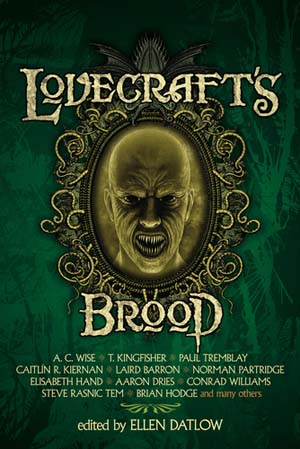
That's nineteen stories without a dud and that's seriously impressive. This is technically a sequel anthology, to 'Lovecraft's Monsters', another Tachyon trade paperback with a neatly consistent cover design and four of the same authors. I want to seek that out but I really should dive into the anthologies waiting my review. Two of those are also Datlows and one's a Tachyon. ~~ Hal C F Astell
For more titles by Ellen Datlow click here
|
|
|