|
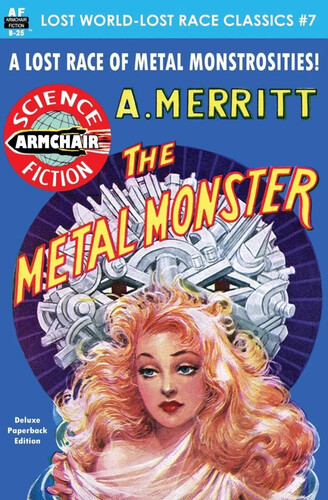
Originally serialised in eight parts in 'Argosy All-Story Weekly' in 1920, H. P. Lovecraft avoided this novel at the suggestion of fellow 'Weird Tales' author C. M. Eddy, Jr., who called it dull. He caught up with it in 1934 and adored it, suggesting that it "contains the most remarkable presentation of the utterly alien and non-human that I have ever seen." He also suggested that Merritt calls it his "best and worst" and agreed with him, as the "human characters are commonplace and wooden—just pulp hokum—but the scenes and phaeonomena... oh boy!" They aren't wrong.
It begins with a conceit that I'm used to seeing in the work of another 'Argosy' author, Edgar Rice Burroughs, delivering fiction presented as fact. Dr. Walter T. Goodwin is a renowned botanist, as we ought to know from the earlier novel 'The Moon Pool', another lost world-lost race book from a couple of years earlier. That isn't a book I'm familiar with but I should pull it down from the shelf at some point. Merritt became enough of a name that he got his own magazine, like Isaac Asimov, Ellery Queen and Alfred Hitchcock. I should know more of his work.
Dr. Goodwin is off to Tibet again, this time with Chiu-Ming, who he hired in Teheran, and a couple of Tibetan ponies. Richard Keen Drake, Dick to his friends, joins them, too, through circumstance; Goodwin knew his father, Prof. Alvin Drake. All these characters, except perhaps Chiu-Ming, who's dead before we got to know him, are as commonplace as Lovecraft suggested. Dr. Goodwin is the archetype of a scientist and Dick Drake is the archetype of an explorer, just as Ruth Ventnor will soon show up as the archetype of a damsel in distress and her brother Martin as the archetype of the wildcard, sent into weird places by weird events to recount weird warnings.
All these are regular people, human beings stumbling into a strange place, this one on the other side of the Ting-Pa, which has been split by something that sucked in the aurora. Drake believes it to have been a deliberate act but by whom? Given the vast footprint they find, a rectangle thirty feet wide and two hundred long, they're not likely to guess. Ruth and Martin tell of odd men who wear antique armour and talk in archaic Persian. And blocks like kids toys, but metal, modular and sentient. And that's what we find: cubes, pyramids and spheres, but able to join together to form new shapes that can be devastating.
We learn that when they become a giant flail and things get brutal. "It swept through them like a scythe through ripe grain. It threw them, broken and torn, far toward the valley's sloping sides. It left only fragments that bore no semblance to men." That's nothing compared to chapter twenty-six, which is so brutal that the logical comparison isn't to another novel but the destruction of the town of Lidice by the Nazis, which hadn't yet happened at this point, merely presented as a mecha kaiju movie animated by Ray Harryhausen and set in the times of legend.
Here's where Lovecraft's praise of "the utterly alien and non-human" comes in, because there's a lot less story here and a lot more spectacle. To keep with thinking of this in visual terms like a film, it's an art film over a narrative plot. Most of what we see is discovery rather than story, giving an opportunity to Merritt to go hog wild with descriptions. He does that early, throwing in allusions to the classics and spending a page and a half to attempt to capture Norhala's unearthly beauty. I couldn't visualise all the geometry but I did feel how weird it was, how vast, how multi-sensed. It's dense description as the primary point of the book.
And the majority of that descriptive power goes into tackling the city that may be well the metal monster of the title. There are a lot of possibilities there: the creatures, if that's the appropriate term to use, that are given names like the Emperor or the Keeper of the Cones; or the machinery they control; or the city they either occupy or are part of. I have to assume that it isn't the blocks themselves, or the title would be 'The Metal Monsters', plural rather than singular. I wonder how readers of different ages will see those blocks because it may actually affect how they receive the novel as a whole.
To someone like Lovecraft, reading in the thirties, it was something entirely new, what is possibly a metallic alien lifeform—this is fantasy, through and through, but there are sections that deeply covet a science fiction grounding, references to Ernst Haeckel, Gustave Le Bon, Svante Arrhenius and especially Jacques Loeb's 'The Mechanistic Conception of Life' almost pleading that case. I'm a child of the seventies who grew up in the eighties, so I saw Zeroids and Cubes from 'Terrahawks'. A modern-day audience, who grew up on sensors, miniature cameras and solar panels are likely to think Minecraft. While the spheres and cones suggest vector graphics would be optimal display, a particular focus on cubes keeps that raster graphics style in mind.
It's the sheer otherworldliness of these aliens, if indeed that's what they are, that shaped—sorry, not sorry—my appreciation of this book. I'd have liked characters who did more than just wander passively around in an alien environment. I'd have liked a story that extended beyond the skimpy scenes of revenge in the city of Ruszark, with Norhala and her mecha kaiju crushing the potential descendents of Alexander and Xerxes. I'd have liked a lot of things. What I got and appreciated is this vision of mechanistic life wrapped up in poetic description. Merritt gets downright pastoral here, then drowns that sort of vista in its precise opposite: gleaming sentient metal.
While was too early for my pulp centennial project by only a handful of years, that will bring me a Merritt story next month, as 'The Woman of the Wood' coincidentally debuted in the August 1926 issue of 'Weird Tales'. Also, 'Seven Footprints to Satan' was serialised in 'Argosy All-Story Weekly' in July 1927, so I may take a look at that this time next year, either as a pulp centennial or in novel form; I believe I have a few editions of that on the shelf. I'm looking forward to it. I want to see if everything Merritt was drenched in description or if there are plots in his work asking for notice. ~~ Hal C F Astell
For more title in the Lost World-Lost Race series click here
|
|