|
Eric Temple Bell, the Scotsman behind the pseudonym of John Taine, is a surprising author to pen a fantasy novel, but then it was his first, originally published in 1924. His later novels shifted more into science fiction, including a 1931 novel serialised in 'Wonder Stories' by the name of 'The Time Stream' that introduced the concept of the fourth dimension unfolding as a flowing stream. That is much more like the sort of thing we expect an influential mathematician might write. He's been called one of the first scientists to write science fiction.
His best known work is likely to be non-fiction, a compilation of biographical essays called 'Men of Mathematics' responsible for inspiring three generations into the field. In the same year this was published, he won the Bôcher Memorial Prize from the American Mathematical Society for work in mathematical analysis. He died in 1960 but is still remembered today through Bell numbers and Bell polynomials, both used in partitioning of sets. Oddly, while they usually play into factors and permutations, they also apply in literature to rhyming schemes in poetry.
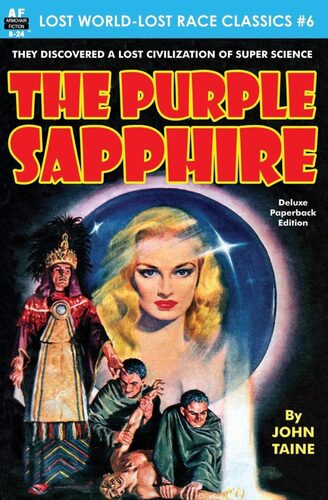
This is lost world fantasy, though, as highlighted by the cover art for this Armchair Fiction edition being taken from the novel's reprint in 'Famous Fantastic Mysteries' in August 1948. It suggests a race of people in the Himalayas that's not merely lost in the usual sense of being separated from a wider world, but also degenerated from a heyday of superscience long ago into a superstitious fragment today. Crucially, their legends speak of other fragments leaving their home in Tibet for other lands and, having lost most of their knowledge in a calamity, ache to find them again so as to restore them to their former glory.
We're brought into it when General Wedderburn hires John Ford (no, not that one) and his niece Rosita Rowe to find his daughter Evelyn, who was apparently kidnapped a dozen years earlier. It seems that the culprit was a man calling himself Singh who had been working for the general as a highly intelligent servant. This was in Darjeeling and the British government's secret service has searched all of India to no avail. Ford is a renowned gem-trader much travelled in the deserts of Asia and his daughter is highly capable herself, unusually intelligent for a female character, even a lead one, in a lost world novel from this era.
Wedderburn puts a good case but what seals the deal is his unveiling of a lead box inscribed in an obscure oriental script that contains what resembles a huge sapphire. It's entirely spherical and rates at two hundred and fifteen carats. What's more, while there are no marks to suggest that it has been cut, it seems to be hollow, its centre responsible for it shifting from blue to purple when placed in direct sunlight. They make a quick sale for £225,000 before they leave for Tibet. And yet it's not the purple sapphire of the title. That arrives soon afterwards with a delirious man lost in the Himalayas for the eight years and they sell that for a cool five million. Pounds not dollars.
This delirious man is the third member of the party, once he finds his way back to sanity. He's an English member of the British India Survey, Captain Montague Joicey by name, and he's the third because they orchestrate a scheme to leave the general behind. They're not trying to cut him out of anything, they just know from Joicey's background information that he'd never make it. This is how they can get in, retrieve Evelyn, and bring her back to him. With as many more of these huge sapphires as they possibly can.
Seven weeks in, we're over halfway through the book but still on our way. However, we've learned a lot, both directly from Joicey and indirectly from an ancestor of his who followed the path many years earlier and wrote about it, perhaps as much of a character as Joicey himself, who affects an anomalous monocle and sports weird burns on both hands. He teaches them both ancient Tibetan which will be crucial once they make it far enough to matter. Before then, they have to navigate a tunnel under the Himalayas full of thirty-foot-tall statues of blue men holding weird devices, then a desert with "league-long breakers of blue flame". It's a memorable and dangerous journey.
Eventually, of course, they make it to their destination, because we wouldn't have a novel without that. If we hadn't already caught the able foreshadowing, here's the point at which the novel truly reveals that it's far more than just a lost race fantasy novel. Much of it really functions as a clever con perpetrated by Joicey, not on us or indeed on his companions but on the degenerate remnant of the Great Race that lived there long ago. Of course, it's an adventure story, with all that travel and fantastic backdrop, and it's framed as a mystery with Evelyn as a living MacGuffin, but it's the con that makes it all possible. It isn't a heist, not really, but it shares some aspects of that too.
In short, there's a heck of a lot here and I like it. The fantastic elements are evocative and so are the locations, which oddly start out needing the visual stylings of a Stanley Kubrick to bring truly to life but end up in a setting that could easily have been shot in a desert valley used for episodes of the original 'Star Trek'. Taine also makes us feel the danger of the journey, especially when we cross the desert with its infernal cold blue flames dancing everywhere. We realise, of course, that they're going to make it but it often feels like they might not, their bodies left to rot slowly with others who made it in but never made it out.
There's also a surprisingly forward-looking use of women. Sure, the two leads are male—Ford the experienced gem trader and explorer and Joicey the even more experienced guide with his fount of specialist information—but the MacGuffin is female and so is Rosita, who's established quickly without the rug being yanked out from under her later to relegate her into a damsel in distress. I would read another John Ford novel if there was one but I'd read a Rosita Rowe novel too and I'm very likely to enjoy that even more. What's more, women have elevated purpose in the realm of the remnant of the Great Race, which ends up explaining the mystery of why Evelyn was taken to begin with.
That's six books I've enjoyed out of six in this 'Lost World-Lost Race Classics' series, even though I would call them very different otherwise. Part of me wants to dive into more John Taine, though I've only got a couple of them on the shelf: a Galaxy digest edition of his 1931 novel, 'Seeds of Life', and a cool Arrow paperback of his final novel, 'G.O.G. 666' from 1954. However, I know that none of them count as fantasy, so wouldn't read like this one, and I'll be bumping into some of them soon enough anyway in my pulp centennial project.
In particular, 'The White Lily' and 'Seeds of Life' both appeared in 'Amazing Stories Quarterly', in 1930 and 1931 respectively, and 'The Time Stream' was serialised in 'Wonder Stories' from 1931 to 1932. That's only four years to wait for more, though five other novels predate them if I go by the order of publication. They first appeared in book form, though I should have a bunch of them from their reprint editions in 'Famous Fantastic Mysteries'. ~~ Hal C F Astell
For more titles in the Lost World-Lost Race series click here
|
|
|