|
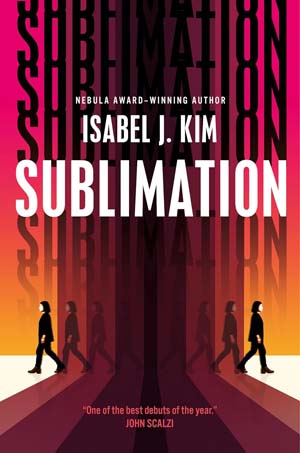
This book had a very interesting premise: when a person immigrates, they can leave a copy of themselves behind. This doesn’t happen every single time but often enough to make travel a bit precarious…or a deliberate choice. The one implied constant is the mental state of the person. If a person is determined to create a copy, then a copy will be made. If the person is torn between leaving the country they love for a new, uncertain existence in a foreign country, then a copy will be made. This has been a certainty in humanity’s existence so long that entire bodies of law have evolved to account for the sudden appearance of another identical person – which country do they belong to? And here’s the hook: they can reintegrate at will; all it takes is physical contact between the two bodies or instances. So there are societal mandates about touching and even technology that can disrupt/prevent the reintegration. The belief is that a reintegrated individual will have all the memories that both bodies experienced, no matter the length of time of separation. Our protagonist, Rose, discovers that isn’t exactly true.
Rose and her mother left Korea when Rose was a small child. They left behind Rose’s other self, Soyoung and her mother. Rose went to the United States and Soyoung grew up in Korea. The only point of contact that Rose retained from her family in Korea were phone conversations with her Grandfather. When Grandfather died, Soyoung called Rose and asked her to come back to Korea.
Much of the story concerns itself with Rose’ existential crisis over the decision to return. She had never spoken with her instance and could not understand why Grandfather had insisted she return when he passed. Grandfather left two confusing issues; he left his house to Rose and he asked Rose to reintegrate. Since he had never broached either subject to Rose; both she and Soyoung are very confused.
Rose and Soyoung have one point in common: they each have a common friend who also instanced – by choice – sending one to the United States while one remained in Korea. Yujin (who stayed in Korea) and YJ (who went to the US) regularly converse and are close friends; although that term doesn’t strictly apply to oneself. Yujin and YJ are counting on a legality to justify their decision. If Yujin and YJ reintegrate, they/he will be eligible for US citizenship which will negate the mandatory military service term required of all Korean men. In other words, he’s trying to dodge the draft. In addition, since each pursued different career goals, they/he are counting on having twice the professional credentials. They are in agreement about their goals but pesky things like romantic relationships get in the way – which one of them should have a long-term relationship and which one should avoid them? If their goal is to return to Korea, then YJ can never have a long-term relationship.
The story POVs alternate between these four characters which keeps the story pace flowing nicely although sometimes this reader felt distinctly unsatisfied when a POV narrative didn’t even last two full pages. But the story plot advanced smoothly and consistently as each pair navigate their feelings about reintegration. As was evident from early-on, the story is all about that – do they or don’t they?
And here was my biggest issue with this novel: is it a romantic tragedy or is it science fiction? The implication of this unexplained phenomenon speaks to science fiction even though it is never scientifically explained. But the ‘infrastructure’ of the novel is not science fiction; instancing is only a MacGuffin. I am concurrently reading a treatise on science fiction and fantasy* which clearly illustrates why a reader would feel this disconnect. Reading science fiction or fantasy creates an expectation from the reader that certain elements will be present. The reader also expects certain behaviors and explanations for the fantastic elements; both of which are sorely lacking in this story. Romance also creates expectations for the reader about relationships and story arcs; this book definitely has those.
The author invented a crisis – does the government have the right to stop/deny integration with technology – which would alleviate the trepidation many felt when they chose to travel. Or, does the public have the right to choose? This drove the story resolution although this reader didn’t really buy into it. Even with this device, the story remained a “do they or don’t they” story. Despite the marketing, this just wasn’t a true science fiction story. ~~ Catherine Book
*“Trace Elements” by Jo Walton and Ada Palmer, Tor Books, published 2026.
|