|
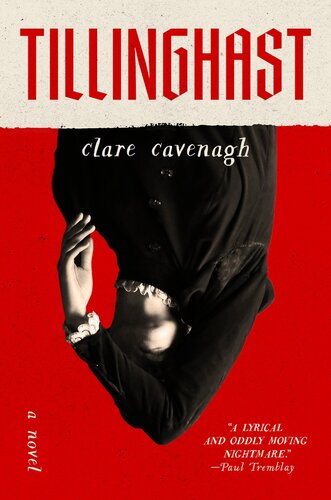
I haven't read Clare Cavenagh before, which isn't surprising given that this is her debut novel, but I'm intrigued as to what she'll move on to next. This is far from a typical book and it's one that will attract a whole bundle of labels, most of which will be partly fair but entirely misleading. It got to me marketed as a horror novel, which isn't the worst way to approach it, given that, after all, it is about vampires, even if the V word doesn't actually arrive until the author's note after the book's done and dusted. However, it's tame for horror and works much better as general fiction, being a thoroughly unusual story of a father and daughter changing each other's lives for the better.
When we begin, Stutley Tillinghast doesn't know he's a father and, given that he officially died in 1826, it would seem like a fair assumption. He grew up in a small New England town called Uxford, where his father was a local priest. In fact, he inherited the family business, as it were, and kept a church and a congregation for decades. Of course, as he no longer ages, he moved away for safety reasons and presumably got up to all sorts of things that we'd usually expect to see in a book like this one. However, he's been back for fifteen years, now that everybody he knew is long gone, and is even restoring the church, albeit perhaps more out of a perceived sense of duty or routine as a deliberate intention of purpose.
He's a thoroughly unusual lead character, not because of who he is but because of what he is. He's a vampire, though he surely uses some other word to describe his condition, but he comes over as a serial killer to us. Sure, he kills a man and drains him of blood, an act that makes him feel great, even though he knows he'll feel different out of the moment. However, he also buries the drained corpse in his cellar, something he's been doing long enough that he's designed a balance rotation. He says a prayer over the grave and adds this latest name to the list in his confession. All the logic in play reminds us of serial killer; only the method states vampire.
I'd argue that being a vampire has become as much who he is as his real name, to which he's found a way back after so long. We never learn much about his history and, unless I'm being exceedingly dense, we never learn how he became a vampire. It's just who he is and potentially who he's been for longer than he can remember. We only meet one other like him, while he's exploring his life in flashback, and the suggestion is that they get together, if only for one night, because they're the same and they recognise that, even though they very possibly don't even know what they are and how they became that way.
So, when I talk about what he is, I'm talking about someone so thoroughly out of time that it can't be easy for him to function in society, not that he tends to do much of that. A telecoms guy comes by to do checks and is shocked to discover that he doesn't have internet, let alone the wifi that he expects, and, in fact, doesn't even have electricity in his house. He does drive a car, but that's the closest he gets to the 20th century and he's somehow living in the 21st. Of course, he doesn't have a television. He doesn't even have a clock in the sense we might expect. When he has to track the passage of time in hours, he counts the chimes on his grandfather clock.
As a character study, this is fascinating even just being about Stutley Tillinghast. Vampires in the horror genre usually survive for centuries by changing with the times, doing everything they can to remain anonymous in a world where that's increasingly difficult. This vampire doesn't do that in the slightest. I got the impression that he's hardly changed since he was a young man, back in a very different late eighteenth or early nineteenth century timeframe, and he's lost every anchor to the world. He's become defined by the routine of his seventy-day kill cycle. We may not know an awful lot about the past couple of centuries because there isn't much there to know. He's drifted through it almost like a dream.
And so we meet him at the point that he's about to give up the ghost, as it were. He doesn't want to do any of it any more. He wants to come clean, in writing, and burn it all down. He's started the prep work when the phone rings, a landline that he's almost forgotten is there and certainly isn't going to work much longer because it's about to be rendered obsolete. His daughter Sarah is ill, he's told, at the Willcox Inn. Does he know where Lena Browne is? Sarah's birth certificate states that that's her mother. Given the unusual shared last name, it seemed like Reverend Tillinghast might be a good lead in the absence of any others.
The thing is that he has no idea who Sarah is, but he does know who Lena Browne is and he's never forgotten her. So he goes to get her, he brings her home and, using an existing agreement with a contact he's politely blackmailing at the local hospital, obtains the meds needed to treat her. And now we have a story, even before Sarah actually wakes up and joins the fray. Now Tillinghast has a purpose, because Sarah's upstairs, in a troubled state that suggests that she's like him and Lena. However, he doesn't know what she or any of this means to him yet.
Of course, this becomes a story about a father and daughter who are thrown together at a crucial point in both of their lives, even though they don't know each other or anything about each other. Presumably Sarah knew she had a father, whoever he might have been, but Stutley had no idea he had a daughter. This is new for both of them and maybe something new is exactly what Tillinghast has needed for a very long time now. At this point, whatever this condition that they share might be, it's almost a MacGuffin. It's important to them and they're close to being the only characters in the book, but it ceases to have much importance to us, at least when compared to them.
I think I'm safe in talking about what the author brings up in her note at the end of the book, as it is never made clear what this condition is. Cavenagh doesn't give us any vampire lore and, in fact, rather avoids it. Tillinghast is who and what he is and that's enough. Lena was the same and they may have been the only ones until Sarah came along. There are hints dropped at points to explain some logistics, mostly through Sarah rather than Stutley, but they're background not foreground. What matters is them and who they will come to mean to each other.
So, what prompted Cavenagh to write this was the "New England vampire panic" of the period in which Stutley was still alive, mostly in Rhode Island but affecting the surrounding states too. The panic was a superstitious response to the disease of consumption, which we know far better today as tuberculosis. It was called consumption because people literally wasted away, for no apparent reason, as if they were being drained of their life. Some who died before them were exhumed and what seemed like fresh blood was present in their stomachs, so superstitions joined the dots and came up with the undead, corpses rising from the grave to steal the blood of the living. If you find this truly weird, look up Mercy Brown and others like her.
While we never learn what the Tillinghasts truly are, Stutley's story does begin with this vampire panic as a backdrop. I'm not sure that Cavenagh suggests that any of those superstitions had any validity. I think she found this odd slice of history fascinating enough to wonder how it would play out if she dropped actual vampires into it and, once they were there, how they would survive into the modern day. On all those fronts, she did a wonderful job. The superstitions stay superstitions, making those flashback sections feel like a historical novel, but vampires are real and we follow a strange path forward.
I liked this a lot, because of what it is and what it does but also because it really can't be bothered to acknowledge any sort of genre boundaries. Is this a horror novel? Sure, I guess. There are also elements of fantasy and historical fiction and it succeeds best as a character study of an entirely unexpected relationship and how it saves both people involved. That it's sympathetic, given that their survival guarantees the deaths of many others in the future, speaks all the more to the skill with which Cavenagh crafts them.
And now I'm intrigued as to where I'm going to see this crop-up online. I can't see it getting much traction in the horror groups I'm in online but readers there with more open minds and individual tastes may well share it. It's the sort of book that may float past a lot of people but the ones who grab it are going to remember it. While it ought to show up in general fiction groups, I don't think I belong to any to see. I just hope it finds an audience somewhere. It's certainly worthy enough to deserve one and I want it to reach one so that I can read more books from Cavenagh in the future. We need more unique voices. ~~ Hal C F Astell
|
|