|
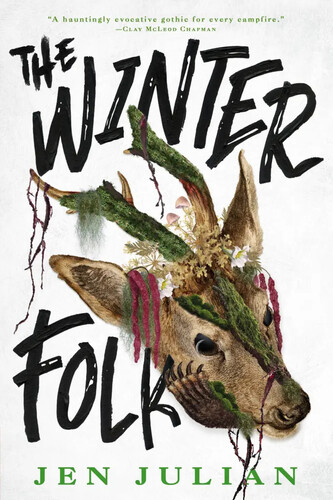
While this wonderful novel is being marketed as a "haunting Appalachian gothic horror" novel, I'd argue that it's closer to dark fantasy, my eventual elevator pitch description being 'Spirited Away' if the bath house was run by the fae. In fact I could totally see this adapted into an anime, perhaps over four separate episodes. The way the story is structured, the breaks would be natural. That's not a typical path for a novel set in Appalachia. I'm unsure what state we're in because Jen Julian doesn't tell us, but the small town is Little Gunning and it's where Moth grew up.
Back then her name was Vera Stoker and now it's Vera Stoker Whitfield, because she grew up and moved away, got married to Martin and had a daughter called Cass, who's now nineteen and with her parents as they return to Little Gunning for a holiday. Well, that's what they think. Vera, who thinks of herself as Moth, the name the Winter Folk gave her over two decades earlier, is there to find Deerhaven, from which she was expelled twenty-one years ago. And this is her story, told in a conversational style to mimic the oral history tradition of folklore.
Most of the book is taken up with back story, as we learn about how Moth got to this point, but it starts in the modern day and returns to it often, because whatever happens, it's not just going to affect her. Martin wonders what's going on when his wife disappears for an early morning hike up a mountain. Cass, a nineteen-year-old looking for purpose in between high school and college, is a lot more aware of what's going on around her than her withdrawn nature suggests. Moth worries about her, though that's primarily for her own reasons. She excelled in high school to get her into college but crashed out of it with a nervous breakdown. She's projecting.
Julian teases us with moments of strangeness but it doesn't take too long for them to manifest in the shape of Lo, who tells her about Deerhaven and Mr. Oslin, the Host and Master of the House, then takes her to a wooden door in a clearing. It's painted red and its doorknob is of decadent red glass, but there's no building around it, just the clearing. Nonetheless, going through it gets them to Deerhaven, a lodge, run by the antlered Mr. Oslin who's looking for a winter housekeeper. Just three months of work, from December to March. Vera signs up and so becomes Moth. Real names cannot be uttered here; doing so leads to immediate termination and perhaps much worse.
Now, if this whole setup didn't make us think of the fae already, then the fact that wages here are negotiated is another giveaway. Moth agrees to work for three months in return for a huge stone house, with a laundry list of attributes. She probably doesn't believe that she'll get it at this point but she does, after surviving her first winter. And that's where the fae part of my elevator pitch is supplanted by the 'Spirited Away' part. The guests are arriving, many of them regulars who come back every year and stay for the duration.
And these are strange guests: twelve-foot-tall waifs, creatures who wear second skins as coats or arrive on a trolley with no tracks. Dr. Moon has twelve eyes. Miss Twill keeps an entire congress of owls underneath her dress. Mr. Ansa vomits up red mud and builds a nest with it in his room. Part of me simply revelled in the wealth of otherwordliness on display, especially as none of it seemed familiar, other than Mr. Oslin's antlers, that not being unusual with the fae. Part of me wanted an accounting of where all this came from. Did Julian simply conjure it all up out of imagination or is there grounding for these particular characters in Appalachian folklore? I have no idea.
While all these guests are strange, to one degree or another, there's also Barkus and his six cats, each of which is the size of a station wagon, in keeping with his immense stature, at least ten feet tall and broad with it. He's strange too, but he's also willfully destructive in often disgusting ways. Cleaning up after him, or indeed his feline companions, is not a trivial task, and every moment of it feels acutely dangerous. Down in the Sifter realm below the lodge, there's a stall where battle scars are traded. As soon as Barkus arrives, we imagine characters acquiring such.
And I'll stop here, because we're past the setup, which would count as the first of those four parts to an adaptation, and moving into the second. Chapter four alone is a serious ordeal, outrageous in its privilege and powerful in its telling. It deserves to be experienced without spoilers, even if it ends only about a third of the way into the novel. As you'll imagine, what happens here continues to affect what comes later and Julian is astoundingly capable at building towards where she plans to take us, one careful layer at a time.
Unfortunately, that means I can't tell you about a heck of a lot of things. Of course, Lo is far from the only person working for Mr. Oslin, so you'll meet a bunch of other workers at Deerhaven, each there for their own reasons and negotiating their own salaries. Some of them become important to Moth and to the story, the relationships between them evolving considerably. Many return to Deerhaven for multiple seasons, though that's never a requirement, and their stories build year on year.
Of course, just as there are regulars, there's also turnover in the staff, which applies just as much to the guests. We'll get to know some of them reasonably well over multiple seasons, while others will arrive and stir things up in a single one. I won't name any of them, but I will point out that the 'Spirited Away' vibe hit me as soon as the guests started to arrive. I mention that here because a guest who becomes important in the third quarter is in many ways reminiscent of one of the most remembered guests at the bath house in that film. They follow very different paths, I should add, so this is far from a lift or an homage, but it feels impossible not to see the comparison.
Given that I haven't been able to talk about the entire middle half, I'm certainly not going to talk about the ending, but I will say that things escalate seriously. Gothic stories tend to be slow burns and Appalachian folklore is often laid back but, while this might start out slow and laid back, it has no intention of staying that way. Everything seems internally consistent but I have to say that I did not see many of these twists and turns coming. A few elements were relatively inevitable, but the story grows in scale, power and urgency and I wouldn't complain about any of it. It's a delight.
I haven't read Jen Julian before, though she has other books out. Her only previous novel is from last year, another Run for It title called 'Red Rabbit Ghost', but it wasn't one they sent over to me for review. It also looks like dark fantasy, but perhaps more overtly horror than this book. Before that was a much earlier collection, 'Earthly Delights and Other Apocalypses', published in 2020 by a small press called Press 53. I'm intrigued to dive into both of them. ~~ Hal C F Astell
For more titles by Jen Julian click here
|
|