|
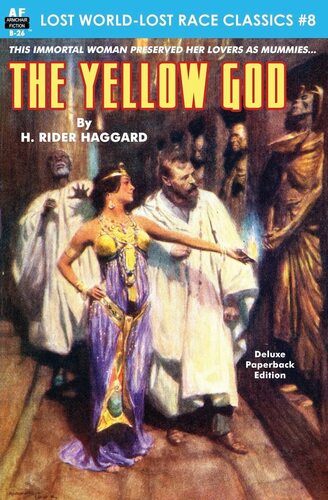
I've been building an H. Rider Haggard collection for some time, entirely through what I could find in the wild, and I'd obtained twenty-one of fifty-nine (counting novels and short story collections). This wasn't one of them, so I guess it was a hard to find title before Armchair Fiction returned it to print as part of their 'Lost World-Lost Race Classics' reprint series. Certainly the Wikipedia page for it is skimpy, merely stating that it was first published in 1908, by Cassell in the UK and Cupples & Leon in the U.S., adding that E. F. Bleiler dismissed it as "not one of Haggard's better works".
It's certainly neither 'King Solomon's Mines' nor 'She', the latter of which this strangely predates within this series, but it certainly has merit. I'd also argue that the character of Jeekie Smith is a real shock. He's merely a Negro servant when we meet him, but he evolves into companion and is happy to continue evolving from scene stealing support to bona fide lead. It isn't merely that the logical lead would be dead a hundred times over without his help, it's that this entire story could not exist without him. He's why it begins, why it progresses, why it ends. He's even given the final words. How many novels in 1908 by old white Englishmen feature a character of colour like that?
It begins because he brought the Yellow God of the title back to England from his native tribe, the Asiki, somewhere in West Africa, in the company of a missionary, Rev. Austin. Now he's servant to the reverend's nephew, Maj. Alan Vernon, who unwisely left this fetish in the hands of Sir Robert Aylward, MP. While this is mostly straight adventure, the Yellow God constitutes a supernatural element, initially by merely bringing good luck. That's why Sir Robert has recovered in two years from near bankruptcy to a fortune of a couple of million pounds. It's also presumably why Alan is close to losing Yarleys, his family estate, especially after he quits Sahara Limited.
You see, Alan is a decent and honourable man, the stuff of which heroes have always been made, and, while it was his plan as an engineer to flood the Sahara, Sir Robert is a clever con man who's running it as a financial scam. It'll make millions for him and his partner, Mr. Champers-Haswell, but they'll be gone by the time it collapses, making paupers out of anyone else involved. It would theoretically make Alan rich too but, when he discovers the scam, he opts out, however impactful the consequences to him.
That won't be restricted to Yarleys either. He has his eye on Barbara Champers, a distant cousin who returns his interest, but she's two years from her inheritance. Her uncle, the very same Mr. Champers-Haswell who's Sir Robert's partner in crime, must approve of her husband before she's twenty-five or it'll all go to charity, as per her father's will. He plans for her to marry Sir Robert, almost double her age, and, after she accepts Alan's proposal instead, bans her from seeing him even socially. Conscience has a price.
Enter Jeekie, who has a plan. Why not visit the Asiki, who have ridiculous amounts of gold that is worthless to them, and simply walk off with a whole bunch of it. Just as he made it out with Alan's uncle through use of the Yellow God, which is a mask secured on the head by leather thongs, and the holiest thing to the Asiki, why not do the same thing again? Sure enough, after reaching the Asiki, they learn that the tribe don't believe that Rev. Austin ran off with their god, they believe that their god ran off with Rev. Austin. Its return is all part of the same story.
So, it's Jeekie who starts the story by stealing the Yellow God and it's Jeekie who continues it by talking Alan into returning it to the Asiki on the major's own head. I liked him from the very start, because he speaks in believable pidgin that doesn't feel contrived, because he has real character and because he has a confidence to him even as a servant that boosts substantially as they arrive in Africa. For a while he feels more like a companion, perhaps taking the role of a sergeant to the major, carrying a shotgun and using it too. By the time they encounter cannibals, he's effectively become the lead.
It might seem like the journey from the African coast to the land of the Asiki, who are, of course, the lost race in play this time out, could be seen as the weakest part of the novel. After all, we're supposed to be in West Africa but the dwarf race of "tree monkeys", to use Jeekie's term, and the Ogula cannibals who succeed them, are all drawn from South Seas stereotype. This feels less like West Africa and more like the jungles of Borneo. However, the Ogula soon grow out of stereotype. Cannibals they may be, but they're decent people, brave and loyal and maybe soon sworn off long pig through a new alliance with Alan and Jeekie.
Well, Jeekie, really, because this is where Alan falls very much into his shadow. We might consider it inevitable given that Jeekie's on home turf so knows the peoples, their languages and customs, and can thus turn that knowledge to his own advantage. However, that's just not how this sort of story goes. Alan is supposed to be the strong white hero who conquers all around him, bringing a glimpse of civilisation with him. There's a little of that later, when he meets the Asika, the leader of the Asiki, and she inevitably falls in love with him. He teaches her western ways, though she has a habit of interpreting his words through very different cultural norms. However, none of it helps his plans. It's always Jeekie who moves them forward.
However well and unusually drawn Jeekie happens to be, the Asika is far more stereotypical stuff, in a variety of ways. She's clearly yet another take on Ayesha, the immortal queen Haggard made famous in 'She' over twenty years earlier, although the Asika's immortality isn't quite as literal, a constant renewal required through reincarnation, rather like the Dalai Lama. However, she feels rather reminiscent of Antinea, the equivalent character in Pierre Benoit's 'Atlantida', which is an odd note, given that Benoit was accused of plaguarising 'She' rather than 'The Yellow God'.
I didn't buy into that argument but it's a lot easier to buy into him basing Antinea on the Asika as the details match up much closer. Let me explain. You see, the Asika has a succession of husbands that she calls Mungana and, through her reincarnated take on immortality, it's a rather long list. However, she keeps them all in a special hall, each secure within his own niche, wrapped in sheets of gold and wearing golden masks: Egyptians, Romans, even a Viking. Eleven years later, Antinea keeps all the men who die of their love for her in a special hall, each secure within his own niche, electroplated with orichalch, the equivalent of gold in Atlantis.
Of course, that's only the most obvious parallel but there are others. Both Antinea and the Asika are immortal. Both fit the "sinuous evil beauty" description used here. Both fall in love with their heroic white visitors, who nonetheless escape their clutches. Of course, these are more generic in nature and owe much to Ayesha and 'She', as does the use of names beginning and ending with A. Antinea, however, never presided over an "orgy of witchcraft and bloodshed" like the Asika does here, which is glorious pulp exotica performed on a grand scale.
Of course, while we're conditioned to watch Alan and the Asika play their games, with the former manoeuvering her towards letting them leave with their gold and the latter steering him into her arms as the next Mumgana after the current ones dies at a specifically defined date and time, we really watch Jeekie, because he's the one who makes this happen. He's glorious here as a strange combination of proper Christian English gentleman, wily African savage and criminal mastermind, pulling Alan's strings, with his knowledge, and anyone else's he can, without theirs. His dialogue is full of religious references, but his reference to 'Mary Had a Little Lamb' as a hymn underlines an inconsistency in theology.
As if to highlight how he's grown from servant to companion to lead, he doesn't merely get to win the day, completing his plan in every detail, but also deliver an ironic fate to Sir Robert, now Lord Aylward. When they meet again, towards the end of the story, he's given a speech beginning, "Beg pardon, Right Honourable Lord, you do what I tell you just to please Jeekie" and I translated it to "Watch that 'boy' shit, redneck. You're talking to the Sheriff of Rock Ridge". However, Bart didn't set Hedley Lamarr up the way that Jeekie does Lord Aylward. He simply shoots him dead. This has a much more resonant appeal. It's art, pure and simple.
And so, while this isn't 'King Solomon's Mines' and it isn't 'She', it's worth a lot more than Bleiler's dismissal of it in Wikipedia. That quote is taken from his book, 'The Guide to Supernatural Fiction', which I checked out of the Internet Archive to see what else he had to say. He dismisses Jeekie as "his comic servant", unfairly minimising his part in every aspect of the story. This is Jeekie's book and I left this wishing he had his own series, not that, I must admit, it would have been viable. His entire story is here. I just wanted him to go on forever. ~~ Hal C F Astell
For more titles in the Lost World-Lost Race series click here
For more titles by H Rider Hagard click here
|
|