|
This graphic novel from LBInk is a quick read but it's not going to fade from memory quickly. It's a powerful book that looks at a topical issue from a number of angles and likely makes us, whoever we are and whatever background we come from, aware of nuances that we may not have realised. However, that said, the length is arguably the biggest problem with the book, because there are an awful lot more nuances that have no room to manifest.
In particular, the focus on one ghost boy, largely through the one person who can see him, a white girl, can be seen as problematic, as can the redemption and forgiveness angle, given how far that journey has to be. A longer book, following multiple new ghost boys with the people who see them being of different age and race, and with a longer path towards redemption, may have put issues like these to rest. However, that would be a different book. This one is printed on quality paper so it's actually quite heavy in the hand for a book of this size. And hey, two hundred and fifty pages is hardly insubstantial. Maybe it wouldn't reach as many people if it were three times the size or in a set of three volumes.
Jerome Rogers is dead in the first panel, but his ghost is still there looking down at his body. He's a young black boy who's been shot by a white cop who thought that he had a gun. He did, but it's a toy, for reasons that we'll discover soon enough. Still, the headlines point out that the officer had no choice. "He had a gun." If we live in the United States, we've all seen this story before, far too many times, and only the power of irony finds me reviewing this at the time when the shooting in the news was of a white woman rather than a black man. That's not this story, though there are a lot of crossovers.
Anyway, after introducing us to dead Jerome, Rhodes jumps back in time to introduce us to alive Jerome. He's a good kid from a good family but he lives in a bad neighbourhood, again surely for reasons that this book simply doesn't have room to address. Then he's dead, looking silently over those who are left. The book alternates between alive Jerome and dead Jerome, recounting the events that led him to be outside with a toy gun lined up in the sights of Officer Moore. While his grandma is able to sense his presence, that angle goes no further than her raising the suggestion that he should move on, leaving Sarah as the only living human who can see him.
She's the white girl and she sees him in court during the preliminary hearing for the cop, because she's the cop’s daughter. Of course, she thinks he's wonderful and must have been doing his job, but that take doesn't last long once she meets Jerome. And, for us to buy into her effectively shifting sides as quickly as she does, there must be another story. What has her dad done in the past? What has he said? What sort of family environment has he fostered? After all, we know that he had no real justification to shoot Jerome and he lies through his teeth on the stand. He thought Jerome was "big, hulking, scary" and at least twenty-five years old.
He knows that's all bullshit; he's lying just to save his skin. But, even if we take the most optimistic path here and assume that he's not an actual card-carrying white supremacist who hates all black people just because they're different, then his actions prove that he's still a racist. In the heat of the moment, he chooses deadly force and shoots a boy who's running away from him, in the back, then claims under oath that he feared for his life. Whatever his motives, even if he doesn't foster any, it's certainly not the action of a good cop and, if he's the best this city has to offer, then that system is completely broken.
Eventually, we learn that Jerome had the toy gun because Carlos gave it to him, in reaction to his being beaten up in the school bathroom by the same bullies that plague Jerome's life. He used it to warn them off and, hey, maybe Jerome can do the same. As you might expect, to fool a bully is shorthand for the toy gun having to look authentic, and, if it looks authentic to a bully, it's surely going to look authentic to a cop. Rhodes is cutting Officer Moore a little slack with this revelation that he doesn't deserve. She cuts him more by showing him suffering from the ramifications of his decision. I can see a lot of readers not appreciating this, but her push is towards forgiveness, the most obvious example being Carlos coming clean to Jerome's family about the gun being his.
However, she also pushes towards awareness, which is where Emmett Till comes in. Jerome sees his ghost early in the book and wants him to tell his story, though he waits until Jerome is ready to lay that on him. Through this angle and through Sarah doing her homework and turning into a budding activist, we realise just how many black kids have been killed in "regrettable incidents" like this one. That's as close as Rhodes gets to suggesting that it isn't really about Officer Moore, it's about the system that placed him into a position of power. And that isn't going to change any time soon without awareness and forgiveness.
Oddly, the angle that affected me the most was the one about privilege and it's surely the most subtle one on display. I'm white and male and British and the son of a headmaster, all factors that give me privilege, even though our family wasn't and isn't wealthy and we've all had to work hard to get anywhere in life. The longer I spend in the States, the more I realise the truth that, while I am certainly not as privileged as some, I'm also certainly more privileged than many. That kicked in hard here when Jerome's ghost wanders around and discovers that there are schools that have science labs. "Wish I'd known the world was so much bigger and better than my neighbourhood."
All in all, this is an incredibly powerful book. If you have a heart, then the tears are going to come and not just in one particular place. This is a tough story, through its very nature, but it's a story that sadly has to be told because what happens to Jerome keeps on happening. Rhodes suggests the framework for change, which is just as hard, built on awareness and forgiveness, sadly neither in ready supply under this administration, which seems dedicated to pretending that the country only has white people in it and, even if you find black people, nothing bad ever happened to them. Books like this shouldn't be needed but, sadly, they're needed more and more.
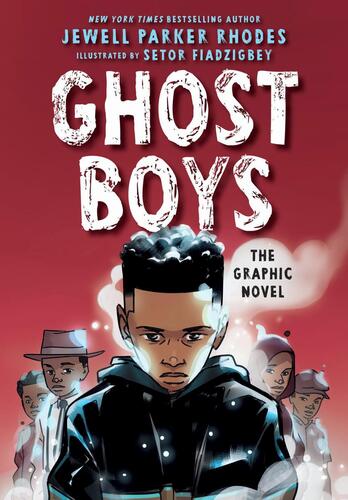
I've talked entirely about the story and its context thus far but this is a graphic novel, so I should also comment on the art, which is by Setor Fiadzigbey. I believe that Rhodes is African American and that she's written a number of children's books that explore race issues. However, Fiadzigbey is African, born and raised in Ghana, where he still lives today. Given that, I would expect that his connection to racial issues is more likely to tie to colonialism and multi-ethnicity, rather than the peculiarly American brand of institutional racism, but his art backs up the power Rhodes brings to the story. He draws in surprisingly thick lines without a lot of nuance in shading, but his use of colour and posing is excellent. It all works very well together. ~~ Hal C F Astell
|
|