|
I realise that it's 2026 and Neil Gaiman is a problematic name to touch. I've enjoyed many books of his and I continue to enjoy adaptations of them by other, less problematic hands. I'll be reading at least two more of them next year as part of my runthrough of winners of the Hugo Award for Best Novel but I can at least avoid supporting him financially by only buying them secondhand.
In this case, I was lent this book to read and review by a friend and, having read it, feel sure that it was because of Dave McKean's artwork far more than Gaiman's writing. The latter is delightfully unclear, an unnamed narrator "scrabbling around in the past" trying to hang on to glimpses of an array of characters, many of them relatives. All, except perhaps a teasingly immortal "professor", the term used by Punch and Judy showmen to describe themselves, are now dead, and even when they weren't, they weren't always able to remember either. The truth here is doubly obscured, an observation underlined by suggestions in the text that adults frequently lie and so can mirrors.
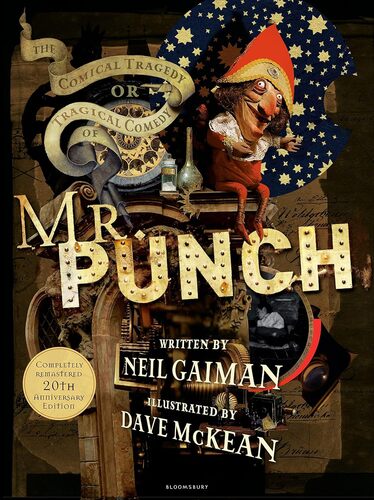
I found the text to be a haunting reminiscence of a young boy’s time in Southsea but it wouldn't be remotely as effective without the contributions of McKean. The cover lists him as the illustrator, a role we encounter on every graphic novel we read. However, inside he's more accurately credited as the illustrator and designer. This isn't a traditional graphic novel with the artist's contribution limited to drawing pictures. This is mixed media, appropriately so for a story featuring puppets so deeply. Some panels are drawings but others photographs. Some are both, layered together to be all the more freaky. And, like the cover, some are staged with puppets.
While my friend Edward, who lent me this book, may not have realised it, I'm probably much more familiar with McKean's work than I am Gaiman's. Sure, I've read 'Stardust' and a bunch of volumes of 'The Sandman', but that's about it. Those two Hugo winners will be new to me, though I did see the television adaptation of one of them. McKean's work, on the other hand, I've been enjoying a great deal for over three and a half decades, mostly through work he didn't create with Gaiman, who has been a frequent collaborator since before I'd heard of either of them.
I first encountered his recognisable style on the Batman graphic novel 'Arkham Asylum', written by Grant Morrison, but it was suddenly everywhere across multiple media. He created important covers for important albums by favourite local bands to me like Paradise Lost and My Dying Bride, among many more from further afield. His artwork showed up frequently on the zine scene. And, of course, he directed the astoundingly unique feature film 'MirrorMask', the only collaboration with Gaiman I knew aside from some of his covers for 'The Sandman'.
As you might imagine from the title and my comments above about puppets, the age-old story of Punch and Judy is woven throughout the narrator's reminiscences so deeply that it often feels to be more about that fiction than his reality. I haven't seen a Punch and Judy show in decades, but, like both the creators of this work, I'm English and Mr. Punch was a cultural icon everybody knew, even if some of the more gruesome aspects to his show had been toned down by my day. Last time I encountered him was absolutely gruesome, though, because a Punch and Judy show played a key part in Guy N. Smith's horror novel 'Manitou Doll'.
That came to mind quickly here, because we start out on a fishing trip with grandfather Arthur, a relatively short trip to the seafront. There's nobody else around and, when the boy gets bored, he wanders up the beach to the otherwise empty Punch and Judy booth to encounter a Smith-esque scene, Mr. Punch hurling their baby off the stage and onto the beach to bleed. Later, Arthur gets committed to a madhouse for a while and we wonder how contagious that is. With so much of the imagery Victorian in nature, right down to great-uncle Morton being a hunchback, maybe for one of the reasons uncovered here and may not, that does seems viable.
While I'm reading this as a graphic novel, apparently it was also intended to be a CD-ROM, with a smattering of the art for that included here as supplemental material. I wonder how involved the CD-ROM would have been, because the best parts of the story tie to the discovery of secrets, even if they're mostly professional ones. We learn that the people who ran Punch and Judy shows call themselves professors while their assistants who collect money and work the crowd are bottlers. The professor we spend most time with, Mister Swatchell, turns out to be a secret of his own, that (or swazzle or schwazzle) being the name of the device used to create Mr. Punch's shrill voice.
Perhaps appropriately given the deliberately vagueness to the memories here, I can't remember which characters performed in the Punch and Judy shows I saw as a kid. Apparently, the standard set in my day (given that I'm assuming this story was set maybe a few years earlier) omitted some of the older characters who had fallen into decline. I did know Pretty Polly was Punch's girlfriend, but didn't know that Jim Crow used to be a frequent character in the show. I hadn't realised that the baby is always a stick puppet, while the rest of the cast are glove puppets. It makes sense that Mr. Punch is the only such worn on the right hand because he's always on stage. Everyone else has their turn on the left. And a professor won't bring out Mr. Punch until it's showtime.
Those details come out within the story so they're Gaiman's, however much of it was trawled from research rather than imagination. Most of the success here though is McKean's, because this has his eclectic fingerprints all over it. While many panels, entirely in isolation, would look weak, even worthless, when put together they gain not just context but a life of their own. I realised that the text is so ephemeral that we can either dip into it or just let it wash over us. However, the art is a museum to wander back and forward through. I frequently found myself turning back pages so as to dive deeper into an image I'd just left and often, in the process, caught new sweeps of imagery.
And that's how I think I'll remember this. The story, if we can call it that, is a flawed memory of an era that was never what we thought at the time, told by an unreliable narrator who relies on the unreliable narrators of his past. All of it could be true or none of it and it really doesn't matter. It does its job but then it's gone, like all memories. The artwork that accompanies it, however, is an outstanding gift that keeps on giving. ~~ Hal C F Astell
For more titles by Neil Gaiman click here
|
|