|
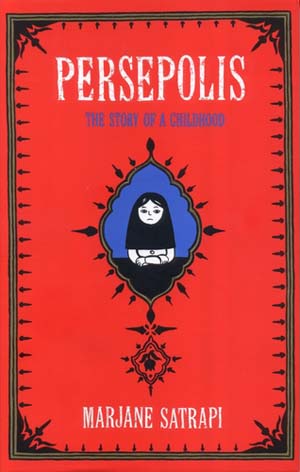
My graphic novel this month is timely for a bunch of reasons, not all of them happy. The happiest is that I read and reviewed 'Wake Now in the Fire' in March, a submitted graphic novel by Jarrett Dapier and AJ Dungo about the organised protests of students in Chicago in 2013. The reason was that their school district had banned 'Persepolis', an autobiographical comic book by the Iranian author Marjane Satrapi, which many felt was the best book they'd read that year. She's briefly in 'Wake Now in the Fire' herself. Sadder reasons are that the west, this time the United States and Israel, is interfering in Iran once again, and that Satrapi died in June.
It doesn't take many pages for comparisons to 'Maus' to scream out to be acknowledged. Both are nonfiction works, revelations of dark times in history, told with simple black and white comic book art across two volumes (at least in English; it was originally four in French) by a writer close to the material. It's worth mentioning that both have been banned by American school districts, which is a dubious and highly ironic badge of honour; but an important one, all the more so, it seems, as time passes.
There are crucial differences too though. The Islamic Revolution in Iran has not been explored in literature to even a fraction of the depth that the Holocaust has. This tells Satrapi's own story, so it's autobiography rather than biography; she personally experienced everything that happens in this story, while Art Spiegelman was telling his father's at one level of remove. Most importantly, perhaps, at least for effect, Satrapi was also a child at this point; this volume (or two, depending on how you count) span a time from age ten to age fourteen. It's important to see this story from a female perspective but especially so to see it from someone young who doesn't understand the nuances of what's going on, at least at the time.
I should explain "simple" as well. This is simple artwork, in the sense that it's drawn with few lines, not much in the way of background and no attempt to provide any sense of shade in between black and white. However, the longer it runs the more obvious it is that "simple" doesn't have to mean a lack of subtle but imaginative design. For instance, as early as the second page, the religious men who command that girls cover their faces, close bilingual schools and separate students by gender have huge beards. They're the mouths of the revolution but we can't actually see their mouths, as their beards obscure facial features as effectively as veils. A page later, with demonstrations both for and against the veil, those for have closed eyes but those against have open ones.
While Marjane is just a kid, it soon becomes clear that she's from an important family. Her great-granddad was the deposed emperor, she's told. The Shah's father confiscated everything that he had. To her family, the Shah is the bad guy and it's cause for huge celebration when he's deposed. "Let's enjoy our new freedom," her dad tells her, blissfully ignorant of what's to come. A bunch of political prisoners are released, many of them family or friends who had been tortured. Marjane learns that class difference is a social construct then bumps into the realisation that Mehri, their maid but almost her sister to her, isn't allowed to eat at the same table as them and can't pursue the boy next door. Privilege is a huge character here, ironically given what's about to happen to it as Islamic law bites down on what it deems decadent.
All this is presented through the eyes of a pre-teen, who doesn't understand things like that. She wants to be a prophet and has written a holy book, forbidding things like aching joints. She bumps into a lot of quandaries and wants to respond in absolutes. Before he's deposed, her teacher tells them that the Shah was appointed by God; after that point, she wants them to rip that page out of their textbooks. Mum teaches that forgiveness is a must but can't apply that rule to torturers, who should be massacred. If prisoners are heroes, then Marjane's dad, who has never been locked up, can't be one but Uncle Manoosh can and he was confined for nine years. Quantity must mean quality!
What follows is much as you might expect, but told in ways you might not. I got a real kick out of a black market that sells tapes of western music, without knowing every artist's name. Her parents smuggle in a couple of band posters from Turkey, including an odd one in which Iron Maiden seem to only have four band members. Satrapi's genius is to juxtapose cultural moments like that with the re-arrest and execution of Uncle Manoosh as a claimed Russian spy, presenting both with the same level of impact and importance because she was a pre-teen girl. When she leaves for Vienna at the end of this volume, she solemnly gives away those posters as her most prized possessions.
While the story is in what happens, whether it's important on a national scale, like a war between Iran and Iraq, or just to a twelve-year-old girl, like her Kim Wilde cassette, how it's depicted in art is massively important. This is a book where the author is equally as important as the artist as she is as the writer and she does things that I haven't seen in comic book art before. We must all know intellectually that an artist who understands anatomy can draw better human figures, but there's little of that on display here, beyond believable proportions; Satrapi gets over character emotion more like a cartoonist.
However, she uses a lot of techniques here to great effect and I didn't expect many of them. Some aren't too surprising, like her capable use of white space or an occasional flipping to draw in white on black for effect, not all of it to depict night. One very effective panel is entirely black, for good reason. There's also a frequent and vibrant use of repetition, not by copying one panel to another but through use of textiles or tesselations that ably depict scale or cycles, even hearken back to a different time. There are brutal contrasts too, perhaps none more than the page with a big panel of young soldiers caught in explosions placed over a smaller one of Marjane partying with friends. The movements are strikingly similar but the tone and style are light years apart.
The greatest effect, of course, is that young Marjane breezes through much of this story without understanding what's really going on. Of course, we can see the true impact of what's happening behind her and, the more she naïvely misses it, the more impact it seems to have on us. There's a lot going on here and every moment of it is worth telling. So much of it seems iconic, whether in text or art, as if it's an epochal moment distilled down to its essence. Built up over a hundred and fifty pages, it carries a serious punch, especially as this isn't just the Iran we've been conditioned in the west to imagine.
Some of it is, for sure. This isn't an apologia for Islamic fundamentalism. It just provides a context for where it came from and why, highlighting all the things that we know about it that are terrible in every sense of that word, but plenty more about Iran, both good and bad, that we may well not have known. It's a serious eye opener, a glimpse at a culture and history from a notably different perspective, one that has extra validity because Satrapi was actually there at the time. It isn't at all surprising that 'Persepolis' has garned so much acclaim and that it impacted kids reading it in schools in Chicago. And it underlines why they saw so much irony in it being banned. ~~ Hal C F Astell
For more titles by Marjane Satrapi click here
|
|