|
While I've been patiently waiting until this third and final volume to 'The Secret of the Swordfish' arc to find out what the titular Swordfish is, I found a much bigger surprise at the very end. This is the beginning for Capt. Francis Blake and Prof. Philip Mortimer, so I expected to learn about who they are and why they're important within the framework of an initial story. However, it's also an introduction to the world they live in. I took the backdrop to be a third world war, waged and won quickly by the Yellow Empire, led by Basam Damdu, who rules from Lhasa in Tibet, but fought by a resistance within which our heroes feature prominently. Apparently I was wrong.
That's just the backdrop to this first story arc, making me wonder all the more where it's going to go next. We end with the rebels victorious, the Yellow Empire defeated and, we ought to assume, its emperor blown to smithereens along with his Imperial Palace. That renders the final panel, in which Blake and Mortimer stand amidst the rubble of London, as much a beginning as an end, the untouched dome of St. Paul's Cathedral behind them. Now civilisation can rebuild afresh, into the world in which the rest of the series can unfold.
This made me wonder about whether I'd made some false assumptions at the very beginning. The series is Belgian, originally told in French and featuring quintessentially English heroes amidst an international supporting cast, a notable approach. It felt contemporary, set in a landscape that's recognisably our own. 'The Secret of the Swordfish' began serialisation in 1946, right after World War II, from which many images were borrowed, not least the final panel, and I commented sadly in my first review about how soon it fell into another world war. Well, maybe I was assuming much too much.
So I went back to the beginning of the arc in 'The Incredible Chase' and looked for a confirmation that this is our world. I couldn't find it. Sure, it's eerily familiar but maybe it's alternative history. There's nothing here to outright state that either of our world wars happened. Nobody calls this new assault by the Yellow Empire World War III, even though it's immediately global. Maybe it's a First World War to Blake and Mortimer and the rest of the people we meet. I'm going to keep my eyes open over the next few books to see how much of its history matches ours. Next up is clearly Egyptian, so that ought to provide an initial comparison and I can work forward from there.
Anyway, enough idle thought. What happens here in the conclusion to this story arc?
Well, a month has passed since the events of 'Mortimer's Escape' and the two sides are continuing unabated. The Yellow Empire is dispatching intellectuals, engineers and other undesirables off to concentration camps and the Liberty resistance network is countering them wherever it can. The train where we rejoin the story proves a great setting because it encompasses both sides, Empire soldiers sending these prisoners into exile and the partisans mounting a commando raid aimed at freeing them. It serves as the war in microcosm.
On board this train are Jack Harper and Donald Bell, both prisoners. The former is a district chief and the latter an Atomic Energy Commission engineer. They're meeting for the first time but the former knew the latter's brother, Lt. Archie Bell, and they get on like a house on fire. Bell proves to be the key to the rescue, bravely retrieving a live grenade thrown at the train and diverting it into the car containing the soldiers mounting its defence. Two days later, they reach the Cliffs of Makran above the secret Liberty base we visited in the previous volume. Bell saves Harper again, this time from falling into a pool filled with spider crabs.
From here, we get a full tour of the base, given to selected new arrivals, those working in fields of use to the establishment. Harper's one of those because Blake and he are old friends. Bell makes it too, on Harper's recommendation. They have a strong need for atomic engineers. I like both of them. They have the same British stiffer upper lip, ever keeping calm and carrying on, whatever the enemy throws at them. Bell dismisses the offer of a doctor, in favour of a clean bandage. That spirit is what the Liberty network needs in abundance and apparently is gradually building.
Of course, it's not that simple and things start to go horribly wrong merely a third of the way into the story, important parts of the base suddenly blowing up in vast explosions. It's all handled very well indeed, but it isn't the biggest surprise in the world to find the sneaky Col. Olrik at the heart of the sabotage. It's been almost sedate so far, never boring but orders of magniture calmer than the non-stop chase action that dominated the previous two volumes. For most of twenty pages or so, we've had plenty of opportunity to breathe and we need that because we're about to kick into high gear again.
Olrik's presence doesn't just give him access to perform sabotage; it means that he knows where this secret base is and his escape means that he's able to pass that knowledge on. Before we can blink, the imperial fleet shows up en masse to bombard the rocks above the base for a sustained thirty minutes. Meanwhile, inside, the race is on to get the Swordfish ready so that it can make a concerted effort to turn the tide. And, sure enough, Edgar Jacobs delivers lots of back and forth action, as each side gains an edge and then loses it again. It's wonderful, escalating stuff.
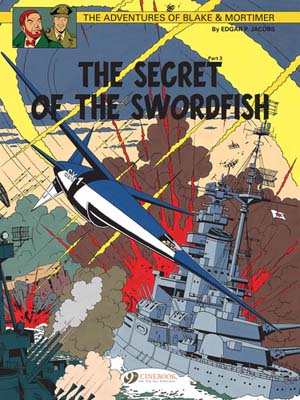
I've missed a lot out to avoid spoilers but I guess I can point out that the Swordfish is a state of the art fighter plane, given that SX-1 is right there on the cover art, weaving its elegant way through the chaos of the final battle. It and SX-2 are prototypes with atomic rockets. They can launch from the water, pretty important when they're stored in an underwater base, and they have a glorious design that would have looked futuristic in 1949, when the original serialisation finished, but don't look remotely dated to the hindsight of what's now over three quarters of a century.
That forward thinking is echoed in the design of the secret base, which is powered by the ocean, a collection of six huge turbine generators feeding off the difference in temperature between the surface and the bottom of the Strait of Hormuz. I adored all these design elements, not least the entrance, which is as memorable as any I've seen to a secret lair. Diabolik would feel completely at home with the cave system to train network approach, all centrally monitored, of course. Even the train design is delightful and simple.
That's showcased in the first full page panel, after an initial six to collectively recap the prior two volumes. There are four of these full page panels this time out, plus those six, and they're worthy throughout, but it's the third of them that speaks to me the most. It's a far more vibrant version of the image that constitutes the cover art, following the same general idea with SX-1 curving in an almost identical arc. However, the explosion is bigger and more colourful, bright enough that even the shadows of the massive explosion leap out.
Jacobs drew in the same ligne claire style as Hergé, unsurprisingly since both artists were Belgian and 'Blake and Mortimer' started out in the first issue of 'Tintin' magazine. The two can be easily delineated though: Jacobs's lines are thicker and he used more panels (and far more words within them), but the biggest giveaway is his use of colour in action-packed scenes, especially ones which boast huge explosions. Hergé's art was never as outrageously vibrant as this and he never mixed colours the way Jacobs does. The fourth full page panel is reminiscent of 'Destination Moon', but it would never have appeared quite as it does here.
I've enjoyed this three part story immensely, but there are some details that don't hold up and a bunch of others that feel overly convenient. Soldiers of both sides celebrating victories on top of what must be the most radioactive rock in the middle-east feels acutely wrong. The timing of the squadron of Swordfishes that follows the two prototypes is the most convenient moment but not the only one. However, it all holds together surprisingly well, especially for a first story arc, and I want to dive into next month's album already.
I'm especially eager to continue to find out how the background world here will stabilise now that the Yellow Empire has been toppled. Does that mean this war is over? How soon will that calm on a global basis? How easily will the great nations of the world recover from the devastation of the earliest days of that war? Next up is a two parter called 'The Mystery of the Great Pyramid', then a single volume story called 'The Yellow 'M''. It's probably telling that these were respectively the second, third and first books translated into English for the Cinebook series, whereas 'The Secret of the Swordfish' was fifteenth to seventeenth. ~~ Hal C F Astell
For more titles by Edgar P Jacobs click here
|
|