|
I honestly can't remember having so much fun with a book that's this outstandingly bad. Well, the book is impeccable but the contents are outstandingly bad. Fletcher Hanks is what we might call a cult comic book artist, which does not necessarily translate into him being a good one. There's so much wrong with so many of these six or seven page stories that I'm going to struggle to get it all into this review, but, my goodness, it's so much fun to discover what the world of comic books was at a very early point in time. When parents or teachers laughably suggest that comic books might rot the brains of our youth, the work of Fletcher Hanks is what they're imagining comic books are.
This is a big book, because it collates Hanks's complete output, which was prolific but brief. All the stories here date to between December 1939 and December 1941, with the vast bulk of it from just 1940. They were published in a variety of comic books, none of them any of the ones that we tend to know anything about. 'Fantastic Comics' was published by Fox Comics from 1940 to 1941 over a measly twenty-three issues, but Hanks contributed to sixteen of them, often to the tune of a pair of stories, 'The Super Wizard Stardust' and 'Space Smith.
Behind those, 'Fight Comics' and 'Jungle Comics' were both published by Fiction House and ran for much longer. 'Planet Comics' was also a Fiction House title, while 'Daring Mystery Comics' was put out by Timely for eight issues. I know nothing at all about 'Big Three Comics' because it isn't in the 'Overstreet Guide' and the one and only mention of it online is Paul Karasik, the chief architect of this book, seeking a high resolution copy of the final image in 'DeStructo and the Headhunter', in its second issue for Winter 1941. That was the only contribution Hanks made to it.
It helps to read the introductions, one by Glen David Gold and another by Karasik himself, even if they spoil the final strip, credited as an afterword, in which Karasik documents his interview with Fletcher Hanks, Jr., who never even knew that his father ever created comic books. Then again, he only did so for a couple of years and those came a decade after he'd left his family, stealing young Fletcher Jr.'s savings in the process. He wasn't a nice guy, it seems, drunk more often than not and abusive when he was. He wasn't without talent but he could never stick to anything, probably due to the drinking, and that explains why his comic book period was so brief. He eventually froze to death on a park bench in New York in 1976.
So, if Hanks was an awful human being, his production of comic books was just another phase and none of them are any good, what's the point in collating a comprehensive and substantial volume in hardback like this sumptuous Fantagraphics edition? Well, he captured a moment in time in the evolution of the comic book and it's a particularly important moment. He did so as an auteur, the rare comic book creator who wrote, drew and lettered his stories, meaning that everything that we see in them was his work. And, as Gold suggests, he feels like an outsider artist even though he worked within the industry itself. He sees this as "trainwreck art" that we can't stop looking at.
Karasik's introduction adds that he was also ably trained. He studied art remotely through the W. L. Evans School, which also graduated Chester Gould, creater of 'Dick Tracy', whose style he often resembles. There are wonderful examples here of the work he created during his correspondence course, often as homework, and it's everything that his comic book stories aren't: accomplished for one, but also traditional and unoriginal. His vision in comic books stands apart from anything else I've read. I'm no comic book historian, but there's something in what Hanks did that has little resemblance to what anyone else did, even as he was churning out filler material for a medium in its growth stages.
You see, comic books go back to the Victorian era in the UK, where they sat alongside the penny dreadfuls as cheap and cheerful fodder for the masses. In the US, they showed up in 1933 and the Golden Age began in 1938, when 'Superman' debuted in 'Action Comics #1'. That moment is often seen as the birth of the modern comic book, in part because so many publishers leapt onto a new bandwagon and churned out comic books of their own. Hanks was right there to capitalise on the movement and all his lead characters are supermen, with a lower case S, whatever genre they're working in and whatever gender they happen to be.
Hanks's most prolific character is 'The Super Wizard Stardust' who was soon renamed to 'Stardust the Super Wizard' for no apparent reason. He saw print in 'Fantastic Comics' under Hanks's actual name. Alongside him was 'Space Smith', under the pseudonym of Hank Christy. Both of these were science fiction strips but they owe as much to sword and planet stories by Edgar Rice Burroughs as space heroes like 'Buck Rogers' or 'Flash Gordon'. When Stardust travels to Earth from his private star, it's on his "transparent tubular spacial, traveling at terrific speed on accelerated super-solar light waves", scientific gibberish that isn't what John Carter used to get to Barsoom but still feels very much like it.
Stardust is "the most remarkable man of all time", just as another character, Fantomah, is billed as "the most remarkable woman ever known" and "the most remarkable woman in the universe". Both, like what seems like every character in this book, make constant use of rays. Hanks had zero space to explain things scientifically and no doubt wouldn't have been able to even if he'd had all the space in the world, so explains everything away with rays. The bad guys use this ray. Stardust uses his boomerang ray to send *insert evil effect* right back at them. It's like he's a five-year-old playing with dolls, some of whom are bad and some of whom are good, or at least oppose bad.
So there's a reducing ray, a transporting ray, an anti-gravity ray, a magnetic ray, a suspending ray, a high-power fusing ray, an anti-motion ray, a disintegrating ray, a super-solar fusing ray, a death ray of course (the title of this book is an actual quote from a 'Stardust' story), a hydraulic balance ray, a thermal ray, a retarding ray, a hypnotic-control ray, an oxygen-destroying ray (defeated by Hanks's cheapest creation, a counteracting ray), a revolving speed ray, a restoration ray, a super will-power ray, a negative spot ray, a frigid ray, even a secret ray, whatever that is. It gets highly exhausting but hey, Space Smith's spaceship is ray resistant. That's nice.
My favourite use of rays is accompanied by outrageous repetition. Hanks was good at repetition, which applied not only to the text in panels but to the art too. I would swear blind that he would draw a character once and then copy that pose for use in other panels, often the next panels and the ones after that. It isn't as obvious as cartoon strips that do that deliberately, but it's not far away from it, the only variations being in subtle differences brought in by poor tracing technique, maybe by design but probably not. I don't want to give Hanks too much credit here!
Anyway, in one 'Space Smith' story, the Martians boast, "Our anti-Earth demolishing rays will soon turn the Earth into dust." In the next panel, Space Smith overhears: "Holy mackerel! They are on their way to the Earth to destroy it with anti-Earth demolishing rays!" And in the one after that, he tells the Earth: "I have terrible news - several hundred martian destroyers are about to attack the Earth and demolish it with anti-Earth rays." All this text is pretty large, so there's more text on this page than imagery. That's something Hanks calmed down, surely at editorial request, for later stories.
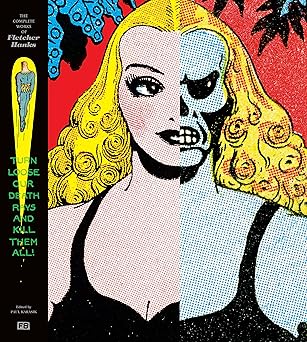
If 'Stardust' was Hanks's most reused character, next on that list is 'Fantomah, Mystery Woman of the Jungle', published under the pseudonym of Barclay Flagg. The setting is completely different, the jungle you might expect, but the mindset is precisely the same as she's just as unexplainably invulnerable, just much cooler. That's Fantomah on the cover art in her two most frequent forms. She flies around as a beautiful blonde in a black dress but, when she's angry, her face turns into a skull, though it retains her blonde hair. Sometimes her body vanishes and she's just a flying skull.
One quintessential Hanks approach may show up the most in Fantomah stories but it's there with Stardust and other characters too. We're used to superheroes saving the innocent at the very last possible moment, in the dramatic nick of time. That doesn't happen here. Ridiculous amounts of death and destruction happens either until the superhero can get there to stop it or until they're actually ready and willing to do so. And I do mean ridiculous amounts. In one 'Stardust' story, "the super fiend of the lost planet" sets Mars on fire, killing millions. In another, the "Skullface" Kurd mob bombs New York and machine guns its police force. In one 'Fantomah' strip, New York is both bombed and eaten by fifty thousand gigantic royal panthers.
My favourite example of this is the second of only two stories featuring 'Whirlwind Carter of the Interplanetary Secret Service', written as C. C. Starr, though there's really a third that's a ripoff of 'Whirlwind Carter' called 'Buzz Crandall of the Space Patrol', written as Bob Jordan. Of course, does it count as a ripoff if it's one person ripping themselves off, albeit for a different publisher?
Anyway, Whirlwind somehow detects the approach of an invisible planet and focuses his negative spot ray on it. It's the Planet of Black Light, the coldest planet in space, and they plan to shift the Earth off its orbit, thus freezing its entire population, and then sell the planet to Mars. It takes a while for Whirlwind to travel from Venus to Earth, even "traveling on accelerated light waves, at 190,000 miles a second", so he arrives a bit late. Sure, he can "adjust the planet rocket vacuum for low-wave propulsion!" and all is well. "Meanwhile, the Earth returns to its orbit and full gravity is restored, but millions of people are killed and injured." But we just move on, as if maybe someone stubbed their toe during the ordeal. "Look! The Earth is perfectly normal!" Yeah, but what about those millions of people killed and injured? Shrug.
Not everything is science fiction here. 'Tabu, Wizard of the Jungle' is Tarzan with superpowers. I'd have liked more of him, because he can magically transform into anything, at one point from man to gorilla to jungle tree vine, but still chooses to run around in a loincloth. 'Big Red McLane, King of the North Woods' is a brawler of a logger, who fights corporate villains and timber thieves with just his fists. He even gets a boxing story while he's looking for love. 'Yank Wilson, Super Spy Q4' is the weakest lead character, who fortunately only gets one story. "I'll use my radio-phonic pencil!"
And the most unlikely is 'Tiger Hart of Crossbone Castle on the Planet Saturn', which is quite the genrebender. It's a medieval European romance, with Queen Hilda seized by Turk-the-Terrible to get his Solinoor diamond back, but it unfolds like a 'Big Red McLane' northwoods story. Just set on Saturn. That was an early story in 'Planet Comics' and it was Tiger Hart's first and last. Most of the odd characters happen early on in Hanks's two year run, because, by October 1940, it's all just 'Stardust' and 'Fantomah' for the last quarter of his output.
I've focused mostly on story here, but the art matches its outrageous nature. The good guys are obviously good guys, whether they're eight-feet-tall like Stardust or just have far too long necks like Big Jim McLane. They're often traced, as I mentioned, so have a limited number of poses, but they do grab hard. When Stardust grabs "Skullface" Kurd, he does so with enough power to crush most of his internal organs. Then again, Stardust punches four bad guys at once while travelling a cool 300,000 miles a minute. Talk about reflexes! And no wonder their heads snap back hard!
And the bad guys are unmistakably bad guys. The more human variety come right out of the 'Dick Tracy' school of art, with grotesquely scrunched faces, jutting chins and gurning expressions. One in a 'Fantomah' story even looks like Elon Musk and he is in Africa, so it's believable. However, the majority are aliens of some description and look more like demons, goblins or trolls. Some are as wild as anything seen in 'Buck Rogers'. Space Smith battles men with no heads but one eye in the front of their chests. There's a headless headhunter, a giant without a head, in a 'Stardust' story.
There, the hero has already used a ray to grow "Master-mind" DeStructo's head to enormous size and it absorbs what's left of his body. Then he hurls him into the "space pocket of living death" so that he can be absorbed into the headless headhunter's body. That's Hanks logic and it can get as vicious as he apparently was in real life. Many of these stories are ably summed up with a bad guy doing something bad, the hero stopping them (often after wreaking havoc) and then visiting some sort of vicious karmic vengeance on them.
Fantomah is the epitome of that sort of hero. In one story, she whisks four diamond mine robbers into the air to transport to the "secret pit of jungle horrors". She transforms them into one man and leaves them under the control of "creatures of an unfound world". He (formerly they) tries to escape, only to be grabbed by a gigantic paw, then fall off a vast cliff and be blown into "the white cobra cavern" to be surrounded by huge snakes. At that point, she pulls him out so a claw can draw him into a rocky wall to disappear forever. Who thinks that sort of thing up? Well, Hanks does. It's not remotely unusual in this body of work.
I could go on forever and you might think that I already have, but I'll shut up now. I adored this, as outsider art, albeit created by an insider. I want to track down these comics to see what the other creators put together. Were others as outrageously bad as Hanks or did he stand out against the other writers and artists? Were they auteurs too? Given that this was a primitive time, only a year or two after the superhero had been introduced to American comic books, were they as primal in their outlook or was that just him. Inquiring minds want to know. ~~ Hal C F Astell
|
|