|
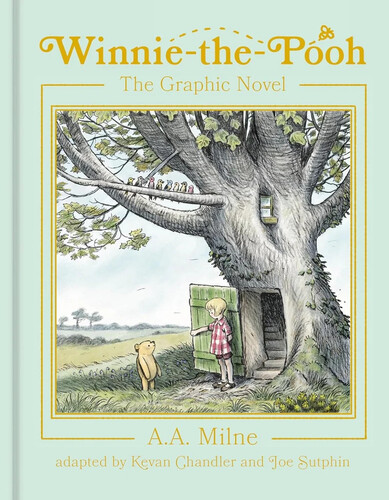
Having happily re-read the original 1926 'Winnie-the-Pooh' by A. A. Milne for the first time in what could very well be fifty years, I launched immediately into this brand new graphic adaptation from Ten Speed Young Readers. It labels itself a graphic novel but that's technically untrue because the original was a collection of short stories rather than a novel and this is a very close adaptation of all ten of those stories in order with the framing story intact. In fact, much of the text is verbatim so Kevan Chandler's job was mostly to cut down Milne's words to fit this format.
The bigger challenge was always going to belong to the artist, Joe Sutphin, because we know the characters visually already. Many first encountered them through the Disney adaptations, which interpretations are owned, meaning that Pooh does not wear a short red top here. However, the readers of the books also encountered the characters visually, through the illustrations of Ernest H. Shepard. One of Joe Sutphin's first jobs here is to redraw Shepard's famous map that featured at the beginning of the original book. He's faithful too but also finds ways to make it his own.
And, to a large degree, that's the biggest comment I can make about this book. Both writer and illustrator are faithful to the original, but the former is restricted by the medium to not be able to anything his own, while the latter is enabled by the medium to be able to stamp his own mark on the material and he does.
Now, Chandler does everything he needs to and does it well. It's simply that the majority of praise for the writing must go to Milne, with a bit left over for his capable condensation of that writing. Maybe the best way to look at his work here isn't to focus on what he did but what he didn't do, as while he had precious little opportunity to shine in his own right, there were plenty of ways where he could have screwed things up horribly, especially with such well-loved stories, but he's happily able to avoid doing so. He doesn't lose any of the original spirit of these stories.
He did make one obvious change, but I'm sure that was required by the publisher. In the very first story, Pooh ascends into the air under a balloon to get the honey at the top of a tall tree, but the bees decide to sting him and Christopher Robin uses a gun to burst the balloon and get Pooh back down. The suggestion that six-year-old boys keep guns in their houses in the woods is obviously an outdated one and Chandler accordingly updates that to a catapult. I can't argue with that, but it's hardly a major creative input.
The only writing detail that I could argue to be a negative arrives in the second story, when Pooh visits Rabbit, but it would be incredibly harsh to hang it on the writer. Once he's inside, Rabbit, as a generous host, offers him either honey or condensed milk with his bread and he replies, "Both. But don't bother about the bread." That's not unfair, but it loses crucial elements from the prose original. Milne has "'Both,' and then, so as not to seem greedy, he added, 'But don't bother about the bread, please.'" Pooh doesn't look remotely apologetic here. Perhaps we could hang that on Sutphin rather than Chandler, though it's hardly an easy challenge for him.
However, if there's nuance lost at this point in the story, there's also nuance added later on in the very same story. With Pooh stuck in Rabbit's doorway until he can lose enough weight to be pulled out again, Milne tells us how Christopher Robin reads Sustaining Books to him for a week. That's good but there's hardly any emotion in it. Sutphin provides that with bells on in successive panels, dedicating a full page to half a line of text, and his middle panel on that page is an absolute gem, carrying all the emotion in the world.
He gets plenty of other moments to shine too and he takes them. Piglet suffering for his stupidity in masquerading as Roo is one, fully getting across how Kanga sees right through him but has fun pretending that she doesn't. Eeyore trying to see his tail after Christopher Robin nails it back on is joyous. Pooh rescuing Roo from the river benefits from a visual element. I'd count chapter nine as a visual highlight in entirety, because Sutphin ably depicts the elements of danger and panic in the floods that hit the wood and trap Piglet in his home.
Best of all, though, is the wonderful final panel. Not only does it work as the bookend that it is but it adds a nuance that isn't there in the original text. Christopher Robin starts the story by walking down the stairs, holding Pooh by the leg, his head bumping down each step. He similarly ends the story by walking back up the stairs in like fashion. They're good bookends but that's where Milne leaves it. In this adaptation, Sutphin had the foresight to add Eeyore, Kanga and Piglet at the top of the stairs, underlining the tie between fact and fiction in these stories that Milne had explored so well in text (and which I talk about in my review of the original novel).
What all this boils down to is that this isn't only a highly enjoyable graphic adaptation of a much loved work. It's an acutely rare example of one that works whether you read it before or after its original. Readers who come to it from the Milne book and know the stories well should enjoy this immensely without finding anything to complain about. Brand new readers who start here would have no problem loving it in its own right without losing that if they treat it as a gateway and dive into the original. That's such a hard balance to find. Kudos to Chandler and especially Sutphin for finding it here. ~~ Hal C F Astell
For more titles by A.A. Milne click here
|
|