|
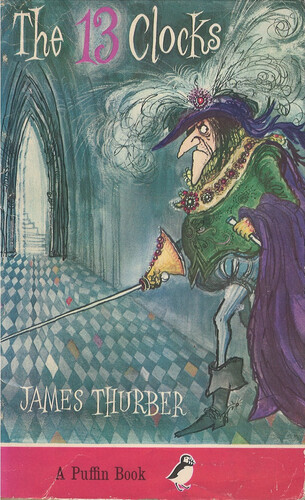
This was intended to be my classic children's novel for the month, until I realised that, while it was absolutely classic and for children, it isn't a novel. It's a novel length collection of two stories that had previously been published separately. I'd guess they might count as novellas, given how large the font size and how frequent the illustrations. With all of that, 'The 13 Clocks' runs about eighty pages and 'The Wonderful O' about seventy. This isn't a large book and it's easy to devour in only one bite, though these stories count as two of five written by James Thurber. An edition of all five, adding 'Many Moons', 'The Great Quillow' and 'The White Deer', would seem to be viable.
'The 13 Clocks' was the fourth of those five and it tells its story in what feels partly like prose and partly like poetry. Rhythm and rhyme are as important, it seems, as story, something even more apparent in 'The Wonderful O', which was the fifth. I could see a huge amount of fun reading 'The 13 Clocks' aloud, but only a true masochist would even attempt that with 'The Wonderful O', as it would make decreasing sense as it goes without being able to see the text. It's inescapable that Thurber had an absolute blast writing it but I bet he never tried to read it aloud.
'The 13 Clocks' is set in the gloomy Coffin Castle where time has stopped. As you may well imagine, there are thirteen clocks but they were all frozen seven years ago and have read ten-to-four ever since. The Duke, whose castle it is, enjoys receiving suitors who wish to seek the hand of his niece, the beautiful Princess Saralinda, but he enjoys sending them on impossible quests still more and slaying them for their failure (or indeed for any reason he might conjure up on a whim). We arrive with the latest such suitor, a young minstrel named Xingu, though the mysterious Golux, wearing his indescribable hat, knows that he's really Prince Zorn of Zorna.
Of course, the Duke sets him an impossible task. His spies bring him the news that he's Prince Zorn who could simply go home to retrieve a thousand jewels from his father's copious vaults, but that would take him three and thirty days to get there, three and thirty more for his father to make a decision, and a third three and thirty to get back. So, the Duke gives him nine and ninety hours - not days - to fetch the same amount of jewels. It's impossible, of course, except that this story is made out of fairy tale stuff and the Golux has both an agenda and a solution.
Of course it works out, because it's a fairy tale and all fairy tales, at least those written in the U.S. in the twentieth century, have happy endings. The originals, not so much. However, there was no chance that it wouldn't end happily for everyone who deserved a happy ending and Thurber is so outrageously tidy about how he ties up every possible loose end that the only person complaining is the Duke himself. "The tale is much too tidy for my taste," he says, while still within it. It's a lot of fun but it's short and convenient and transparent to anyone with background in fairy tales that runs deeper than Disney adaptations.
'The Wonderful O' is at once a better and worse story. It boasts an even skimpier plot but Thurber ratchets up the wordplay to ludicrous levels and, as long as we're on board with that, this is a gem. If we aren't, then it's repetitive in the extreme, albeit in the same liquid language that elevated 'The 13 Clocks' but more so. The conceit is simple. Littlejack has a map. The man in black has both ship and crew. Between them, they can sail to the island of Ooloo on a treasure hunt. Simple, huh? Well, Black hates the letter O, which is why his ship is called the 'Aeiu' and it's rather unfortunate for him that the island is named Ooroo.
So, after they find nothing but take over the island anyway, Black decides to abolish the letter O. The island of Ooroo is thus renamed to R and, over time, everything else follows suit. Cue the fun with language, amidst the occasional literary allusion, including an inevitable one to Robert Louis Stevenson's 'Treasure Island'. That comes up while listing islands, few of which seem to contain an O. I was invested at this point to practically bounce up in bed to shout "Oahu!" but the better half probably wouldn't have appreciated that, being asleep at the time.
Much of what follows boils down to figuring out what the islanders can do when they can't use the letter O. Builders are in trouble, you see: "But all he can build is bric-a-brac and knick-knack, gew-gaw, kickshaw, and gimcrack. No coop or goathouse, no stoop or boathouse." You can imagine how natural it would seem to leap into recitation? Well, that follows for a while, but it descends into a level of chaos that would be very difficult to read aloud. It doesn't matter how good you are at it. After all, "Even schling is flish." By the time we get to stumpers like "Let us gird up ur lins like lins and rt the hrrr and ust the afs", you might have given it up as a bad job. As is pointed out, "What was the letter of the law is now the law of the letter".
The plot in 'The 13 Clocks' was at least obvious and relatively adhered to, but it's subservient here throughout, probably because it's become by decree just a plt. Eventually, though, Thurber works his way around to a point, which is that there are four words containing the letter O that must not be lost under any circumstances. The characters, or what pass for them in this story, must find out what they are and learn how to use them. Of course, Thurber is tasking us with that task too, with only three of them ("hope", "love" and "valour"—yes, Thurber was an American author but I have the 1958 Puffin edition, so it was translated into English) are immediately identified. They and we have to search for the fourth, which makes this unexpectedly timely. Sure, that's a clue.
I had a lot of fun with this book, because it's so relentlessly playful. It's playful with words, most of all, but it's also playful with rhythm. It's prose rather than poetry, but it's prose that often veers into poetry at the least moment, even if Thurber rarely throws in line breaks to make a structure obvious. He's much happier letting his sentences trot sedately or gallop out of control, whenever a moment calls for it. It owes a lot to Lewis Carroll (I saw "borogoves" in 'The Wonderful O', albeit now "brgves") and Edward Lear.
Surprisingly, given how nonsensical 'The Wonderful O' gets, the better examples of nonsense are found in 'The 13 Clocks', especially in the mouth of the Golux. Does a line like "I only resemble half the things I say I don't. The other half resemble me." owe more to Lear or to Groucho Marx? When the Duke orders to "feed him bread without water and water without bread", we're surely back in Lear country. Even the logic behind how this story wraps up is nonsense, but delightfully so. It has to be read with a twinkle in the eye and a curl to the grin. Fortunately I had both. ~~ Hal C F Astell
|
|