|
It might not look like I've reviewed a Guy N. Smith novel this month, but I've actually reviewed two of them; they were merely both published under pseudonyms. 'The Hangman' was an adult novel (albeit not adult in the way that earlier pseudonymous adult material, like 'Sexy Confessions of a Games Mistress' was adult), with Gavin Newman the name on the cover. That was the last book he would write for Piatkus, his first publisher of hardback fiction. 'Badger Island' is a children's novel, so it carried a different name again, Jonathan Guy. It was also in hardback, his first book for Julia MacRae Books, who would publish three more of his children's animal novels.
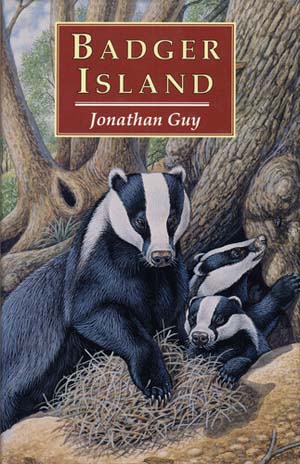
I should point out that this wasn't Smith's first novel for kids, because he'd novelised four Disney movies for New English Library back in the mid-seventies when he was starting out. It always felt jarring, looking at a bibliography that shifted over three books from 'Song of the South' to 'Sexy Confessions of a Relief Nurse' to 'The Slime Beast'. However, those featured pretty basic line art on their covers, against plain-coloured background. Richard Orr's gorgeous cover art here is on a completely different level of elegance. The layout is just as elegant too and it all felt good.
In fact, at the time, the only detail that felt odd to the fans was that, after sixty-one mass market paperbacks and a digest (or a handful of them, if we count the porn), it was suddenly all hardback for Guy. His first was 'The Knighton Vampires' to kick off 1993, but other than 'Witch Spell', which followed it in paperback, everything he published in 1993 and 1994 was only in hardcover. That's a five to one ratio. If hardback publication suggested a different class, then the times they were a-changing in more ways than just Smith diversifying his output.
Regardless of the name on the cover, were any die-hard fans to stumble across this and read with no knowledge of the real author—that's a recognisable Guy N. Smith photo above the new bio on the back flap—they'd have figured it out pretty quickly. For a start, the setting is Hopwas Wood, a frequent location for Smith novels, like 'The Sucking Pit' and its sequel, 'The Walking Dead', and a part of 'Bats Out of Hell'. Halfway through, we make it to recognisable subsets of Hopwas, like the Devil's Dressing Room and the Hanging Wood, which we've visited in those horror novels. It would not have shocked fans either to find that Smith knew his stuff when it came to animals, because he had published many nonfiction works about them, not least 'Animals of the Countryside' in 1980.
What we learn here is that badgers keep quiet at night. The leader of this particular sett is Krag, who is canny and experienced, but still has a wire noose tight around him from an earlier escape. His mate is Jetta and they lead a quiet life in Hopwas, whether it's because they're on fair terms with other animals, like Rus and Tosca, the dog fox and vixen who easily escape the hunt early on, or because the local gamekeeper, Jenkins, is one of the good guys. He's a conservationist and has no intention of disturbing the natural order of things, except to keep the area stocked for shoots.
Of course, not everything is sweetness and light. A change of leadership within a sett, a required thing over time, is done through a fight to the death and Krag knows that he's likely to face Baal in the autumn, a fight he expects to lose. Before that happens, he knows he has to move the sett to another location, his last important contribution as leader. That's because Jenkins dies and his replacement is an ex-poacher called Reuben, who is a completely different kettle of fish. He sees the danger Reuben and his terrier Warrior will bring and he wants them gone before it matters.
Unfortunately, he leaves it too late. We're only into April (as early as page nineteen) and Reuben attacks the sett. Fortunately, Krag and Jetta and many others make it out alive and move on into the neighbouring land, known as the Soldiers Wood, because it's owned by the War Department. Baal, however, loses his credibility and is taken in a net for the badger baiters, but sold to a local farmer instead, where he becomes a kind of pet for his children, growing fat and lazy in captivity.
Krag finds the sett in the Soldiers Wood, led by Dul, and negotiates temporary shelter and safety for them as they gather their strength to move on to a new sett of their own. Time passes and we encounter many other animals in the locale—Raol the crow, Sacko the stoat and Pyne the polecat who's travelled in from Wales and would get a book of his own in 1995. Krag also visits the old sett and learns about Baal, so visits him too at the farm, learning about Reuben's intention to attack Dul's colony and kill all the Soldiers Wood badgers once the moon is up.
And so we're set (pun not intended) for a number of threads of story. Krag still wants to take his badgers to a new sett in a new location where they can finally feel safe, not just from Reuben but from anyone. He's still up against the clock, not because Baal is still a potential challenger but as Dul doesn't want this stranger colony there and may well decide to challenge Krag himself, to kill him off and effectively inherit his badgers. That clock is ticking before Reuben arrives, even if Dul doesn't believe it. In a way, there's a longer term clock ticking too, as one very telling line for Guy exhibits: "One day, perhaps not in his time, there would be nowhere left to go."
While that line plays perfectly in this context, of a colony of badgers seeking a new wild place to be a new home, it could apply just as well to the human characters in many of his horror novels. There are themes that run relatively consistently throughout the majority of Smith's fiction and one of the biggest is the difference between city folks and country folks. In fact, city folks moving to the countryside without understanding (or caring about) country ways is a go-to, as is the changing of things that have been unchanged for centuries. Many of the old characters who are country-born and know no other way of life would feel that line in their bones. It's clear here in a story without many human characters at all that the animals of the countryside have the exact same mindset.
Of course, we're behind Krag from the outset. He's a deep character, drawn in sympathetic brush strokes, wise but not all knowing, old but not past it, loved and respected but not irreplaceable. He doesn't have much competition for our sympathies, though to a degree those go out to every one of the animals in this book, all the way down to Baal, in his farmyard kennel, chained to a ring in a wall that he could probably break if he tried. The farmer isn't a bad guy and Jenkins was obviously one of the good guys, so we're not anti-human here. Most of the people in the story are just there in the background doing their jobs. Only Reuben counts as a villain. However, the animals, even a wildcard like Dul, are worth more to this story.
While there are themes in the scenes at the farm that echo 'Charlotte's Web', the primary theme here is survival. Smith, who had featured no end of different animal species prominently in many of his horror novels, not always in the role of monster, clearly relished the opportunity to tell this story entirely from their perspectives. He had the knowledge to do it too and this feels as strong and accurate and effortless as any of the country scenes in his adult novels. Not all the characters make it through to a happy ending, but there certainly is one, not just in the short term for Krag and Jetta, but a much longer term one because, of all things, of a thoroughly believable quirk of geology.
I liked this a lot, even though it's a complete change of pace and tone from Smith's regular books. 'The Hangman' wasn't quite his norm either but it came a heck of a lot closer than this. It sold too and Smith suddenly found himself writing in a pair of parallel flows. After 'Badger Island' and 'The Hangman', he would go through three iterations alternating a children's novel for Julia MacRae with a horror novel for Zebra. I remember Guy being particularly happy about this state of affairs. He'd finally broken into the American market and he'd successfully diversified his output. What's more, after those six books, his next would be the western he'd always wanted to write. And after that, it would be time for an entirely new era.
See you next month for 'The Dark One', back under his real name, and 'Rak: The Story of an Urban Fox', his second outing as Jonathan Guy. ~~ Hal C F Astell
For more titles by Jonathan Guy (aka Guy N Smith) click here
|
|