|
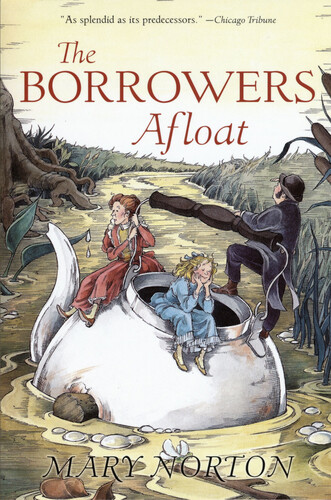
I had a blast with 'The Borrowers', which introduced us to a new and glorious fantasy world of the tiny people living in the cracks in our lives and thriving on what they can scavenge from our world. It had a tough ending, but it was a good one and it led naturally to a second book to explain to us and reassure us that Pod, Homily and Arrietty Clock were all alive and well, even if their lives had been turned upside down.
I wasn't as fond of that second book, 'The Borrowers Afield', which didn't have to introduce us to anything but needed to do more to transition a novel into a series. There were plenty of depths in the original that seemed to be forgotten in the follow up, replaced by a strong need to survive. Having made it out of the house, which had been the only home they'd ever known, at the end of the first book, they don't really find another in the second. They do find a temporary home in an old boot but the badger sett they were aiming at turns out to be full of foxes not relatives.
That made the book a transitory one, taking us from the first to the third, which followed after a nailbiting period of four years. After the usual preamble in our world, we kick off in chapter two with the Clocks climbing a ladder inside the wall of a gamekeeper's cottage and finding a family. Everyone that they thought was in the sett is right here, not just Lupy and Hendreary and a few others, but even people they thought were long lost, like Eggletina, eaten by a cat or some such. Well, she's here too. All of a sudden, three books in, we have more than four Borrowers.
I say four, as the Clocks count as our primary three but we also met a fourth outdoors during 'The Borrowers Afield'. Spiller is important in that book but he's much more so here, no longer a mere outsider, flitting around and occasionally rejoining the story. Instead, he drives much of it. Sure, he's still an outdoors Borrower, which we have to assume is a rarity, but he's much more aware of the world than any of the others. He has places everywhere and he lives on the road and his wits, moving from one to another, presumably popping into the stories of every Borrower in the area, even the ones we haven't met yet.
I didn't know what to think about Spiller in the second book. He was there, then he wasn't, and it meant that he never really established himself. Here, we learn a lot more about him, as he takes a much larger role in proceedings, and he grows into the most fascinating character thus far. I've always had the impression that, if there was a lead, it was Arrietty, maybe because the Miyazaki movie took her name rather than that of the series. At this point, she's easily the Clock with the most potential within the series, but I'm even more eager to learn more about Spiller.
Initially, of course, there doesn't seem to be much need for him and his services, once the Clocks have finally been reunited with their broader family. Early on, this is about adjustment, as these proud Borrowers find themselves effectively guests in someone else's space. What's more, it's a given that almost all the cool stuff that Lupy and Hendreary have used to be theirs. Apparently, it all arrived one day, delivered on the doorstep inside a plain white pillowcase. Pod takes it all in stride, remembering what they've been through. "Mustn't grumble," he says, while Homily does just that, finding fault in everything and complaining about their lot.
One interesting note here is that Homily seems to be intensely jealous, however quiet she keeps it in company, about her stuff being effectively reassigned. Now, in our world, I could understand that. To have stuff, lose it and then find that a family member's acquired it all and feels proud of the fact, that's a kick in the teeth. However, these are Borrowers. They own nothing whatsoever until they find it and borrow it. Their entire way of life is built on theft, though, of course, they're more likely to see it as their needs being provided before in the way of their world. Given that, it seems a little odd that Homily feels different when the stuff they stole (or was given to them) is stolen in turn (or given to others). Is that double standards? "Findings keepings," says Pod.
Anyway, while the Clocks are finally safe for the first time since the late stages of book one, that clearly isn't going to last. Homily isn't remotely happy. Pod isn't either, as much as he hides it. If Arrietty had her way, they'd go back to living outside, like Spiller, as dangerous as it became last time out, almost getting captured by Mild Eye the gypsy, whose lost boot they'd made into their home. The question is whether the gamekeeper's cottage is a haven or a prison. It felt to me like they were just finding the courage to move on again when it's thrust upon them. Arrietty talks to Tom and discovers that they're about to move out, which will be the end anyway.
Enter Spiller. He suggests that they move to the Little Fordham model village, packed with small houses that are perfect for Borrowers but rarely used. He knows how to get out of the cottage, a tricky task given that Tom's lost ferret is hanging around in wait outside, he knows how to get to the river through the drains and he knows how to get down the river to the model village. In fact, he knows a heck of a lot of stuff, because this is what he does. While all the other Borrowers make the best of a single space in a single place, he enjoys all the possibilities that the world offers, so goes everywhere and knows everything. He just tends to keep quiet about it, because he doesn't like to talk to people that much.
I'll shut up here, because, while it's hard to define spoilers in an episodic novel, I'm getting quite a way into the book. The grounding is that they find a new home, only for it not to feel right and for them to have to leave it again anyway. So, they team up with Spiller, leave and move on. That gets the story in motion, but there's a lot more to come, whether it's freeing or dangerous. Just as book two was a way to get from book one to book three, this one also feels rather transitory. The end clearly isn't the end, merely a point to hand off to book four, 'The Borrowers Aloft', but the important thing is that it doesn't only feel transitory. There's a lot more here.
If we can assume that Mary Norton always had it in mind to continue 'The Borrowers' further, I'd suggest that she moved on from her initial idea for the series. 'The Borrowers Afield' is episodic and somewhat loose, as if she wrote it in order and didn't know where she was going until she got there. 'The Borrowers Afloat' feels like she knew going in that the Clocks were going to find their extended family but not stay with them, at least not for long. Maybe she realised the potential of a character like Spiller to compare ways of living and even the scope of it. Suddenly, Lupy and the rest were tiny people in a tiny world, just as the Clocks were under the farmhouse floorboards in book one. With Spiller, they could become tiny people in a vast world, exploring possibilities and never running out of them.
I should add that, while the Clocks travel what must seem like a huge distance for people so small, they're still very close in human bean terms to where they started out. Norton makes that clear by bringing back a few human characters in support. Mild Eye gets to be a threat once more, with young Tom Goodenough, the policeman Ernie Runacre and even, briefly, Crampfurl the gardener and Mrs. Driver, the reactionary villain of the original book, all making appearances. Readers in 1959, having waited four years for this third volume, must have expected a fourth, hopefully a lot sooner than later. Indeed, it arrived in 1961 and I'll dive into that next month. ~~ Hal C F Astell
For more titles by Mary Norton click here
|
|