|
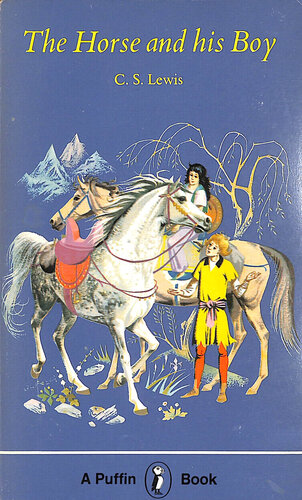
The fifth novel in the 'Chronicles of Narnia' to be published, 'The Horse and His Boy' stands out as an anomaly in more ways than simply not being the fifth within internal chronology. According to Narnian time, it unfolds during the long reign of the four Pevensies at Cair Paravel. Wikipedia has that reign as lasting fifteen years, but the final chapter of 'The Lion, the Witch and the Wardrobe' suggests much longer. However long it was, this book therefore takes place during that chapter, a thousand years before the three books published in between that and this. I guess that means we can also extrapolate that it takes place in 1940 in our world.
One anomaly is that this never follows established series characters. King Edmund shows up twice to play a supporting role, while Queen Susan and Queen Lucy do so once each. King Peter only gets mentioned in passing, as he's in the far north battling giants, and this predates Eustace by a year in our time and a thousand in Narnian chronology. Another is that it also boasts only tenuous ties to Narnia, which we learn is a land not a world, and we only spend a moment in that land towards the end of the book. The lead character is neither Narnian nor from our world.
A third is that this is also the first story to get mentioned in advance, a grand old tale recounted by a blind poet in the background during a scene in the prior book, 'The Silver Chair'. Oddly, given that we aren't drawn out of that story to be told this one, its brief mention includes a big spoiler. It is, we were told at that point, the "grand old tale of Prince Cor and Aravis and the horse Bree", which makes it rather surprising to discover that it's a grand old tale of Shasta and Aravis and the horses Bree and Hwin. Did C. S. Lewis change his mind about it during the writing process? No, he merely disguised it, because Shasta is really Prince Cor of Archenland.
To be fair, that twist is hardly the most unexpected such in children's literature. After all, Shasta is a white-skinned young man in the dark-skinned country of Calormen, having been adopted as a baby by a fisherman who found him washed into shore in a boat accompanied only by a dead man. Forty pages in, he's mistaken for the runaway Prince Corin of Archenland, and, shortly afterwards, when Prince Corin shows up, we realise they're the spitting image of each other. At this point, it's pretty obvious even to the naïvest reader that they're twins separated at birth who simply never knew each other. We merely have to wait a while for answers like who and why.
There's a map right after the contents page in my Puffin paperback, so it's clear that Calormen is far to the south of Narnia, on the other side of a vast desert. However, rather bizarrely, neither is labelled on the map. The city of Tashbaan, home to the Tisroc who rules Calormen, appears at its very bottom, with the most northernly stretches of that land. With the majority taken up by vast stretches of empty desert, the very top is Archenland, which we later learn borders Narnia to the south. Therefore, the map features neither the start nor the end of the journey that we think we will take, Southern Calormen being an unknown distance below it and Narnia being above it.
When we meet him, Shasta is a young lad putting up with life as the son of an abusive fisherman, Arsheesh, who may well be about to sell him to a passing nobleman, the Tarkaan Anradin. Instead, he escapes with the Tarkaan's horse, after learning that it talks, on account of being from Narnia, and thus warrants a different pronoun. He's called Breehy-hinny-brinny-hoohy-hah, prompting an immediate shortening to Bree, and, because Shasta has never ridden before, he's in charge of the escape throughout. In a sense, it could be argued that Bree rescues Shasta and himself together.
They soon encounter and accompany another horse and rider, whose situation isn't far different from their own. Aravis is a young noblewoman of impeccable heritage who's escaping from both an evil stepmother and an arranged marriage. She's the daughter of the Lord of Calavar but was engaged against her wishes to Ahoshta, who's at least sixty years old but soon to advance to the important position of Grand Vizier of Calormen. Like Bree, her horse Hwin is Narnian and stolen, so can also talk. Why animals can talk in Narnia but nowhere else is never explained here, even in the vaguest Ozian sense that it's a fairyland.
Adhering to the horses' standard cry of 'Narnia and the North!', they travel northward until they reach Tashbaan and thus, after weeks of travel, finally make it onto the map. Tashbaan is busy at the best of times, but it's busier than usual because a Narnian delegation is visiting, King Edmund and Queen Lucy there because Prince Rabadash wants to marry Queen Susan. We spend time with both of them and other characters we know, like Tumnus the faun. It's here that Shasta is plucked off the streets by those who believe him to be Prince Corin and it's here that he meets the prince, who climbs through his window and happily swaps places with him.
As you might imagine, Shasta and Aravis are split up at this point, so the story follows suit and her experience is no less notable. She bumps into an old friend, Lasaraleen, and the two end up stuck, unseen, in a room with the Tisroc, Prince Rabadash and Ahoshta, now the Grand Vizier, while they make dastardly plans in secret. These plans involve war, kidnap and conquest, as Queen Susan has no intention of marrying Prince Rabadash but he'll go to extraordinary lengths to marry her, like conquering her land, kidnapping her and forcing her into the marriage.
That's the setup and it's a good one, one that plays a lot more into adventure than fantasy, what with Calormen being a relatively grounded translation of any random Arab country. In most ways, it feels like the Arabia we know from 'The Thousand Nights and One Night', if entirely shorn of its fantasy elements. There are no flying carpets or magic lamps here and we don't believe that the Grand Vizier has any magical powers. Some details about the twin princes are reminiscent of the story of Castor and Pollux and the epic sweep of the story through kidnap and conquest feels like it's more akin to tales of Troy and Sparta than anything more fantastic.
Of course, there's an element I haven't mentioned yet that has to arrive at some point and that's Aslan, the avatar for Christ in this series. He's actually there throughout, popping in and out as he deems fit to nudge the story in the direction he wants it to go, but we don't know that for the vast majority of the book. It isn't hard to pick up on some of them, whenever a lion appears even if it's in the periphery, but his appearance happens before the book even begins, making Shasta's story highly reminiscent of that of Moses, from his arrival in a basket over water to the part he plays in prophecies, not freeing his people from slavery but saving them from entering into it.
I had some doubts early, once it became clear that Shasta was a different colour to his father and everyone else around him, but I never found this problematic from a racial standpoint. Maybe it's because, while, Calormen is clearly a take on the Middle East and the Mediterranean, it feels like the Middle East and Mediterranean of fiction and myth rather than fact. That distinction gives it some allowances. However, after Aslan appears and everything gains a religious aspect, that's an awful lot harder to find. It isn't that Narnia is favoured as God's country, because the twin princes are from Archenland not Narnia, but suddenly there are a whole lot of questions about what else Aslan could have done in Calormen but apparently chose not to do.
Until Aslan's appearance and possibly even after it, this was my favourite book in the series thus far. We might tend to think of the 'Chronicles of Narnia' as a fully formed series, but Lewis clearly improved greatly as a writer during it. Ignoring the religious aspects for a moment, 'The Lion, the Witch and the Wardrobe' has all sorts of problems with flow, structure and consistency. However, those were far less evident in 'Prince Caspian' and they were mostly absent in 'The Voyage of the Dawn Treader'. Also, while there were passages of literary beauty in the first book, their number increases with each further volume and I found myself reading some of these aloud.
That progression makes me all the more interested to revisit 'The Magician's Nephew', which is a further leap backwards. While 'The Horse and His Boy' would have placed second according to the internal chronology of the series on its release, that would push it back to third because it serves as a prequel to the entire series. It's a period piece in Earth time, happening in 1900 rather than the early forties, but the beginning of Narnian time, literally year 1, a thousand years before the events of 'The Lion, the Witch and the Wardrobe' and 'The Horse and His Boy' and more than two before the other books I've read thus far. ~~ Hal C F Astell
For more titles by C.S. Lewis click here
|
|