|
This is one of the titles I found during the research phase of this project. I don't own a copy and, in fact, hadn't even heard of either it or its author, Marion St. John Webb before. She was an English writer for children and her character, the Littlest One, who appears in at least four books, was an influence on A. A. Milne. Winnie-the-Pooh first appeared in his 1924 poetry collection for children, 'When We Were Very Young'. 'The Littlest One: His Book' predates that by at least six years and it does much the same thing in much the same way, right down to illustrations by A. H. Watson being a dead ringer for E. H. Shepard's for Milne.
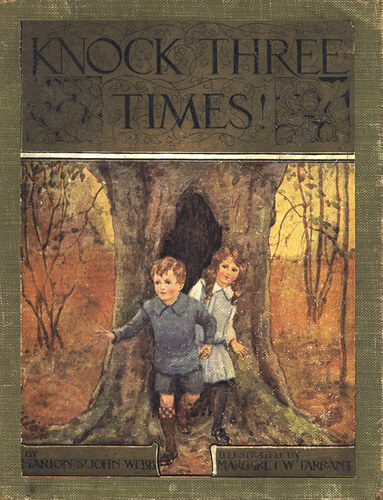
Initially, this 1917 novel seems to be yet another portal story told in the Enid Blyton style, but it's more mature and, if it wasn't for one unfortunate parallel that didn't manifest for sixty years, it would seem both creepy and effective. As it is, it's hard not to make that parallel and it's likely to shape anyone's visualisation of it. But I'm getting a little ahead of myself. Let's jump back to Jack and Molly's birthday party. They're twins, they're turning nine and they're particularly eager to see what Aunt Phœbe has sent for them. Jack wants a paint set, Molly a silver bangle.
Unfortunately, it seems that Aunt Phœbe is all about functionality, which means that while Jack does indeed receive his paint set, Molly only gets a pincushion. It's shaped like a pumpkin, but it's rather surprisingly grey. She pops it on her dresser and sticks a pin in it and that's that. Well, that is indeed that for the twins' birthday but Aunt Phœbe would be surprised to find that "this useful little thing" she sent to Molly throws her and Jack into a fantastic adventure that's fraught with danger. And it starts that night on Molly's dressing-table.
Molly hasn't quite fallen asleep when she realises that something's moving in her room. She soon realises that it's the pumpkin pincushion, three times its original size, rocking from side to side. It keeps growing until it's as large around as a bicycle wheel, then rolls off the edge of the dressing-table. It rolls down the stairs and out the back door. It rolls down to the garden and into the wood behind the house. It rolls all the way to a gigantic tree, where it knocks three times on its bark and the three opens it up like a door.
Now, in 1917, this would have felt agreeably weird, especially given that Jack and Molly naturally have to follow the pumpkin through this door into the tree, then out of another door on the other side into what they're soon told is the Possible World. They've been living in the Impossible World, which is where you and I are right now. At least I hope so! There's some chance involved because it seems that the portal only opens if you knock three times under a full moon. It isn't opened often but it was once before from the Possible World side, when they banished an evil influence over to the Impossible World.
Can you hazard a wild guess as to what that was? Yes, indeed. It was a giant Grey Pumpkin and it's now back to cause unbridled chaos across the land that kicked it out. Fortunately, Glan, who's the first person the meet in the Possible World, has the skinny on what happened and he's happy for the twins to hear that story, which we can fortuitously listen in on.
There was an evil little dwarf man—yes, that's a notably unfortunate stereotype, but such things are wildly mixed in this book—who orchestrated a weird scheme of revenge against the king, with whom he had grievances, using his sick daughter as his mechanism. The only path that she has to recovery is pumpkin juice, so the dwarf destroys every pumpkin in the land but one, as a means to bring the king to his knees. In doing so, he discovers that his grievances are imaginary but it's too late and the princess dies. The king then has the dwarf imprisoned within that final pumpkin, the magic used turning it grey, and banished from the kingdom.
Fast forward a considerable amount of time and the Grey Pumpkin has caused so much trouble in the Possible World that Old Nancy decided to banish it to the Impossible World where it wouldn't be able to do any more damage. She transformed it into a pincushion first and recites the nightly spell needed to keep him that way. It seems that she's been diligent in that duty ever since, until tonight when everything began again.
Fortunately, there's a Black Leaf that can stop him, which grows for thirteen days every year in a random spot in the kingdom before disappearing again. It is supposedly out there right now and, if they can find it in time and recite the appropriate words, it'll put the Grey Pumpkin under their power. Surprisingly, the king uses the scientific method, dividing the kingdom up into squares and assigning subjects, including Jack and Molly, to search each of them for the Black Leaf. And, with that long but detailed introduction, we're underway. Oh, one more detail: the Grey Pumpkin has minions to complicate the search.
Enid Blyton isn't an unfair comparison here, especially in the scenes in our world and the first few extra convenient ones on the other side of the portal. However, Webb settles down at that point so this novel can unfold consistently without further recourse to convenience. While it is episodic, it still feels like a novel, unlike Blyton's fantasy books that I love the most, like the 'Wishing Chair' books or the 'Faraway Tree' series. Those are episodic but they're also broken up into what almost pass for vaguely linked short stories without much real consistency. She got by on imagination but Webb gets by on talent, crafting this as a single consistent story.
Now, it's still clearly meant for children and not particularly old ones either. Locations are given a set of evocative but relatively straightforward names: Goblin's Heath, Giant's Head Hill and Lake Desolate, for example. Characters are often memorable, not necessarily the earliest ones such as Glan and his father, who hasn't laughed since the advent of the Grey Pumpkin and has only smiled twice, but later ones. Mr. Papingay surely has to be the most memorable, living in a house where almost everything is painted, from the books to the windows, even Percy the dog outside. He's an interesting supporting character here, but seems to have at least four books of his own.
The Grey Pumpkin may have been creepy in 1917 but he isn't particularly scary, especially for those of us who have seen 'Attack of the Killer Tomatoes', perhaps its three sequels. If you haven't seen it, then I should explain that it's a parody of monster movies from the fifties and it's just as silly as its title suggests. If you have, then I'm sure that my description of the Grey Pumpkin rolling off the dresser in Molly's bedroom sounded exactly like a Killer Tomato and that comparison springs back to life whenever the Grey Pumpkin rolls back into the story. That's deeply unfortunate.
Scenes with his minions are much more effective and often neatly scary, not least because they're good at setting traps in the sort of way we expect from fairy tales. It doesn't hurt that comparison for us to be out in the countryside, meeting goblins in the fields or little girls who take them home to their old crones of mothers. Now, the latter is another unfortunate stereotype, very much the fairy tale witch archetype. However, her eyes are wonderfully horrific: "The old woman's restless beady eyes became suddenly still, and she fixed upon the children in turn a piercing stare, gradually opening her eyes wider and wider and wider until they became two big round black balls encircled by saucers of white—great, staring, still eyes... then suddenly the lids snapped over them and they were once more little darting black beads."
Now, I should balance the evil little dwarf man and the archetypal fairy tale crone with the goblin horde that Jack and Molly encounter on Goblin's Heath, because they're nothing like their typical stereotype. In fact, they're honestly good guys this time out, refreshingly so. In fact, they're able to point the twins in the right directions to find characters to trust and they follow suit and, even if what follows is episodic, it's carefully linked, all the way to Miss Lydia, who's an old blind woman and a very brave one too, very much on the side of the good guys.
This is Marion St. John Webb's best known book and the only one given a publication year on her bibliography in Wikipedia. I've only been able to track down a few but it seems that some of them are in verse, like 'The Littlest One' while others are novels, like this. I'd like to find a much better bibliography that breaks all that down and gives some context as to what can be found within it. I would especially like to find a copy of 'The House with the Twisting Passage' but it's available only in audio editions, even though it's public domain as all her books should be, because the cutoff at this point is 1931 and Webb died in 1930. ~~ Hal C F Astell
|
|