|
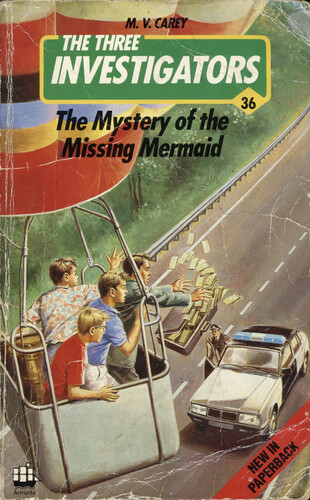
This book may be called 'The Mystery of the Missing Mermaid' but the mermaid that goes missing is really only one of a few mysteries that may or may not interconnect. All of them unfold within a small neighbourhood in Venice where the boys are helping Bob with interviews and research for a paper he's writing on urban change. They're surrounded by a carnival atmosphere in the run up to the Fourth of July, but there's also a dark undercurrent pervading the mood: runaways, drink and drugs, crime. And, of course, the mysteries play into that.
The first mystery is minor. The boys are talking to old Mr. Conine when Regina Stratten loses Todd again. He's her five-year-old son and he has a habit of wandering off and getting into trouble, like writing on Clark Burton's gallery window with toothpaste. The Three Investigators aren't hired at this point, but Jupe finds Todd anyway and brings him home, which may help to ground him and his colleagues within the local community for when Todd goes missing again and isn't found so easily. Mermaid Court is a small community but a close knit one and M. V. Carey places us within it in such a natural way that we almost forget to pay attention for clues.
Regina works at her father's bookstore, called the Bookworm, where Todd's lifelong companion is a huge family dog, inevitably called Tiny. Althea Watkins sells rocks at Rock Hound; Les Anderson runs the kite shop, High Old Time; and Mrs. Kerinovna, who's probably a Russian ex-pat, sells yarn at Some Warm Fuzzies. The Nut House is a café, at which Pete ends up working briefly during their case. The court's name comes from the Mermaid Inn, which is no longer in use but which had quite a storied history in its time. Burton, like Jupe a former actor, owns that and the Mermaid Gallery, which sells art over the rock store. The mermaid of the title is a statue that sits inside the door of the art gallery.
For the longest time, Todd's disappearance seems like the real mystery here and it certainly has a powerful impact on the community, not least because it's accompanied this time by a particularly gruesome discovery: Tiny, dead and stuffed in a neighbourhood bin. Yes, the dog dies and early; if you can't deal with that, don't dive in at all, but it all happens off screen, as it were. We don't see him killed, merely find his body and think the worst for the boy he was surely guarding. The statue doesn't remotely carry the same level of impact but, it goes missing too and it continues to rub at Jupe's brain.
While everyone's focused on the missing five-year-old and Jupe lets the missing mermaid sit in his mind, there are a slew of other smaller mysteries too, many of them sparked by Mrs. Peabody, an old lady with an agreeably acerbic tongue. Her most frequent target is Mooch Henderson, who is rather suspicious—he works at the café but clearly has some sort of illegal side hustle going—but she has plenty to say about Burton too. He can't have been involved with Francesca Fontaine, the legendary film star who vanished from the Mermaid Inn, because he wasn't around back then, but the boys discover that he wanders around in disguise, which has to be suspicious, and he also tells them stories from his movies as if they were his own life.
The first success here is the location, because Carey manages to put effective boundaries around Mermaid Court without completely isolating it from the rest of Venice. That enables her to create build a vibrant carnival backdrop, especially against Fourth of July holiday celebrations, but keep a sort of small town vibe where we can be relatively sure that all the clues and suspects are right here, if only we read them properly. She achieved something similar with the apartment complex in 'The Mystery of the Invisible Dog' but she's much more successful here.
The next success, as much as it might not sound like it, is the mix of multiple mysteries. This ought to be about Todd's disappearance, which naturally hits the news and sparks a major search of the immediate and surrounding areas by more people than the Three Investigators and the Mermaid Court locals. However, rather than follow a string of clues to the solution, the boys are caught up in the various other mysteries that manifest at or around the same time. They can't ignore them because there's always the possibility that one or all might connect to the core mystery.
There are few reasons why that's important. One is that it has the welcome side effect of making the Three Investigators seem like too small a group perhaps for the first time. That prompts the inclusion of the unofficial "Fourth Investigator", namely Worthington, albeit sans the gold plated Rolls Royce in favour of a less conspicuous grey van. Another is that while some of these mysteries absolutely tie directly to Todd, none do in the way that we might expect and some don't at all. I'm thoroughly impressed as to how Carey wove everything together within a mere hundred and fifty pages, giving each mystery enough time to develop appropriately but without giving away the big picture until very late on. This may be the best plotted book in the series thus far.
I even appreciated a set of believable mistakes on behalf of the characters. Pete manages to drop a tray of dishes while working at the café. Jupe, much to his embarrassment, gets stuck in a dumb waiter at the Mermaid Inn. Even Burton's stories could be seen as mistakes, given that Jupe sees through one of them because of his detailed film knowledge. Apparently, the Sundowner Theatre in Hollywood shows a lot of old black and white movies and Jupe goes there a lot. He's a fan of the 'Detective Henry Hawkins' series, starring, Barry Bream, which isn't real but which is reminiscent of a lot of nineteen-thirties detective series. This, and an equally imaginary nonfiction book, 'Scream in the Dark', helps him in ways he never expected.
All in all, I'd call this one of the best books in the series and that surprised me in a couple of ways. For one, its mysteries are relatively mundane for this series, certainly if compared to the heyday books of Robert Arthur; there's certainly nothing here that could be interpreted as supernatural and not really anything that would count as weird either. The closest we get to anything pulpy is a place called the Slave Market, which turns out to not be what anyone thinks it is. Oh, and it seems that Hector Sebastian has acquired the chest of a famous magician called Stregonio, which takes us back to 'The Mystery of the Talking Skull'. However, it has nothing to do with the story at large and doesn't even show up until Bob's reading his case notes to him at the end.
My other surprise is that this feels very late in the series to play this well. This project has killed a childhood memory of mine that things went downhill after Arthur died and especially after Alfred Hitchcock died. Sure, there are occasional low points, especially courtesy of Kin Platt as Nick West, but William Arden and M. V. Carey did excellent work and hit many balls out of the park. However, I'm still somehow surprised at how good this one is. It tells me that the series didn't just still have legs, thirty-six books in, but it was absolutely thriving, at least this time out better than ever. And next up, to test that, a second contribution from new fish Marc Brandel, 'The Mystery of the Two-Toed Pigeon'. ~~ Hal C F Astell
For more titles in this series click here
|
|