|
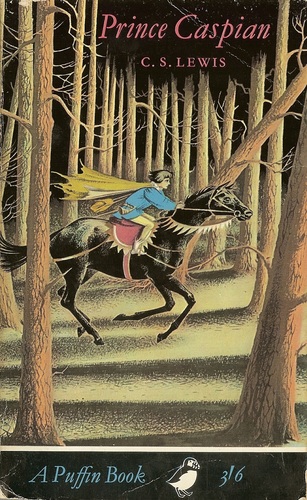
I hadn't realised how complex the 'Chronicles of Narnia' was, outside of the individual stories. This was the second book published, in 1951, and C. S. Lewis had finished writing it before 'The Lion, the Witch and the Wardrobe' had seen print. However, it isn't the next book in internal chronology, as 'The Horse and His Boy', the fifth to be published, fits before it in the timelines of both Earth and Narnia. In the former, it's 1941 now, a year after the previous book, and we start with them going back to school after the holidays. In Narnia, well, it's so far forward in time that they've become a legend rather than merely history.
I found this setup fascinating for a few reasons. For one, the wardrobe is one of the quintessential portals in children's fiction, but this book doesn't use it or indeed any portal. The four children are on a sleepy country train platform when they're simply dragged into Narnia, as if called by a force that can't be resisted. Later we learn that it was the blowing of Susan's magic horn. As for time, it seems that they arrive at Cair Paravel, where they ruled together for decades, but it's no longer a recognisable place. The castle they knew so well is now a ruin and the peninsula it sits on is now an island. Later, we discover that the River Rust is now in a gorge and Aslan's How is a hill built on top of the stone table that played a pivotal part in the first book.
Fortunately, the Treasure Chamber at Cair Paravel is intact, partly because it was hidden behind a secret door but mostly because the castle is a shunned place now, supposedly haunted, enough so that that when two soldiers float by in a boat with a body in a bundle, it only takes Susan firing an arrow to send them fleeing in terror. So now they have Lucy's bottle of healing, Peter's sword and shield and Susan's bow and arrows. They also have the boat that the soldiers left behind as well as the body they were planning to dump out of it. The latter is a dwarf named Trumpkin and he tells a tale that made me wonder if this was merely a framing story. It isn't and the two soon merge.
Trumpkin is part of a rebellion, a quiet one given that dwarfs aren't supposed to exist anymore. A lot has changed since the children's time on the thrones at Cair Paravel. Telmarines have invaded Narnia, Caspian I being Caspian the Conqueror. The current king of that line ought to be Caspian X but his uncle Miraz usurped the throne, after murdering his brother, Caspian IX. Why he didn't kill young Caspian too, I have no idea, as he'd have been the heir to the throne at that point, but it's a danger now, because Miraz's wife, Queen Prunaprismia, has given birth and so he has his heir. The prince's tutor Dr. Cornelius, secretly a half dwarf, has him escape into the forest.
We've already learned, along with Prince Caspian, that Narnia isn't the happy place he's been told it is. Between high taxes, stern laws and the cruelty of his uncle Miraz, Narnia is building towards a rebellion. Now we learn that the state of affairs the Telmarines believe exist is false. There are dwarfs yet in Narnia and, alongside them, animals that talk and many other details believed to be myth. Caspian, grounded in Old Narnian lore by Dr. Cornelius, soon encounters plenty of them, not least because after his horse bolts in the forest he wakes up in the den of Trufflehunter, a talking badger. By this point, though he doesn't know it, he's blown Susan's magic horn.
In Trufflehunter's den, there are two dwarfs, Nikabrik and Trumpkin. Before long, he encounters three Bulgy Bears, Pattertwig the squirrel, the Seven Brothers of Shuddering Wood and so on. It isn't hard to grasp that Reepicheep the mouse was able to keep hidden, but that doesn't seem to be as easy a task for Glenstorm the centaur and especially the giant, Wimbleweather. Similarly, it seems that fauns still exist and satyrs and whatever else that the children would have been used to in the Old Narnia from more than a millennium earlier but the Telmarines simply don't believe in.
That prompts an interesting parallel to our world, especially given that Telmarines are human. It almost feels like 'Prince Caspian' might count as urban fantasy, at least within Narnia. There are humans living out their lives believing that creatures of fantasy don't exist but which are around them anyway. It also prompts more discussion of just how much this series is Christian allegory. It didn't seem that way in the first book, Aslan very much excluded, and it doesn't here either, with a traditional fantasy game of thrones (lower case) as the story and the presence of gods, plural, not one of which is the Christian one.
There's a river god, who feels entirely pagan, as of course are the dryads and the satyrs and their ilk. He's freed from bondage by Bacchus, the god of wine and debauchery, who prances about with a multitude of maenads, dishing out wine to everyone. It seemed odd to me, given that Bacchus is a Roman god, for him to be accompanied by Silenus, tutor to his Greek equivalent, Dionysus, but I realise now that he continued on as Silenus into Roman mythology, rather than acquiring a newer name. Only Aslan feels Christian, all the more because he only joins the story after Lucy believes in him. Initially he only appears to her, potentially playing into a common fantasy trope that gods only exist when they're believed in. I wasn't expecting to see that here.
I enjoyed this second book in the series, going by publication order, and I enjoyed it more than the first, because it tells a far more consistent story. I especially enjoyed how Lewis handled a change over substantial time, allowing history to decay into mythology and the inevitable work of nature to affect geography. However, I'm interested to see how that continues, with the four children, now legends, in two completely different eras of Narnian history. Checking up on internal chronology, I see that they'll return to both in later books. Next up for me is 'The Voyage of the Dawn Treader', which appears to unfold the following year in Earth time and only a few later in Narnia time. ~~ Hal C F Astell
For more titles by C.S. Lewis click here
|
|