|
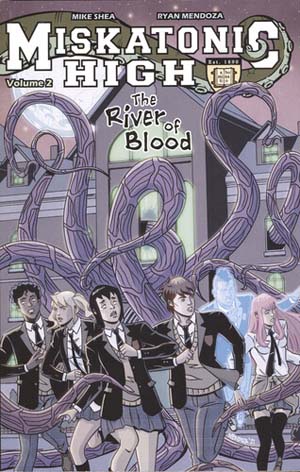
Everything we needed to know as a grounding for 'Miskatonic High' was covered in the first book, so this second gives Messrs. Shea and Mendoza plenty of opportunity to run free. It encompasses issues seven to thirteen of the ongoing comic book series and follows a similar mindset to the first six, with each issue a story of its own within a broader series arc. As before, each is introduced by one of the principal characters, the additional issue led by Isis the librarian cat. While all that's in motion, these issues also expand the series mythos considerably, with many direct references to recognisable H. P. Lovecraft characters and stories.
Also as before, the quality is generally high, Mendoza's art just as strong as last time and Shea's writing even more effortless. They're getting into a serious flow and that makes me want to dive into volume three, which I can't because it doesn't exist yet. I prefer my comic books in graphic novel format so I have no plan to track down the individual issues. I can wait for the next collection. The anthology-esque approach doesn't affect the quality much, though it's easy for me to pick out my least favourite story, not because it's bad but because it's much looser than the others.
We open with a two parter, 'The Legacy of Innsmouth', the first new explicit reference in this book to H. P. Lovecraft. The first part opens wonderfully with a page that follows the Miskatonic River's flow from Altar Rock to Innsmouth and the ocean. That's to set up Ren and Alex (with the pervert ghost in tow) arriving to look for Sarah. If you'll recall, the first book ended with Sarah and Barry going missing after a disastrous Halloween dance. The latter's parents live in Innsmouth, so that seems like a good place to start and Shea is more than up to that challenge.
It's a packed story, with gorgeous dark architecture, weird goblin rat creatures in an abandoned hospital and new species of horrors, not just the shoggoth we might expect but also marshes, not a creature I recall, otherwise. The shoggoth is also much bigger than I expected. When we leave it, Innsmouth is dealing with a kaiju problem. There's plenty of back story here for characters as well, not only by exploring where Barry came from but also temporarily reuniting Alex with the mother who left her long ago.
Those two parts were introduced by Simon and Alex, still arguably the most prominent characters in play. 'Bad Habits' is led by Matt, still my least favourite; both in who he is and what he ends up doing. Here, he's become an intern at a bank and, unbeknownst to him, an imminent patsy. Unlike last time, though, his story isn't the weak one, though it's more about Anton than Matt. After we leap back in time to 1934 to visit the Yellow King Inn as it burns, we shift to his perspective, which is appropriate given that most of the characters in this one are ghosts.
This story also introduces the Arkham Society, though we have to wait until later to find out what they're really up to. That arrives in 'Reflections Out of Time', Ren's story, in which the characters all leap back to an early time in Miskatonic history. What's really neat here is that they don't just travel, even though they're using an honest-to-goodness time machine, they shift into the bodies of their parents, grandparents and so on back down their family trees. That also means that the count of primaries shrinks the further we go back in time, because some families were elsewhere historically, like Ren's family, who were in the Philippines a couple of generations back.
Before too long, it shrinks to just Matt and Anton, whose ancestors were both at an early Arkham Society meeting. When we get to 1733, said ancestors are on different sides of a massacre, one a settler and the other a Native American. As you might imagine, it's the latter who's still there as we go back even further, to a truly bizarre time that we won't expect. In the previous book, when Shea was at his most batshit insane, the story stopped working. Here it carries on just fine. I like this one a lot.
I like 'Stir' even more, which is introduced by Sarah but revolves around Simon and his half-sister, Trish, who's just as ambitious and headstrong as he is. She's becoming a principal character, if she hasn't already become one. The Community Service Club to which they all belong drops off books at the Dunwich Correctional Institute, Simon's idea because it's part of his plan to visit his father, who's incarcerated there, for reasons. I don't believe there's any mention of Erich Zann, but it's a given that Shea was playing with that character with this musical story. Sure enough, he mentions 'The Music of Erich Zann' in his notes at the end of the book.
The weakest story to me is 'The Other Side of the Mirror', where the obvious influence is right in our face from moment one, with the title character of Lovecraft's 1941 novel, 'The Case of Charles Dexter Ward'. It's not a bad story, with a reference back to 'Reflections Out of Time' and the end of Matt's bank intern story arc, but it doesn't quite live up to its substantial ambition. I'm pretty sure there's stuff going on here that I didn't grasp.
There's plenty of ambition in the strongest story too, which is 'The Dream Quest of Alex Davison', the one introduced by Isis. This is about Alex and her training as a witch, with the librarian cat as her initial guide into the Dreamlands but a succession of other librarians taking over to represent the various primal elements, including an unwanted one in the Warlock of Miskatonic University. He'll be back in future issues, I'm sure, but there's more going on in this story than him. Nyarlathotep's here for a start, tasking men of Leng with stealing them away to Sarkomand. There are the cats of Ulthar, Aklo symbology, the music of the spheres, the works.
As with the previous issue, there's also a bonus story, this one revisiting earlier scenes but from a different angle, that of Richard Meeks, editor of the 'Miskatonic High Tattler'. He obviously likes Alex but she doesn't seem to notice his existence, unless it's his photography interfering with one adventure or another. It doesn't seem like much on its own, but it deepens his character and that may well prove important in later issues.
All in all, I'd call this a stronger collection than the first one and I thoroughly enjoyed that. Now, in the absence of volume three, I wonder if it's appropriate for me to dive into the only other issue I have, which is a crossover between 'Miskatonic High' and 'Lovecraft, P.I.', the latter a comic book I haven't read before. I'll give it a shot next month, but it'll need to give me plenty of background. ~~ Hal C F Astell
For more titles by Mike Shea click here
For more titles by Ryan Mendoza click here
|
|