|
Well, this led me down a rabbit hole I wasn't expecting! Given that this is a children's novel telling of the boyhood of King Arthur, I was surprised to find that one section involves young Art, known at this point as the Wart, teaming up with Robin Wood (i.e. Robin Hood) to battle anthropophagi, cannibal monsters in the forest. So I looked it up and couldn't find mention of them, which is weird for a novel that's abided for almost ninety years, has been adapted into a Disney movie and won the first Retro Hugo for Best Novel. Instead, I found mention of the castle of Morgan le Fay, which absolutely wasn't what I read at all.
Initially, it looked like I was reading a different version to the norm. 'The Sword in the Stone' was originally written as a standalone novel, published in 1938, but T. H. White later revised it during his expansion of the story into a tetralogy known as 'The Once and Future King'. That version was released in 1958 and appears to be regarded as inferior. However, it seems that both versions are anthropophagi free in favour of Morgan le Fay's castle, so I kept digging. It turns out that White's revisions began in 1939 when 'The Sword in the Stone' crossed the pond and that was perhaps the most obvious change for the American edition. Clearly, I'm reading the UK original.
All that said, this immediately looks daunting, quite possibly why I remember starting it as a child but not getting very far into it all. However, it's a lot more accessible than it initially seems. It's a humorous book too, White's characterful take on Merrie Olde England as a fantasy time and place imagined with his tongue firmly planted in his cheek. There's an absolute farce of a joust between old friends, King Pellinore and Sir Grummore Grummerson; after they're knocked off their horses, they spend half an hour bashing each other over the head with swords and then, with armour not helping their vision, stumble around trying to find each other until they collide with trees.
The Wart is very young at this point and living in the Castle of the Forest Sauvage. Sir Ector owns the place and his son, the future Sir Kay, is being educated to follow in his footsteps. The Wart, a name given to Arthur by Kay, is following suit so that he can eventually become his squire. If you imagine this as a school story, though, let me dissuade you of that notion. Education here means subjects like fencing, horsemanship and the theory of chivalry, at least until Merlyn shows up and it gets rather abstract. Now, the Wart gets to be transformed into creatures so he can learn how life is for them. Different lessons turn him into a fish, a merlin and a badger. He even experiences the dreams of the trees and the stones.
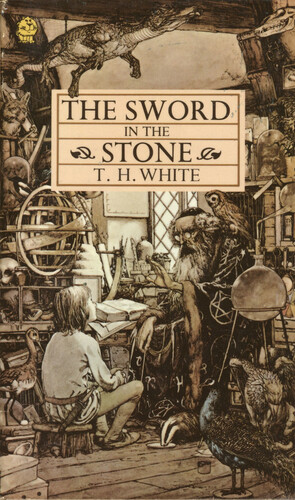
While there's real insight here, mostly because Merlin is living backwards and knows full well that the Wart will become the "Rightwise King Born of All England", contrary to all expectations, what White gives us for the most part is adventures. It's an adventure that shows us what he's worth in the early stages, because Kay unwisely loses Cully, a tiercel goshawk, and it's the Wart who finds him in the forest to bring him back. Doing so leads him to King Pellinore, seventeen years into his hunt of the Questing Beast, and Merlyn in his glorious abode, as ably depicted by Alan Lee on the cover of my 1977 Lion paperback. The animal hanging from the ceiling is a corkindrill. It's stuffed. It winks anyway.
Another adventure has Kay and the Wart captured by the witch Madame Mim to cook for dinner. It falls to the Wart to get them out by sending a goat for Merlyn, who wages a wizard's duel with her in much the same way as Morpheus would do in 'The Sandman' almost a century later. And, of course, there's the adventure in the wood, into which Kay and the Wart venture to save Wat and the Dog Boy, both kidnapped from the castle. They meet Robin Wood and many of his merry men, joining them in their attempts to wipe out the anthropophagi (or take Morgan le Fay's castle, in alternate versions).
As much as I enjoyed the more traditional scenes that don't involve any sort of magic, coming-of-age sequences during hunts and jousts and the like, not to forget the battle in the wood, it's the transformation scenes that played best to me. They're all about the Wart, for one, instead of the Wart and Kay, and they're the most real scenes here.
The scariest moments for me weren't found in Madame Mim's kitchen or the anthropopagi camp, but in the moat and the mews. Merlyn turns himself and the Wart into perch and, after the latter learns to breathe with gills and swim with fins, they visit Black Peter, or Old Jack the pike, King of the Moat. He's eerily still while he talks but almost grabs the Wart at one point in his vicious jaws, just through instinctual movement. The Wart has to endure an ordeal as a merlin on his own, but he comes through it, even without what seems like enough preparation.
I learned plenty too, though I've already forgotten what it taught me about dog breeds, hawking accessories and jousting etiquette. Most unfamiliar words stem from those pastimes: lymers and gaze-hounds, varvels and rufter hoods, fewmets and quintains. Does "tally ho" originate in "il est hault"? Maybe. I just wish I could figure out what dialect the hedgehogs speak when the Wart is a badger. "Only plëace us can do for un is to hit un onter nöase. A killee's heel they nëame un in ter scriptures." It's English, but it's very old English with what feels like plenty of Dutch.
Given that the book is called 'The Sword in the Stone' and the back cover blurb on my copy at least talks up the "sword stuck in an anvil attached to a stone", my biggest surprise was that the book's almost over by the time that shows up. My edition is only a little shy of three hundred pages and there are only twenty left when King Pellinore finally asks, "Have you heard?" King Pendragon is dead and he has no next of kin, hence the titular sword, on which is enscribed "Who so Pulleth Out This Sword of This Stone and Anvil, is Rightwise King Born of All England." For all that it ends the boyhood of the Wart and begins the reign of King Arthur, White handles it with neat humour and sleight-of-hand.
This isn't just the book with Madame Mim and Archimedes the owl and the Questing Beast (which story becomes something very different). It's a real gem of a mediaeval fantasy that's much more accessible than I remembered it being whenever I first attempted it. I wish I'd have read it sooner than I did. It's an acknowledged classic for a reason, even it's such an outrageous fantasy that the peasants are happy being peasants and even the rain behaves. It's much more than the animated Disney feature and even its songs are fun, maybe partly because we only have to read them. ~~ Hal C F Astell
For more titles by T.H. White click here
|
|