|
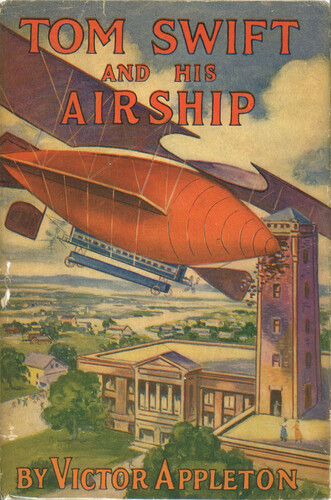
"I hope it doesn't explode," says Mr. Sharp. So it explodes. This is the ninth explosion so far, which isn't a trend Mrs. Baggert is happy with. Andy Foger and his cronies come running to see who was killed in the blast. It's hardly a promising start for Tom Swift's attempts to build an airship but, as bad as that might seem, nobody's hurt and this is simply the process of experimentation to get to the point where a new technology can be called safe. I do like that it takes quite a while to get this vehicle up and running, Tom even landing a patent on a key new design to avoid a jamming rudder. It isn't done in a throwaway page.
Of course, once Tom and Sharp, the balloonist from 'Tom Swift and His Motor-Boat', test it okay for travel and then successfully take it into the air, it takes them a mere five minutes to collide with a tower, coincidentally a tower at Rocksmond Seminary, where Mary Nestor goes to school. This is a routine thing for Tom Swift, it seems, and it boggles the mind today that people could simply build their own airborne vehicle and take it out on a flight across multiple states. No licences. No flight plans. But hey, if folk didn't need that sort of thing on the road, why would they need it in the air?
After only three 'Tom Swift' books, I found myself wanting to know more about a subject as dry as the history of vehicular regulation. So I looked it up.
Karl Benz patented the first automobile in 1886 but it took a while for cars to become affordable for anyone not rolling in cash. That happened in the U.S. in 1908 with the Model T Ford, the same year that Rhode Island became the first state to require a driver's test. Both Massachusetts and Missouri started issuing driving licences in 1903, but, by 1930, an incredible half of the forty-eight states were still apparently blissfully happy without them and only fifteen had a driving test. The slowcoach in both instances is South Dakota, which didn't issue licences until 1954 or require tests until 1959!
Tom Swift lived in New York state, which required licences and tests for chauffeurs from 1910 but not for the general public until 1924, though drivers in New York City itself were five years ahead of that curve. Nothing seems to have been in place to regulate air travel until the Air Commerce Act of 1926. So, whatever form of transportation Tom chooses to build, he's free to do anything he likes with it for quite a while yet. The first five books in this series were released in 1910 and he'd have a Sky Racer in 1911, an Aerial Warship in 1915 and an Electric Locomotive in 1922, all of them before New York state would get round to asking him to acquire a driving licence.
Meanwhile, back in the actual story, they decide to call this airship the Red Cloud and it's a beast. It's not truly an airship alone, because it's two planes layered on top of each other with a massive gas bag on top. It has an engine, propellors and the works, enough to theoretically take it up to a remarkable eighty miles per hour. They can run with engines if they want to, just like any regular biplane, or entirely without them, just like an airship. That apparently overdone design turns out to be just right, because Mother Nature throws a slew of obstacles at them and each component plays a part in getting them through. It also sleeps five, has its own galley and plenty of room for two weeks of supplies. That's a serious vehicle!
They plan to take three people on the maiden run across multiple states, although the third slot after Tom and Mr. Sharp is completely up for grabs. Barton, Tom's father, who suddenly seems to be an old man for some reason, is far too busy working on a mysterious project that turns out to be a submarine; Tom's friend Ned Newton can't get time off from the bank; and Garrett Jackson, the Swifts' assistant, is too timid. It takes Wakefield Damon literally crashing into the porch to fill that third slot. Yes, that's frustratingly convenient and the most frustrating thing about it is that it isn't even the most convenient convenience in the book, but there are fewer such than usual.
I should mention here that he's apparently being chased by the Happy Harry gang, the bad guys in the first two books, who broke out of jail during a storm. Ned recognises Happy Harry's tattooed ring in one scene, Tom runs into Anson Morse in another, although Eradicate Sampson is happy to dump a bucket of whitewash on him; and now the whole gang chases Wakefield Damon. It ought to have no relevance to the airship passengers, given that they're about to fly away to Atlanta, a big trip from New York, but, unbeknownst to them, it's setting up a story that'll become an important one both for the town of Shopton and for them personally during their absence.
You see, these bad guys have been planning to rob the bank in Shopton and they do so just before our heroes set off in the Red Cloud. What's more, Andy Foger, perennial thorn in Tom's side, sees the tools he's picked up for the trip and adds one and one to get three. Damon's suspicious too, as he's been handling large sums at the bank. Everything adds up to a peaceful journey until they're mysteriously shot at by vigilantes who recognise the vessel and plan to obtain part of the reward money for the warrants out on Tom and Damon.
Of course, everything works out in the end and in mostly satisfactory fashion too, relying on only a single outrageous convenience. My favourite moment is when they take Sheriff Durkin up to help stop the bad guys and discover that he'd never even ridden in a car before. Somehow, how old this series truly is continues to surprise me. My other favourite moment happens back in Shopton with not only Andy Foger getting his comeuppance but his father too, who serves on the bank's board. It's all due to the bank manager, Prendergast, demonstrating an unexpected but highly welcome sense of humour.
This third instalment in the 'Tom Swift' series is a big improvement over its disappointing second. I enjoyed the first book immensely, with some reservations for the inevitable conveniences due to the formula in play, but the second was a step down in every way. Fortunately, this improves quite substantially. The new vehicle is a lot of fun and Howard Garis, the man behind the house name of Victor Appleton for the first thirty-five books, puts it through its paces: never mind the tower, it's forced to deal with being shot at, losing altitude over a forest fire and even being hit by lightning. Yet, somehow, the closest call happens when Damon's scarf gets caught in the propellor.
The story is much more focused, even though the bad guys continue to be kept at a distance. I was much happier with the upfront danger they posed in 'Tom Swift and His Motor-Bike', but that has been abstracted considerably over the next two books. Talking of the Happy Harry gang, I do hope they don't remain the villains for the whole series. They were fresh and dangerous in the opening volume and their threat naturally flowed over to the second, but they were given a firm ending at the end of that one which was temporarily undone here. It's fair enough as a one-time thing but I would expect considerable diminishing returns if it's kept up.
The new approach I liked was to have the story unfold primarily during a single excursion. The first book worked fine with a variety of outings, but I got dizzy watching Tom whip back and forth across Lake Carlopa in the second book. Here, once the Red Cloud sets off for Atlanta, it keeps going and has to deal with everything that arises on the way. It goes so well that they extend the journey to Key West, but only get to Berneau, North Carolina before learning about the warrants out in their names and so heading home to clear them. Next up is 'Tom Swift and His Submarine Boat', so I can hope for a similar single expedition, the subtitle suggesting a quest for sunken treasure. ~~ Hal C F Astell
For more titles in this series click here
|
|