|
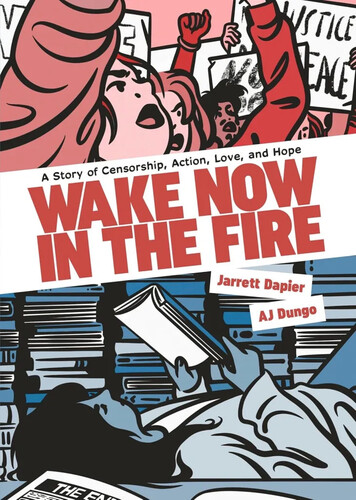
I'm having an absolute blast exploring the world of graphic novels every month and I've now got a new title to add to my schedule: 'Persepolis' by Marjane Satrapi. Actually, there are two volumes, 'The Story of a Childhood' and 'The Story of a Return', but the events in 'Wake Now in the Fire' tie to the first of those. It's a graphic novel too, that explores the reaction to the initial 'Persepolis' volume being banned by Chicago Public Schools in 2013, much of which was instigated by students, initially those who had read and thoroughly enjoyed the book, but soon growing to include those protesting on principle who were drawn to read it because of this scandal.
It's a thick book, running well over four hundred pages, but it's a quick read nonetheless, with its copious narration told with a simple typeface that's very matter of fact, presumably to head off any potential complaints about hyperbole. The art is simple too and drawn with surprisingly thick lines. That means that we don't get to see a lot of expression on the faces of the characters, but it also endows the art with an anonymising factor that feels a little appropriate. The faceless don't have a voice most of the time and this is about students making theirs heard.
We're at Curtis Technical College Prepatory High School in Chicago, which is a fictional take on the real Albert Grannis Lane Technical College Preparatory High School, the largest high school in the state of Illinois and one that's highly diverse in student background. Ironically, it was named for a former superintendent of CPS, given this context. The happy ending isn't merely that the ban on 'Persepolis' is overturned but that the CEO of CPS who ordered it ended up serving four and a half years in prison for bribery and corruption, albeit unconnected to this issue. Her name is Barbara Byrd-Bennett.
Fortunately, most of the names we hear, most but not all of which are fictional, can still hold their heads up in public. That starts with the schoolkids, initially Aoife Connor, who react negatively to news of the ban. Ironically, of course, it's a book about censorship, an autobiographical account of an Iranian woman focused on her at age ten growing up during the Islamic Revolution. However, Aoife read it in Ms. Mills's class and it was her favourite book of that year. She also remembers a swathe of threats against PBS and 'Sesame Street' and wanted to fight back.
And now's her chance to do that because 'Persepolis' is now banned from the classroom, not only at Curtis but across four thousand schools within the Chicago school district. Perhaps realising an important detail that we don't, Ms. Mills delivers all her copies to the school library rather than to CPS as instructed. When the school librarian, Julia Suong, finds out what's going on, she reads the book and seeks clarification from her superiors in the Department of Libraries. Apparently a reconsideration policy exists that means that books can't be simply removed from libraries (not classrooms) without going through a defined process. That hadn't been done.
When clarification comes back that 'Persepolis' is banned from classrooms not from libraries, the other teachers follow Ms. Mills's lead and suddenly there's a serious amount of stock ready for an abundance of schoolkids eager to read whatever's causing such controversy. Jarrett Dapier, who wrote this book, is careful to provide context to this. While it's certainly a win, it isn't the win that some believe it to be. Not all Chicago schools have libraries, so the ban remains complete in them. Even those schools that do have libraries aren't guaranteed to keep them because they're being gradually cut, getting them to the same state. So the fight must go on.
In keeping with the diverse student population at Lane Tech, Dapier populates Curtis with wildly different students, all eventually coming together on this one topic. Aoife is the first, but she has a collaborator in Kendall Dunne. Jackson Sweet is the co-editor of 'The Plover', the school's paper, and he mails Random House for their take on this, which leads to a reply from the author herself. Xochitl Gonzalez also works for the paper but Weston Crawford is a black metalhead skater who's dealing with his own issues and so distances himself from this one. My favourite is Aditi Shahane, who grew up in Mumbai but is now a junior at Curtis. This issue changes the direction of her life in ways she couldn't ever have expected.
And that's not unusual here. While Dapier's primary goal is to explore the issue of censorship in schools through a true life incident, he also takes time to grow these students into characters of serious depth. Aoife plays her part in this protest even though her dad's going through a serious stage in his life. At one point he overdoses and she saves his life by getting him help. He can't be there for her when it matters because he's in restricted psychiatric care. If she's the protagonist, for want of just one, then that's a huge back story.
Aditi's back story is that she's following a path that she believes her parents want her to take, an unsurprising one for Asian kids, but she gradually learns that it isn't strictly true and that they'll support her whatever she wants to do. So she leaves the Model UN, which she increasing sees as "this kind of empty intellectual game" to free herself up to become vice president of the banned book club. My favourite moment in this entire book is when she tells her parents that colleges do like Model UN students and her mother says, "Who gives a shit." The simplicity of unredaction is priceless too.
While Weston's dealing with a gay romantic subplot, what drives him is that he can't forget that his cousin and best friend disappeared without a trace. This book is all about disappearing. Most obviously, it's about a book that is disappeared from classrooms through censorship by a corrupt regime. However, it's also about disappearing people, voices and awareness. Losing one book is important, but losing a school library is more so. Losing a voice in a regime of censors is worse as well and whatever happened to Weston's cousin is critical and likely not isolated.
I liked this a great deal but I am a sucker for this sort of story. That this one is ostensibly true, just adapted into a fictional form with some names changed to protect those who were minors at the time, is merely a bonus. I'm not a huge fan of the artwork, but it does its job and I rather like how it unfolds entirely in shades of blue and grey except for the cover of 'Persepolis', whenever it has a reason to be on a page, because that appears in its real life red. It's the story that sold this for me and it's an important story for American kids to read.
I hope they get the opportunity and the grand irony of banning a book about censorship doesn't extend to banning a book about banning a book about censorship, which is entirely possible in the political climate we're currently enduring. As I mentioned earlier, this ban and ensuing protest is real and took place in 2013, but this adaptation feels oddly timely. It isn't just because of the War on Woke but because of "Real Iranians and their suffering have nothing to do with us anyway." It isn't remotely possible that Dapier had the current U.S./Israeli bombing of Iran in mind when he wrote this because it hadn't happened yet, but, my goodness, that line feels like he did. ~~ Hal C F Astell
|
|