|
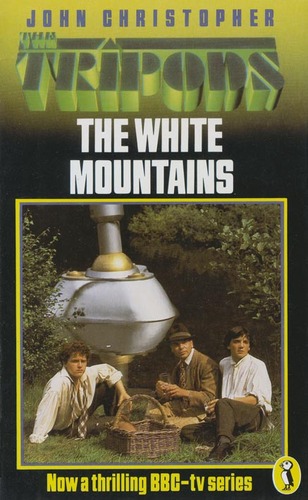
With the five books in 'The Borrowers' series under my belt now, it's time to dive into a new series for my classic children's genre novel project. This one's a post-apocalyptic science fiction trilogy by a prolific author of genre novels for children, John Christopher, that was published between 1967 and 1968, collectively known as 'The Tripods'; though a prequel was added a couple of decades on. The first two books were also adapted into a TV series in the eighties, also called 'The Tripods' but a drop in ratings meant that it was cancelled before the third book could follow suit. I don't recall watching it, but I was thirteen when it began in 1984 so I can't imagine that I didn't.
While the Tripods themselves, always capitalised, were surely influenced by the tripods, without a capital letter, in H. G. Wells's pivotal 'The War of the Worlds', any other influence is far less overt. We're in what would seem to be the mediaeval era, initially in an English village called Wherton, a short distance from Winchester, but there are anachronisms that highlight that the timeframe is really future and post-apocalyptic. Most obviously, there are the Tripods, alien metal giants that rule the landscape, but they don't show up a great deal; instead visiting each village annually for Capping Day when fourteen-year-olds are given metal caps that mark their passage to adulthood.
That happens relatively early in the book in Wherton, when Will Parker's cousin, Jack Peeper, just a year older, is Capped. Capping Day is a village holiday, with celebrations, games and feasting. It ends when Jack returns from the maw of the Tripod, now bald with a metal Cap irrevocably stuck onto his head. He's become a man, but he's also changed inside. He used to tell stories about all the wonderful things that happened before the Tripods came but now he calls it nonsense. "They do it for our good," he tells Will, who can only see how much he's changed. Clearly, whoever these alien masters are, hiding away inside their Tripods, they're in control of our planet and this is how they maintain it.
We're not quite sure when that began because, well, this is the post apocalypse and it's clear that much knowledge has been lost. For instance, the village has its own electrical substation, but it's long fallen into disuse and the villagers don't even know what electricity is any more. An old sign on it says LECT CITY and they believe that's a place. Not only did mankind lose the war with these presumed alien invaders but they've forgotten that there even was one and our masters have an impeccable way of ensuring that nobody ever figures it out.
Not every adult has a Cap because sometimes the process goes wrong, resulting in the damaged people known as Vagrants. There have been four in Wherton for years with broken brains, but an entirely new Vagrant arrives, calling himself Ozymandias, and he uses entire words. What's more, away from public attention, he's completely lucid and he explains the situation to Will, giving him a map to the White Mountains, where men remain free of Tripod control, and certain key details about how he can get there.
And, of course, with Jack no longer himself after his Capping, that means that we don't just have background, we have a quest. Off goes Will, with his cousin Henry Parker added to the journey by circumstance, to head south in search to the White Mountains. After crossing a sea with the help of Capt. Curtis of the 'Orion' and arriving in a new land where the people use different language, they acquire a third compatriot who says his name is Zhan-pole. It's not hard for us to realise that the sea is the English Channel and they're now in France with Jean-Paul, but he's quickly Beanpole to them and they don't even recognise the remnants of Paris when they travel through it.
What matters is that they keep going and that Beanpole is a very bright lad, who would, in a very different world, surely be an inventor. That doesn't help them much in this book but I can't doubt that it will as the trilogy continues. For now, he's more of a guide, especially once they've spent a sufficient amount of time in France for Will to pick up the language. The novel remains in English, of course, with French words left as misunderstandings, like the idea of the Schmand-Fair that we should realise is a railway even if we don't know that in French that's "chemin de fer".
I found Christopher's approach to be fascinating because he paints a vivid portrait of our future in which we're not only subservient to our masters, the Tripods, but we're generally okay with it. What would be different if they weren't there? Doesn't really matter. It's wild to imagine that a city as vast and prominent as Paris has become not only a relatively intact ruin but one that we'll happily ignore and forget. When the boys travel through, wondering at what they see, they're an extreme anomaly. We can only imagine that there's going to be some sort of resistance mounted at some point, but it's hard to see how it might be even close to effective given the circumstances at hand.
Christopher wisely wraps this opening volume up with a scene that gives us at least a glimpse at a different future. I won't tell you what it is or how it plays out but it's the first—and thus far only—moment in which the Tripods aren't absolutely dominant in every single way possible. It isn't a lot and it's in blissful isolation but it's something. And, in the absence of anything, something is quite a big deal, whatever it is. Other than this ending in a way that clearly leads us into a second book, I'd hesitate to guess at what happens next but I'm eager to find out. See you next month for book two 'The City of Gold and Lead'. ~~ Hal C F Astell
|
|