|
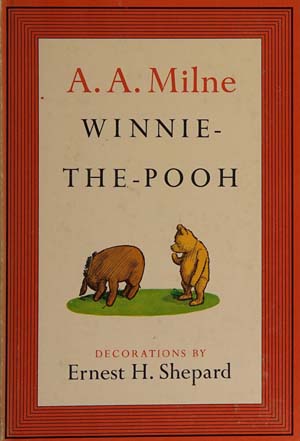
I'm reviewing 'Winnie-the-Pooh' twice this month, which might seem odd but really makes a lot of sense when you think about it. One of those reviews is of a brand new graphic novel adaptation by Kevan Chandler and Joe Sutphin, published in celebration of the centennial of the original book by A. A. Milne, first published in October 1926. So, given that the original book was already on my list as a children's genre classic, now seemed like the most appropriate time to tackle that too.
I must have read this as a kid, but so long ago that I don't remember it. In fact, I'm pretty sure I've even read it in Latin, because a 1958 translation, 'Winnie ille Pu' was an unlikely bestseller, in fact the first foreign language title to appear on the 'New York Times' bestseller list and still the only such in Latin. What I remember, though, aren't a set of stories but the characters in them and not just because Disney brought them to an even wider audience. They're all British standards and I'd be shocked if anyone British from my generation didn't grow up with them, even if they never saw a copy of the book.
A few things became apparent very quickly, the first being that A. A. Milne's introduction is about as quintessential an example as I've ever read. It's a textbook on how to write an intro and that's probably because he was an established writer before 'Winnie-the-Pooh'. He'd already published a mystery novel, 'The Red House Mystery', which I know I haven't read and should, but he was also a regular contributor to 'Punch'. He'd even introduced Winnie-the-Pooh already in a collection of children's poetry called 'When We Were Very Young', which predated this by two years.
The next obvious detail is that these stories are surprisingly short, especially given that there are only ten of them. While they share characters and locations, they're unrelated stories except for the final two, which directly connect. If you were to write synopses for each, they would only be a line or two long, but that's fine. The joy here isn't in depth of story but in depth of character and especially in the joyous prose used to do both. This isn't just a book to read to your kids, it should be one of the first books to read to your kids and it'll be as meaningful to you as to them, albeit in different ways. Just look at the breathtakingly long sentence at the end of the ninth story.
For instance, the first story involves Pooh hearing buzzing and so climbing a tree to eat the honey that must be up there. He falls down again and lands in a gorse bush, so goes to see his friend, the famous Christopher Robin, who lives behind a green door in the forest. He'll have a solution, even if it backfires through no fault of his own. That could well be the most in-depth story here, but it's over almost before it began. It's short. It's absurd. It's funny. And it's delightfully calm, whatever happens. There's a lesson there and it won't be the last.
Christopher Robin, of course, was real. In fact, he was Milne's son, born in 1920 so only six when he got to see himself in print here, though I'm sure he heard the stories before publication. Most of the characters were based on his personal toys, bought from Harrods in the twenties, and if ever you see a photograph of them, you'll recognise every one of them immediately. They're currently owned by the New York Public Library, though the original Roo was sadly lost in an apple orchard in Sussex sometime in the thirties.
Christopher Robin is a character in the stories and also in the framing story that surrounds them. In that, he asks his father (or whoever we assume the narrator to be) to tell him stories about his toy bear, Winnie-the-Pooh. So he does and tells him there are more. "Don't you remember?" And Christopher Robin says, "I do remember, and then when I try to remember, I forget." A few swaps of dialogue later, he's more confident. "I do remember, only Pooh doesn't very well, so that's why he likes having it told to him again. Because then it's a real story and not just a remembering."
I love that exchange, the blurring of fact and fiction that underlines the art of storytelling and its ability to shape minds, especially young ones. Alan Moore describes himself as a magician because of that. He can't turn you into a fish in reality, but he can do it in prose and, if he's good enough, it might seem entirely believable. Christopher Robin had a love/hate relationship with his "fictional namesake", largely because 'Winnie-the-Pooh' was such an immense success that everyone, from schoolmates onward, knew the fictional him before they ever had a chance to meet the real one. I wonder if he'd have treasured this book more if it hadn't been so successful.
These characters are pretty simple, especially Pooh, a "Bear of Very Little Brain" who spends one story tracking a woozle in a circle until Christopher Robin points out that he's really been tracking himself. That prompts him to call himself "a Bear of No Brain at All". However, being slow means that they have to think things through and the logic they follow is impeccable, even when it's not remotely sane, like when Pooh decides to catch a Heffalump and designs a Cunning Trap to do so. Piglet easily pokes holes in that design and he doesn't have much more brain than Pooh.
Pooh's there from the outset in the very first story and he remains the focus throughout. Second billed would be Christopher Robin, but Rabbit and Piglet are mentioned in that initial piece. The former shows up next, losing his front door for a week after Pooh eats too much during a visit and gets stuck trying to leave. Piglet arrives in the third story, following Pooh around that circle until he gets scared and leaves, using outrageous children's logic to get out of the search. Eeyore gets the fourth story, which is about how he loses his tail and Pooh finds it for him.
I was always an Eeyore fan, without ever realising the subconscious neurodivergent reasons why. Back then, he was just different and utterly accepting of his difference and I relished characters like that. His best moments here are in the final story, when Christopher Robin throws a party. I absolutely adore that Eeyore struggles to comprehend that he's actually being invited to it, and almost as much that he then thinks it's being thrown for him. Another story is about his birthday, with Pooh and Piglet both screwing up their presents but finding that it works out anyway.
I was shocked by Kanga and Roo's story because it's outrageously topical for a hundred years on. They've suddenly appeared in the forest, but nobody knows where they came from, and that's an incredibly suspicious thing, so everyone decides that the best way to make this strangers go away is to kidnap Roo and only tell Kanga where he is if she promises to leave and never come back. Of course, it doesn't go to plan and they all end up friends, but that's not the point. The last thing I expected to see in 'Winnie-the-Pooh' was the sort of rhetoric we might expect from Reform UK or some other extreme right immigrant bashing political faction.
I was more shocked by that than how short this book is, ten very short stories adding up to a short volume. However, it was followed a couple of years later by 'The House at Pooh Corner', adding a fresh ten stories to wrap up the series quickly because Milne felt that his son was getting too old for them to continue. I'll have to follow up with that next month, not least because Tigger isn't in this book and, after Kanga and Roo's introduction, I want to see how he's received when he shows up. ~~ Hal C F Astell
For more titles by A.A. Milne click here
|
|