|
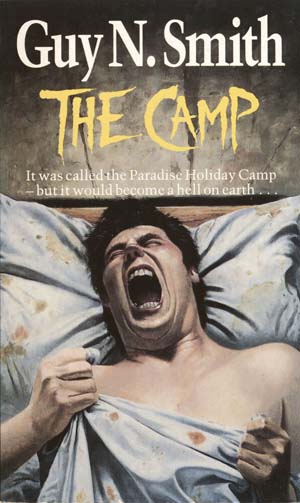
I've been having a blast with the horror novels that Guy N. Smith put out for Sphere as the eighties became the nineties. I remembered 'Fiend' as a personal favourite, but 'Mania' was stronger than I remembered and so is 'The Camp'. Unfortunately only two more of these bulkier books saw print before Robert Maxwell fell off his boat and the discovery of his extreme pension fund thefts prompted the collapse of his entire publishing empire. I don't remember 'The Unseen' particularly well but 'The Black Fedora' kicked off the popular John Mayo duology.
'The Camp' is a sprawling horror novel with an ensemble cast set in the Paradise Holiday Camp, an ironic name given what goes on there. We're there from the outset but we don't realise it because Billy and Val Evans are living in a dystopian future, where nothing works and everything's frozen, a result of the advent of the new ice age. Everyone's going south, it seems, including their memories and their eyesight. But when Val looks out of the window, it's bright sunshine and frolicking kids. It is all in their heads, for reasons we'll soon discover.
There's a government-funded experiment that involves giving the C-551 drug to select guests. The goal is to study Mr. Average and find out what turns people into hooligans and murderers, so they can stop such people in the future before they do anything. There are no side effects but there's a solid antidote on board just in case and if you believe that, I have a bridge in Brooklyn to sell you.
Running the Paradise experiment is Prof. Anthony Morton, undercover as a visiting camp director, and his lovely assistant is Ann Stackhouse, in the guise of catering supervisor. Of course, they're in a torrid affair, regardless of a sizeable age difference, but that ends relatively quickly so Ann can serve as one of our heroes. The other is Jeff Beebee who starts the story with Gemma, but she has a habit of complaining about everything and just up and leaves. After a week, she still isn't back so he moves on. It's an easy move for both Jeff and Ann to fall together, which complicates her job of adding him to the C-551 drug trial.
We meet a whole slew of other characters, many of which are unwitting patients lost in the worlds the drug conjures up in them. Alan Jay is an animal rights nut whose Tory county councillor father pays him not to come home. He wins a holiday at Paradise in a competition and hitches there from the commune he's been staying at. His girl Donna's there when he arrives, but after Ann recommends the laced trifle, suddenly they don't know each other. She thinks she's a hooker called Cindy, who he keeps prisoner so she can't accuse him of rape, which he hasn't committed.
Others may or may not be patients and Smith keeps us guessing on that front. David Dolman was a trades union shop steward who got fired for being too militant. He steals the mike at the donkey derby to press for workers' rights and prompts a death in what the public think is an unadvertised stunt show. He floats around the camp stirring up trouble, which eventually leads to riots. Over in the chapel, Edward Helman is a religious extremist whose wife Margaret has lost her faith. He has a holy war to wage against godless communism. Gwyn Mace is having a nervous breakdown, but his wife Ruth thinks she's pregnant.
While there's plenty of psychological horror in what Morton is doing to people, there's not a lot of death until the Maces' daughter Sarah escapes them to have a good time for once. Her boyfriend Norman is supposed to be joining them, but she finds Alan instead. He tries it on, she rebuffs him and he kills her, panicking into an escalation that leaves three dead and the trial in serious doubt but going ahead nonetheless. Meanwhile, the ruthless Muliman is brought in to take care of Paul McNee, the local dealer, and whatever other problems arise. Suddenly, there's a lot of death and plenty more promised.
Smith juggles these myriad characters well, starting them out in isolation from each other, many of them refusing to leave their chalets, but gradually weaving them together. Like 'Mania', it's all about people who are out of their minds, but this time that's a state induced by experimentation rather than there through self-abuse or mere quirks of circumstance. Also, rather than unfold in a single claustrophobic building isolated from the rest of the world by a serious blizzard, it all takes place in a crowded holiday camp surrounded by five thousand campers who have no idea that most of it is happening. Well, until it escalates because of course it does.
There's a lot here and I'd guess that the showcase scenes aren't necessarily set in stone but might vary depending on what the reader brings to the book. The donkey derby scene might be one, but my attention was more on trying to figure out if all the fictional donkeys were named for Smith's own donkeys over the years. I remember Hobbit as a dog but Muffin was definitely a donkey. The end of Alan Jay is another, as are some of the kills Muliman gets up to. He feeds one of his victims to the pigs. There's another on the cable cars and the sixty rioters Dolman stirs up set up a bunch more. What goes down at the chapel absolutely counts as well, but the one that will stay with me is Billy and Val Evans continuing their quest south for warmth even after being stripped naked.
Within all that, there's a budding romance between Ann and Jeff that plays surprisingly well, even with the deep dark secret she doesn't want to let him in on. While Norman isn't there when Sarah dies, he does show up eventually and searches for her, not knowing that she's dead. While the drug tears Alan and Donna apart, it seems to keep Billy and Val together. Relationships are all over this novel like a rash and they play out in almost as many permutations as instances. Frankly, this one is a gift that keeps on giving because it can be read in so many ways.
Most obviously, it's a horror novel spun out of an ill-advised drug test, in its way a human 'Jurassic Park'. Attempts by the government to socially engineer the nation have shown up in other Smith books, but mostly as motivations for delusional characters; here, it's patently real. However, it's a whole set of stories woven masterfully together, many conjured up by the C-551 drug but others a side effect of it or spun up in response to its consequences. I liked the central romance too, similar to the one in 'Crabs' Moon' but with an ethical twist.
I found the setting particularly fascinating, as it's a direct opposite to so many of Smith's novels. A lot of them play claustrophobic, not just 'Mania' but 'The Island', 'Accursed' and 'Thirst II', stories that were confined to isolated settings and small casts of characters who couldn't escape. Here, it plays almost agoraphobic, teeming hordes of holidaygoers blissfully going about their business as the horror unfolds within their midst; many isolated settings within a sprawling open one and the most populated backdrop, at least since a different holiday camp in 'Crabs' Moon'.
Bring on 'The Unseen', I say, but before that I have two other novels to tackle. 'The Festering' is a shorter novel for Arrow that I remember as being particularly gruesome. Then it's 'Phobia', for an entirely new publisher, Grafton, who only published two original Smith novels but added a slew of older titles in new editions. And then 'The Unseen'. ~~ Hal C F Astell
For more titles by Guy N Smith click here
|
|