|
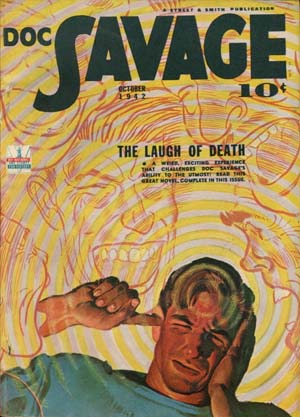
I remember a point early in the 'Doc Savage' series when regular writer Lester Dent decided that not every adventure warranted the use of all Doc's aides. Trying to find something for five people, with very specific talents, to do in every novel was clearly problematic, so he focused on Doc, Ham and Monk as the regular team and trawled in the others as he deemed fit. I mention that here, as 'The Laugh of Death' is almost a solo adventure for Doc, his entire team swept off the board right at the beginning. We do hear Pat's voice in the first chapter and Monk shows up in the second half but that's it.
Instead, we're treated to plenty of fresh insight into Doc's methods, making this one of the worst books in the series for fans of Doc's aides but one of the best for fans of Doc himself. And, while it isn't brought to life on the covers of either 'Doc Savage Magazine' or the Bantam paperback, that starts with a notably surreal scene in the first chapter. Doc's in the far Arctic north, where we find that the Fortress of Solitude is south of the pole in the direction of the Beaufort Sea. He's outside and the temperature is sixty below zero, but he's naked. Doing handsprings.
Well, not quite. He's technically wearing a second skin that happens to be transparent. He's doing research into plastics that can withstand serious extremes of heat and cold, something clearly of use to the war effort. Unfortunately it doesn't work as well as he'd hoped, eventually cracking due to a combination of cold, sweat and flexing. So, back to the Fortress of Solitude to tweak. Oh, and this isn't a vast igloo any more. It's disguised as a block of ice to deceive any planes that might fly overhead.
Contrary to early novels that feature Doc on one of his periodic retreats, this one tells us that he's not entirely out of touch. Sure, his aides only know that he's at the Fortress of Solitude, not where that happens to be located, and they can't reach him directly, but they can reach him indirectly. A process has been set up where someone reports in daily by calling an unlisted number and leaving a message. That's recorded and then transmitted to Doc via radio twice a day. And that's how Doc hears Pat reporting about a man in a green hat, at least until her message is interrupted by weird laughter and her own screams, even though the line stays open for ten minutes.
Doc soon meets the man in the green hat at headquarters. The place has been trashed, with holes drilled into everything, apparently by this mysterious stranger who now asks Doc for the object in the secret safe. The catch is that there isn't a secret safe. He's been on a wild goose chase, even if he doesn't believe that, but he has all six of Doc's companions, his five aides and Pat, meaning lots of leverage. Doc is therefore placed in a rather awkward situation, without any obvious path out. It's an excellent setup and Dent proceeds to deliver tight and intricate plotting.
The worst aspect of the book is its focus on fear, as that seems to have been overplayed in 1942. It was the focus of 'Men of Fear', of course, with Monk, Ham and Johnny turned into cowards. It was a focus in 'Three Wild Men' too, with Monk and Ham unfathomably terrified on an empty yacht. And it was a focus of 'The Fiery Menace' too, with Monk spending most of the book as a gibbering mess. While the explanations for all that vary from book to book, this is still the third in a row to feature fear as a focus and that feels a little much.
Certainly, it's hard to accept, as Dent suggests, here that it's been years since Doc had been truly scared, given that we saw it only two books earlier. However, Dent does really up the ante on this occasion. He's following the man in the green hat when he sees him mugged but the laugh arrives in the aftermath and he runs as fast as he can, hiding himself inside a bank vault. Later, we learn that, even with substantial yogic training early in his life to control his emotions, he rages within this vault, even putting a toe out of joint kicking its door. Sure, he's stuck there for a while due to its time lock, but it's highly uncharacteristic.
Eventually, of course, he quietens down and the vault opens and he's back on the case. He realises he's being set up for a wild goose chase, so hires a double to fly to Cartagena instead. He puts odd plans into motion, such as buying a country newspaper—the company, not the latest edition—and an air raid siren, then hiring a quartet of hunters. He adopts a couple of different disguises, both black and white. And he runs into a burning mansion in an asbestos suit, provided to him by one of the graduates of his upstate clinic who's now working as the local fire chief. He even talks a bunch of bad guys into joining a rebellion formed by another bunch. He gets a lot done.
And, eventually, he even bumps into Monk, rather unexpectedly, given that the inevitable young and mysterious lady who had to be in here somewhere has taken him to see her uncle at gunpoint. He's dead, but Monk's alive, albeit not in great shape, and so we can finally learn a little of what's really going on. Dent has piled confusion on confusion thus far, but here is where it starts to clear and we figure out the big picture. Of course, there's a sonic weapon of some description in play but there are plenty more plot strands to tie up and Dent does a pretty good job.
I missed the aides, who are safe, of course, as Dent wasn't planning to kill them off, just keep them firmly out of play until the final few paragraphs. However, I appreciated how much Dent was able to do with Doc solo without needing to find them something to do. Similarly, I don't believe Doc's rage in the bank vault was quite necessary but he struggles with this one, whether it's because of the unexplainable fear he suddenly experiences, the fact that he has very little to go on this time out or little human details like getting stabbed in the neck. All this makes the novel grittier than is usually the case and I liked that. I also liked having the war as a backdrop, even if Doc isn't over in Europe kicking Nazi ass. We feel the need for the war effort anyway.
I have to say that I'm enjoying these wartime novels more than I expected to, given that the fans generally see the series as gradually decreasing in quality once it got past its heyday. Then again, there's no agreed upon point at which that heyday ends and no consensus on the consistency of a decline. And hey, I'm still in 1942. I still have seven more years of stories to read. ~~ Hal C F Astell
For Doc Savage titles 1-100 click here
For Doc Savage titles 101 on click here
|
|