|
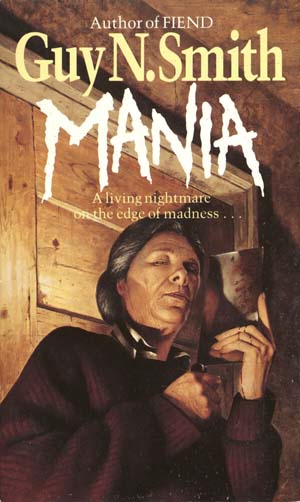
Guy N. Smith wrote five novels for Sphere between 1988 and 1991, before Robert Maxwell's death. That and the subsequent revelations of widespread pension fund fraud caused the collapse of his entire publishing empire. A proof cover exists for the sixth, 'The Knighton Vampires', but the book went to Piatkus instead, becoming Smith's first hardback. They're a notable bunch, starting with a personal favourite in 'Fiend' and ending with a fan favourite in 'The Black Fedora'. Of those sitting in between, 'The Camp' is the one that I remember being strongest, making 'Mania' a real shock.
While the two leads are pretty standard archetypes, Owain Pugh the go-getter hero and Suzannah Mitchell the damsel-in-distress, the rest of the characters comprise a fascinating ensemble cast of damaged people. Every one of them gets time to shine, except perhaps Walter Hill, who meets his end during the prologue, and they take it in turns to steal the book from the leads. Frankly, I can't call out a favourite or even a list of them, because they're all fantastic in their own right and their foibles only escalate during this novel, with everyone confined within the same building during an impressive blizzard.
As if setting us up for the ensemble cast mindset, Smith sprinkles the book with character names from the very start. Gull is a patient at the Donnington Nursing Home, run by Brenda and George Clements, there because his daughter, Margaret Hambrook, and her husband Ronald placed him. The Clements clearly mistreat him, keeping him in a medicated haze and taking sadistic pride in little indignities, which is why he escapes, promptly dying on a nearby road as he causes a pile-up. Fred Ainslow and Vera Brown are fellow patients. Dr. Gidman is the doctor who visits them all and Rev. Hurrell is the vicar who only shows up occasionally.
Bear in mind that we only meet four of those characters in the prologue while three of the others never make an appearance. This is Guy uncharacteristically conditioning us to pay attention to an ensemble cast. It's a good approach. You'll notice that neither Pugh nor Mitchell are among their number and that's because we meet them next, some time later, after the place has been turned into the Donnington Country House Hotel. It's still what it was and it retains the same clientèle, a legal shimmy to get around the problems Gull highlighted.
Both of them are caught out by the blizzard, because it's late November and the winter is getting its teeth in early. Suzannah is a single mum whose fourteen-year-old daughter Rosie talks her into taking her to rehearsals for a pantomime she's in. She doesn't want to go because of the distance, but it's the weather that prompts her car to die halfway. Owain is a second-hand bookseller who's not that far from home when he drives into a snowdrift. They all walk away seeking shelter and it shouldn't surprise that they find it at Donnington, where the Clements don't want new guests, let alone regular people, but can't turn them away because of the snow.
Things seem off from the very outset and we soon learn that the hosts may be just as crazy as the patients they supposedly take care of. Not that they're patients any more. They're residents now, for want of a better term. For a while, we actually wonder if some of them are more sane than the people in charge, though that thought doesn't last too long. George is scared of his wife, whom he calls Mother. Even when she isn't throwing ammonia bottles at walls to end arguments. Later, we discover that Brenda may have spent time in an asylum herself. Clearly she shouldn't be running a place like this, before or after the change.
Like Gull, both Fred Ainslow and Vera Brown used to be homeless and all three found Donnington through Barbara Withernshaw, who has a saviour complex, likely due to her own past. She's also a fierce proponent of proper nutrition, which puts her firmly at odds with Brenda, who serves up all sorts of unhealthy slop on a regular basis. However, Brenda has delusions of grandeur and refuses to allow alcohol or tobacco on the premises, making Fred, who's overly fond of both, another clear antagonist. Vera, who's simple, merely masturbates all the time, wherever she happens to be.
If that doesn't suggest enough potential drama, there are other residents. Alison Darke-Smith is an unfortunate young lady, who's pregnant even though she swears blind that she's never had sex with anyone. Jack Christopher is an inveterate flasher who's also a religious nut, so it doesn't take him long to figure out that Alison's baby will be the second coming of Jesus Christ. George, on the other hand, is a very different sort of religious nut, who may have orchestrated her impregnation by a demon in order to bring about the rebirth of Elspeth, the Clements's late daughter, who died of meningitis.
Given all that, the most grounded person in the building, at least until Owain and Suzannah arrive, is Harry Clements, George's younger brother who lives in the basement and rarely comes out. He's merely nocturnal, celibate and OCD. Then again, he has a huge collection of books and magazines, which he buys online. If Guy's own bookselling business didn't spring quickly to mind as we learned about Owain Pugh, then it's mentioned outright a third of the way in when Harry takes delivery of an order from Black Hill Books. He even points out that the bookseller, meaning Guy, is "bleating for his cheque". He probably bleated for a long while, because Harry doesn't last much longer.
Once we get past the prologue, 'Mania' is split into two halves, 'The Unborn' and 'The Spawn'; you won't be too surprised to find the delineating line the birth of Alison's baby, who's born deformed with a missing hand. The first half is a deep dive into these broken characters, some written with sympathy and others not so much. This has to be the deepest and broadest that Guy had dived by this point. He gives us a lot of characters, but a lot of perspectives too, shifting the point of view often. And it only gets freakier after Harry dies, because his shadow wanders off, a demonic hand comes for Vera and we start to wonder how crazy this is going to get.
Well, the second half delivers on the promise of the first. There's one scene in which Owain comes up the stairs, having rescued Rose from the Clements's attempts to sacrifice her as payment for a replacement Elspeth, while Suzannah heads down the same stairs, trying to escape Jack who had tried to impregnate her with Jesus, only to plummet to his death in the basement. And that isn't close to being the wildest scene in the second half! There's a lot here and it only gets more hectic and more frantic as it runs on. It might sound like a critic's cliché, but I found myself turning these pages faster and faster as it went.
So this is an excellent one that I didn't remember being excellent, which makes me still more eager to read 'The Camp' next month. Like most of Smith's books from this period, I would have bought it new from W. H. Smith's in Halifax, back when horror fiction had a presence on the high street, read it immediately and maybe again soon after but not likely since. I'm sure this hits differently today because I'm a fifty-something grandfather of ten now rather than an eighteen-year-old youth, but I have a feeling that I relished its offbeat lunacy in much the same way. There are moments that I might describe as a product of the time but largely this feels timeless.
And there really isn't much of a negative to raise as a counter to all that. The worst thing I can say about 'Mania' is that the two leads are easily the weakest characters, simple stereotypes that we could find in any pulp novel, not even restricting that to the horror genre. However, maybe that's part of the point. They're just normal folk living normal lives. We learn their backgrounds, so they aren't cardboard cutouts, but there's nothing special about Owain or Suzannah. They take far too long to take action in this book and what action they do take isn't always meaningful. It's trivial to find fault with them.
However, if Smith had made them special, what would that have meant for the novel? I don't think it would be an improvement. They have to be normal and largely unnoteworthy, to better shine a light on the whackjobs they find themselves trapped amongst. It could be worse, of course. Smith had a blizzard isolate an entire village in 'Thirst II: The Plague' only half a dozen books earlier but he also sowed a virulent disease among them first. Here, it could be that everything we see is just character, if we choose to read it that way. Madness is powerful stuff. ~~ Hal C F Astell
For more titles by Guy N Smith click here
|
|