|
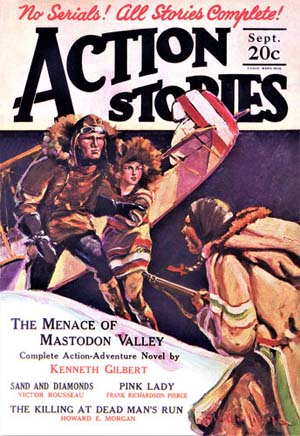
I have a couple of dozen editions of 'Action Stories' but the September 1926 number is the earliest by far. It counts as the sixty-first issue in whole number, but I have none from earlier and not even any from later for another six years. Given how the pulps proliferated in the thirties and how the availability of them opens up vastly, if I'm still working this project in September 2032, I'll be very busy indeed. Oddly, given that this was a well-established pulp, I can't provide the editor's name; they're unknown before October 1935 and after Spring 1949, so I must credit this to Anon. At least we know that the cover artist is H. C. Murphy, Jr., but then it was for every issue in 1926.
The really good news, given that this particular issue is the only one extant from this period, the cover broadcasts that it contains "No Serials! All Stories Complete!" There's a full novel, plus one novelet (without the usual -te suffix) and five short stories, most of them by established writers. They're bookended by the letters section, tagged 'Man Talk' and interspersed by concise articles that are clearly there only to fill pages at the end of actual stories. The boundary between them is clear, but the letters page includes a number of the authors who highlight how their stories are fiction but inspired by real life.
Oddly, the novel comes second, even though it's the cover story. It's a relatively straightforward and short lost-world novel with both a prehistoric and Native American angles, but it's enjoyable enough. I rather like that there are two relationships in play, one the obvious romance between a pair of core characters, Tom Franklin and Edith Gresham, but the other a far less traditional one, between a Liard Indian and a woolly mammoth. He's Anak and he was kicked out of his tribe after being tried for witchcraft. He found his way into this lost world and found a new best friend.
The writer is Kenneth Gilbert, who hailed from Wisconsin, but this is set much further north, over the border into Canada. The Liard First Nation sits in southeastern Yukon, though Upper Cassiar country places the story a couple of hours further south in British Columbia. It's the title location in 'The Menace of Mastodon Valley' and it's a tropical valley that's reached by passing through a four-hundred-foot waterfall. No wonder it's hidden, though they're not the first white folk there. In fact, before their seaplane is taken down by a willywaw, they were on their way here anyway, to seek out Edith's uncle, Thomas Wentworth, a scientist who was looking for the place.
That's pretty much all you need to know to write the rest of the script, because it's a predictable read from Kenneth Gilbert, but there are a lot of neat little touches, starting with that willywaw, which is a sudden and violent gust of coastal wind. It's what brings the plane down, though Tom's background is as an "aerial gypsy". There's a vast volcanic cavern, a sabre tooth tiger and a fight above the waterfall, Holmes and Moriarty style. And, rather unusually, the villain is forgiven. If I was caught aback by anything here, it was that.
Gilbert was a prolific writer in the pulps, mostly contributing western and adventure stories. That holds for most of the authors here, though I've only encountered one and then only just. He's the writer of the first story, 'Sand and Diamonds', Victor Rousseau, the same Victor Rousseau whose 'Surgeon of Souls' series just started a reprint run in 'Weird Tales' in August 1926. He was a British author but he spent four years in South Africa to wrap up the nineteenth century, so it's natural for him to set a story there and the Afrikaans he dotted in and amongst the English feels entirely natural.
Sergeant Luke Evans works for the Bechuanaland Mounted Police and he's dealing with deserters in the Ngami District. However, Simons and Rawlins only deserted in messages sent by others who had killed them and that's the mystery he quickly finds himself caught up in. This isn't particularly shocking as a western, or indeed a Mountie story, the translation to South Africa is interesting. It means that we get hyenas instead of coyotes, diamonds instead of gold and Hottentots instead of Native Americans, but the girl and the poker game remain the same.
Evans is the hero, of course. The leading lady and love interest is Emmy Duplessis, who spends the majority of the story kidnapped. The villain even shot her Hottentot body-servant Jantje, though he's a resilient soul. Even shot, when Luke rides out to get Emmy back, Jantje runs alongside him. Rousseau is complimentary about Hottentots, but in an awkward way, suggesting that they have "a higher or more adaptable mentality than the negro". Oh well, you tried. Other than Jantje, I'd call all the characters archetypes, but I liked the setting right down to the scene where Luke finds himself trapped inside a bushman pit fighting a hyena around the corpses of his colleagues.
We've notched off a lot of genres already, 'Sand and Diamonds' fairly described as a police action story with a romantic angle, all set in a western framework. 'The Menace of Mastodon Valley' has romance too but adds prehistoric lost world to the list. 'Pink Lady' and 'All Clear' are military, but play very differently. The former is really an Irish grudge story, but framed as air vs. sea. I'm not sure what the latter counts as, maybe general fiction, because it's about the politics of command as much as anything else. 'Carry On!' features another police hero, but in the Philippines for once. 'The Winged Ones' is a western and 'The Killing at Dead Man's Run' a Mountie story.
The other seriously experienced writers are Frank Richardson Pierce, H. Field Leslie and Howard E. Morgan. All had written many stories already, so their names would have been well-known to a reader of 'Action Stories', and indeed a whole slew of other pulps, even though none of them have been remembered well enough to even have Wikipedia pages. Each of their stories does the job it wants to do and it's easy to see why they saw print so frequently. It's Leslie's contribution that I'd call out as my favourite, though.
It's 'The Winged Ones' and it's a tale of karmic revenge, making it rather appropriate that Leslie would follow up his many stories for adventure and western pulps with more that serve as backup to the lead novels in character pulps, including 'Doc Savage Magazine' and 'The Shadow'. The lead is Splint Moraine, an unpleasant pickpocket who's following Roth and Vasquez because they have a treasure map. He murders both partway and continues on to the Chest of the Offerings, kept in a ruined shrine in a cavern. Let's just say that it doesn't end well for him.
Pierce's story is 'Pink Lady' and it has a neat ending too, a comedic wrap to a long running grudge between two Irishmen. It's sparked when Apprentice Seaman Moriarty, drunk as a skunk after the Battle of Manila Bay, insults Ensign Michael O'Shea. Time passes and both are promoted, as they are very good at their jobs, but they never leave the feud, which trawls in Gridley, who has strong connections to both of them. It's told with a light heart and unfolds easily.
'The Killing at Dead Man's Run' is Morgan's story, a traditional Mountie story at the other end of this issue to the South African mounted police equivalent. Silas Rathburn, ethnologist, has been murdered at Dead Man's Run, a French settlement in the northern Yukon. Corporal John Steele is the Mountie sent in to solve it. Someone shoots at him on the way there but that story arc goes in a very different direction to what we might expect, introducing us to a French girl, Julie Reevar, a light romantic angle and eventually an understanding of what's been going on up there.
There are two other stories in between these and they're by less experienced hands, even though neither of the authors was a one-hit-wonder. Douglas R. Oliver had published a few pieces already in 1926 in 'Action Stories', as well as one for 'Weird Tales' the year before and others, from poetry to baseball stories, via adventure and war stories. The new fish was John C. Cudoba, who debuted here. He wouldn't publish much more, but would see a couple more stories in 'Action Stories' and one each for 'Soldier Stories' and 'Tropical Adventures'. You name a niche and it had its own pulp.
I rather liked Cudoba's story, 'Carry On!', about Captain McRae of the Philippine Constabulary. He and his men have been fighting Ti-Dukduk in the bush for a week now and he returns to home base to acquire reinforcements. Instead, he finds Piggott, a civilian, who's apparently won half the pay funds from Lt. Trask. That's not half Trask's pay, that's half everyone's pay, so it's a big deal and it falls to McRae to fight on an entirely new front. He sits down to win that money back, which takes a sharp eye as much as a sharp wit.
Oliver's story is the one that's tough to categorise. It's 'All Clear' and its biggest success is clearly its authenticity. It's really a drama about two soldiers. One is Bill Greene, a Canadian fighting the Germans on the Merracel Road, presumably during the First World War. I'm not sure what rank he holds, possibly captain, but the other is certainly his commanding officer, who we first hear about as "Old Mothball". He's far from the character we think he'll be, because of different perspective, and it turns out that he set up pretty much everything that happens. It's a thoughtful piece.
And that's it for this isolated issue of 'Action Stories', except for a whole slew of adverts. The ones at the beginning are recognisable enough, the Garden City Publishing Co.'s offer of a dozen books for two bucks and L. L. Cooke promising to make us wealthy electrical experts before the contents page, then the International Correspondence Schools giving us plenty of options for improvement through education after it. After a page of 'Man Talk' letters, which doesn't even cover the entire first letter, we're told that we can "travel on government pay" as a railway postal clerk, or double that salary in electricity by qualifying from the Coyne Electrical School.
However, there are eighteen full pages of adverts at the end, not including promos for a couple of other pulps, 'North-West Stories' and 'Lariat Story Magazine', which, like 'Action Stories', cost two dimes. By comparison, 'Amazing Stories' and 'Weird Tales' were both priced at a quarter. Many of these suggested great jobs after education, but others are more fun. I wouldn't mind a three-foot-tall telescope for "$1.85 plus a few pennies postage". Just pay the postman when it arrives. How about a free watch book from the Santa Fe Watch Company? Would that be a catalogue? I rather like the designs shown here though.
There's an ad from the Anti-Tobacco League, promising to "conquer the tobacco habit easily". It's at the bottom of the same page that offers a cure for hay fever that seems like overkill. Yes, Curay Radium Remedies uses radium "in mild form proved harmless by physicians"! I might trust that as much as I'd trust the New Science Institute, who state that their amazing little invention weighing no more than a collar button will replace the ox-harness most of us wear for rupture. Or the Anita Co., who hawk "a unique and most comfortable Nose Adjuster absolutely guaranteed". No screws.
If you're not in the market for medical quackery, how about a Buescher True Tone Saxophone so you can "Be The Jazz Queen Of Your Town"? No price is listed but they offer easy payment plans. Alternatively, if you're feeling cynical about that, you could settle for whatever it is that Rhodes Mfg. Co. are offering. I can't tell you what it is, because "It's a Mystery", even with a picture that ought to be able to help, but it "brings men the most astonishing profits you ever heard of". The profits could be $66 in one day, or "average $350 and up to $750 a month" or perhaps "over $200 a week", depending on who you are. It's the "Biggest money maker ever discovered". Just write to them and they'll send you their amazing plan. You can't go wrong! ~~ Hal C F Astell
|
|