|
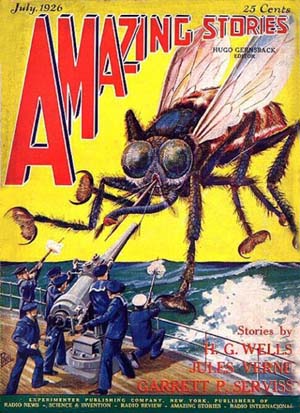
Editor Hugo Gernsback switched up the contents of 'Amazing Stories' somewhat in the third issue. He retained the Jules Verne, H. G. Wells and Edgar Allan Poe focus that he started with but added more short stories and ensured that a few of them were humorous. That continues here, with all three legendary names represented, Verne with the third and final part of 'A Trip to the Center of the Earth', Wells with a short story and Poe with a short short. However, there are nine pieces all told, two of which are brand new stories never published anywhere else, including the cover story, 'The Eggs from Lake Tanganyika' by a new major name to 'Amazing Stories', Curt Siodmak.
Unfortunately, the only copy of this issue shared online is missing a few pages. Fortunately, none of them affect the actual text of the contents, but it's still frustrating to be missing ads, contents and even the back cover. Things kick in with Gernsback's introduction, which is notable for a couple of reasons. One is that G. Peyton Wertenbaker, author of three stories thus far for this magazine, praises H. G. Wells as both author and scientist but the former over the latter. He thinks that the sweet spot for a scientifiction story "should be seventy-five per cent literature interwoven with twenty-five per cent science".
The other is that Gernsback was under the impression that five hundred years, half a millennium, is "little more than ten generations". That rang so wrong to me, I felt compelled to look it up. Ten generations back from me are people like Thomas Rackham, William Broadhead or Richard Noyes, folk born in the seventeenth century or, at the earliest, the very end of the sixteenth. That's not five hundred years. That's three hundred and change, whether the change is nine years or ninety. If we assume five centuries, then we also assume that the average child in that tree was born to a father who was fifty years old at the time. That seems like a real stretch.
Anyway, there are stories in this issue, so let's dive into those, starting with the novel that opens things up. It's only the first part of three, so there's a lot still to come, but I thoroughly enjoyed it, even if I'm not qualified to judge whether it was, as the introductory blurb suggested, "by far the greatest radio story that was ever written." It's 'Station X', a 1919 novel by G. McLeod Winsor, the G. standing for George. He was a British writer of genre fiction, mostly science fiction, fantasy and mysteries, who was born in 1859, so already sixty when this was published. It seems to be his most famous work but I'm unable to find a reliable bibliography to suggest how much he wrote.
The conceit is that hypnotism over radio waves isn't just possible but was proven in our world by a series of experiments in 1923. Whether that's true or not, it's an interesting idea and Winsor does it justice. Alan Macrae and May Treherne have been engaged for a year, but the former is off for a mysterious new job at a "foreign radio station" that will keep him away from her for six months. It will provide him with a generous salary, enough to pay for the wedding, but that's all he knows. It turns out to be Station X, of course, located on a little island three thousand miles from the next station along. Lt. Wilson will command it, with Macrae as engineer and a "Hong Kong Chinaman" called Ling as their servant. There's nobody else on the island, so Macrae keeps a diary.
Unfortunately, Wilson doesn't get along with either of the men under his command and, while it's a frustration for Macrae, it's clearly more for Ling, because pretty soon things escalate seriously. And I mean seriously: Wilson is stabbed to death but he shoots Ling first. All of a sudden, Macrae's on his own. He buries his former colleagues and gets on with the job but the experience combined with the isolation takes a toll and, before long, he's apparently transcribing radio conversations in his sleep, which turn out to be coming from Venus.
Oh yes, we're going there. There's another blissful escalation I didn't expect, but it's a red herring and the 'Sagitta' arrives to bring other people into the story and try to figure some of this out. It's all fascinating though and not just within the story. The Venusian voice tells of a mass body swap between Martians and Lunarians that left six hundred million of the former dead in the bodies of the latter. That's not just a tragedy, it's apparently "the greatest tragedy that our Sun has ever looked on."
Given that the Lunarians are the bad guys in this situation, I wonder why that was the name taken by the collection of New York fans who formed the Lunarians in 1956 and hosted the long-running convention Lunacon as of a year later. Maybe I'll find out in the next instalment. I have a feeling a lot more developments will occur in this novel, when Macrae, who ends this part safely back in the UK, will return to Station X with a new character, Prof. Rudge. Frankly, I have no idea where it may go, which is one reason why I've effectively spoiled this beginning. Were I reviewing the novel as a whole, everything here would be important information.
The other novel present here is 'A Trip to the Center of the Earth', in its frustratingly altered 1871 translation into English. This is the final part of three, but it's the shortest and weakest of them. I see that it ran forty-four chapters in this translation and this part only extends to the last nine. It isn't much and we mostly see things rather than get involved in them, like the giant human that's herding giant cattle, even though we have to wonder about the reality of that, given a placement right after the Poe story that revolves around perspective. Once things start happening, they are rather problematic.
Faced with a gigantic boulder blocking their way forward, they blow it up with dynamite and that affects the sea; destroys most of their goods, including their food; and prompts their final escape. I like the actual end of the end, a realisation that they ventured into the Earth in Iceland and yet emerged from it again in Italy, but I'm not particularly fond of anything else here. How did Verne go so wrong with a kaiju battle between a shark crocodile and a giant ape? It's not far off 'Godzilla vs. Kong' a century and a half earlier, but the twist in that tale is embarrassing. Perhaps it was an original concept in 1864. I should check. And how do our travellers reach the surface without being burned to a crisp? Inquiring minds want to know.
It's odd to find the Verne piece the weakest in the issue, but it is just the weaker closing chapters of an otherwise strong novel, presented in a dubious translation. I should tackle this book afresh in a better translation and see how it plays out that way. It's also important to highlight that the other stories are pretty strong this time out, so the competition was strong, not least from the H. G. Wells piece, first published in 'The Illustrated London News' in July 1898. After four stories, I'm still eager to read more. In the shadow of his famous novels, I'd completely forgotten how good a short story writer Wells was.
'The Man Who Could Work Miracles' is a cautionary tale about George McWhirter Fotheringay, a man who likes to argue. This time, he's arguing about miracles in the bar of the Long Dragon when he performs one and, just like that, he suddenly seems able to do anything entirely through will. I like the concept but I also like the black humour that accompanies it: "All day he could do no work because of this astonishing new self-knowledge, but this caused him no inconvenience, because he made up for it miraculously in his last ten minutes." Of course, things go horribly wrong and, well, he kills everybody. Including me. I can't recall another story in which I, the reader, was specifically killed before. I like that. There's a twist, of course, and it's worth seeking out.
There are three other serious stories and they're all decent.
The Garrett P. Serviss, 'The Moon Metal', first saw print in 1900 as a Harper & Brothers novella. It looks at global financial collapse, prompted by the discovery of an unlimited source of gold at the South Pole. Gold (with a process tweak) replaces steel, but there's a new element to replace it as the new financial standard, namely artemisium, discovered by Dr. Max Syx, who will thus become the richest man on Earth. It's interesting for a number of reasons: for an African workforce, who aren't slaves but simply the best men for the job; for a bizarre magic lantern show that depicts a civilisation collapse on the moon; and for the fact that it's all a con. You ought to experience this for yourself.
The cover story is 'The Eggs from Lake Tanganyika' by Curt Siodmak, which is an odd debut for this magazine, given that it's played seriously but with characters who bear ludicrous and alliterative double-barrelled names. Prof. Meyer-Maier (see what I mean) finds the eggs on an expedition to Udidji that takes him to the Elephants' Graveyard. Natives there talk of giant flies further north and the professor makes the mistake of taking the four giant eggs that he finds back to Berlin. In time they hatch and escape and you can write the rest of the story for yourself, except, of course, for character names like Schmidt-Schmitt and Major Pritzel-Wilzell. Why, I have no idea.
Perhaps the best of the three, rather unexpectedly, is 'The Magnetic Storm' by Hugo Gernsback. I certainly didn't think that a reprint of a short story by the fourth issue of a magazine by its editor would be as interesting as this one. It's a war story, set during World War I, and it features a new weapon conjured up by a young man who works in Nikola Tesla's laboratory. Yes, that Nikola Tesla. We also meet General Poincaré and Marshal Petain and hear about Edison and Westinghouse. It's told in English but with copious amounts of French and German, none of which is translated at the time. Verdammte! Fortunately, it's all translated at the end of the story. Gott sei Lob!
All three of these writers are important. Serviss was a scientist before he was a writer, though he did pen five novels and this novella, all by 1915. His first was 'Edison's Conquest of Mars', a knock off of Wells's 'The War of the Worlds' that was commissioned by 'The Boston Post'. He also wrote ten nonfiction works, mostly about his favourite subject of astronomy. Gernsback, of course, was the editor of 'Modern Electrics', 'The Electrical Experimenter' and 'Amazing Stories', all pioneers. He held eighty patents at the time of his death and the Hugo Awards are named for him.
Siodmak was an important novelist, author of 'Donovan's Brain' and 'The Beast with Five Fingers', but he was also important as a filmmaker and the brother of another, Robert. Curt wrote scripts for 'The Wolf Man' and other Universal horrors, plus 'I Walked with a Zombie', 'Earth vs. the Flying Saucers' and 'The Magnetic Monster'. Robert directed some of his scripts, including the German film 'Menschen am Sonntag', with Edgar G. Ulmer, from a script by Curt Siodmak and Billy Wilder, along with others like 'Cobra Woman' and darker films like 'The Spiral Staicase', 'The Killers' and 'Criss Cross'.
That leaves the Poe and the two humorous stories that seem to be becoming regulars. I lump the Poe reluctantly in with them because it's a humorous story too in its way and it's shorter yet than the others. It's 'The Sphinx', from 'Arthur's Ladies' Magazine', of all things, for January 1846. It's a mere two pages, in pulp size, and seems to be listed primarily as satire. It's cute but there's little to it except a twist. It's his third story to be reprinted in 'Amazing Stories' and none of them is at all like any of the others. Maybe Gernsback had a couple of pages to fill but maybe he was looking to highlight the range of the master, rather than plump down his greatest hits.
The other two continue series established in the previous issue: 'The Scientific Adventures of Mr. Fosdick' by Jacque Morgan and 'Dr. Hackensaw's Secrets' by Clement Fezandié. While the former is another reprint, from 'Modern Electrics' in October 1912, the latter is entirely new, though the series was primarily published in 'Science and Invention' between 1921 and 1925. Only the story in the previous issue and this one were new in 'Amazing Stories'.
The former is the better story and the funnier of the pair as well. This time, Fosdick is playing with electricity and realises that his cat, John L., for the boxer John L. Sullivan, may be the source of an incredible new power source. And so 'The Feline Light and Power Company is Organised'. The idea is simple: place twenty-one cats in a box with a resin floor, let them mount a "grand battle royal" and harness the resulting static electricity. John L. charged with a hundred million volts, but safe in his little rubber boots, makes for glorious stuff for everyone except animal lovers. A dog makes it out alive but it doesn't go so well for the cats, other dogs, even cattle. It's an unusual death toll.
Hackensaw, on the other hand, is persuaded by Miss Pep Perkins to hire Phessenden Keene, for no salary over his trial year. The lad is confident he can impress and he manages that in just a month. Before we know it, he's using Z rays to show auras and takes a photograph in Africa of a bird which turns out to be a girl. So, off they go to Mongalla to investigate 'The Secret of the Invisible Girl', a story that's rather fun until, well, it isn't. It's a wonderful romance that ends in death, but sets up another wonderful romance that also prompts a heartbreak. Not everyone's coming out of this as part of the happy ending. I found it oddly sad.
That's it for the July 1926 issue of 'Amazing Stories'. Next up, a new Verne, this one a novella from 1972; a major Wells short story, the second part of 'Station X' and the start of a serialised novel by Garrett P. Serviss from 1909. There's no 'Dr. Hackensaw' but there's another 'Mr. Fosdick', plus two more brand new stories, though both from writers not only new to 'Amazing Stories' but to fiction in general; neither would be published again. I wonder how M. H. Hasta and Albert B. Stuart, M.D. will fare. Let's find out next month! ~~ Hal C F Astell
For more Amazing Stories titles, click here
For more titles by Hugo Gernsback, click here
|
|