|
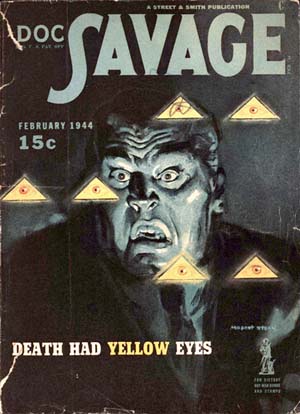
This is another enjoyable enough but hardly special from the wartime years of 'Doc Savage', but it stands out from the crowd for a few reasons. The most obvious is the pacing, which is consistently The characters we tend to expect in the opening chapter don't show up until halfway through; the villain of the piece doesn't arrive until chapter ten of fourteen, without being telegraphed, and it all ends in a frantic rush. I wanted to read the next fifty pages but suddenly it was all done.
Another reason is the way Lester Dent mentions the war. I found it fascinating in the late thirties, in the run up to World War II, how the various authors behind Kenneth Robeson tended to ignore the warning signs in Germany. 'Doc Savage' novels took place all over the world but none of them acknowledged the threat until perhaps 'The Submarine Mystery' in June 1938. Hitler was named in 'Mad Mesa' in January 1931 and our reality gradually seeped into the stories, but then, after a few missteps, most notably 'The Flying Goblin' in July 1940 when Doc stops a man from ending the war, the writers pulled back and avoided any mention for a while.
Of course, they couldn't ignore it for long after the Japanese bombed Pearl Harbor, so we get the German and Japanese armies as villains soon enough. However, once that began, there's no real change to how those stories happen over time. The war's acknowledged because we're in it, even if Doc and his men are constantly frustrated at how they're being kept away from the front lines, and our opponents are the bad guys who do bad things, as befits the villains of stories like these. There are a few novels with a token Nazi or Japanese villain somewhere in the chain of command but who's dealt with so we won't play any further part. Rinse and repeat.
To the best of my recollection, only a single book suggested a change in this mindset and that was 'Hell Below' in September 1943, because it featured a few major Nazis in Mexico not as part of the war effort but to settle down with their wealth before the inevitable collapse of the Third Reich. I felt that was a little optimistic then, but this novel, published in February 1944, echoes it closer to home. This time the Nazis are aware that the Axis is about to collapse so they're squirrelling away what gold they can in Europe. They don't even have time to get to Mexico.
But back to the pacing. One reason this feels off is because it starts with Ham and Monk, instead of a new character, experiencing something strange. Monk's searching Ham's place for something when he sees two yellow spots at shoulder height. Then he's electrocuted by the lamp, which puts Ham in stitches. Doc had asked them to knock off their bickering again, but now it'll escalate with Monk spending a lot of money at a joke shop. However, there are weird noises and Ham also feels a presence and so they call in Doc.
At this point, we have no story. The traditional character who's trying to reach Doc hasn't made it into the book yet, let alone to headquarters, and there's a group of bad guys trying to stop it from happening. They take Monk and set an obvious trap for Ham and Doc. Ham goes in to trigger it as Doc takes the scenic route across the rooftops. And the next thing we know they've all been set up for bank robbery, having to escape from court with Johnny's help. Much of this is routine but we're normally in on the story before all this intrigue kicks off. Not this time. Just two yellow spots.
Without anything to go on, they stumble around until the plot finally catches up with them. Edera Mendl's brother is the one who wants to see Doc. He's Jan Mereschal and she's only in the book as a signature on a photo of Ham. Apparently they met in Bucharest and he promptly forgot her. Jan has a couple of bodyguards, Jay Corwin and Nat Jones, who are Swiss detectives, and they have an enticing redhead secretary and part-time agent called Doris Day, not as ballsy a move as it seems because she didn't have her first hit until the following year or appear in a movie until 1948.
At this point, we're halfway through the book and only now starting to get even a hint about what the story is about. Even now, we can't be sure what we've learned. Ham's a cad, but that's nothing new. Jay and Nat are tough cookies, because Doc is hard pressed to beat them in a fight, though it is a handicap match with two against one. And there's some sort of connection to Romania, which in 1944 means that we're guaranteed to be dealing with Nazis.
My first reaction to all this was that it was different, that Dent was shifting his formula around to see what would fall out, but then I realised that it's really a bit of a cheat. All the best books in the series (and some of the worst) start out with something weird happening, the weirder the better, and then someone who's caught up in that weirdness finds a way to bring Doc into play and then it gets serious. It doesn't matter what the weirdness is, we see it and we're tasked with figuring out the answers to a bunch of questions. What's truly going on? Who's behind it? What are they trying to achieve? Here, we can't do that because we have nothing but two yellow spots.
So we sit back and enjoy the ride until Dent gets round to throwing us all onto a Nazi seaplane on its way to Bucharest. Now, that ride's enjoyable enough because Dent could do this sort of thing in his sleep, but it's just a ride because we're not as involved as would usually be the case. In fact, we are so uninvolved that we're grabbing at straws and maybe getting the wrong end of the stick. For instance, the detectives are Swiss but Jay doesn't understand any German at all. That boggles the mind and I immediately but unfairly assumed shenanigans. This one really isn't about plot.
In fact, there's so little plot that I can't really talk about it at all without spoiling it. The Nazi gold is half of it and I've mentioned that already. I won't mention the other half, except to point out it has an antecedent in 'The Spook Legion' almost a decade earlier in April 1935. The methodology is different but the effect is similar, albeit more technical and less effective. Oh, and it ends. That's about all I can say. It ends and it ends astoundingly quickly. Like I said, I want the next fifty pages. ~~ Hal C F Astell
For Doc Savage titles 1-100 click here
For Doc Savage titles 101 on click here
|
|