|
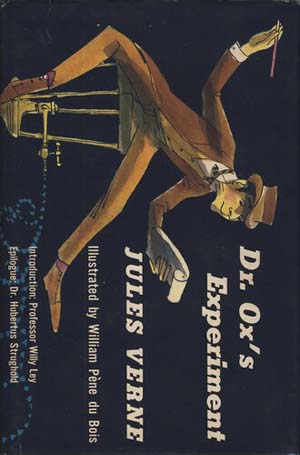
I've been reading a few novels lately in pulp magazines and wondered if I should spin those out to longer reviews or not. Ironically, it's this one that leaps out for that attention first and it's hardly a novel. Officially I believe it counts as a novella, but it only took up twenty pages in August 1926's 'Amazing Stories' and I don't believe that was abridged. My rather unusual hardback edition from Macmillan in 1963 backs up that both versions are the Authorised Translation by George M. Towle. It also adds an introduction, an epilogue, a series of illustrations and a copious bibliography.
What makes this edition so unusual is that it isn't oriented in the usual fashion. We tend to expect books in this sort of format to be laid out in portrait style so we can read from top to bottom and, when we're done, turn the page and read the next one likewise. I can imagine your puzzled look at this point because you know this. Every book on your shelf works this way. Why would I even bring it up? Well, because this one doesn't work this way at all and it takes rather as lot of getting used to. We have to untrain a lifetime of muscle memory.
What we have to do is rotate the book ninety degrees to the left, so the spine is towards us. We're in landscape now, which looks great but feels completely wrong. Then we open the cover towards us to see that the artwork and the text on the flap of the inside cover are also landscape. It feels weird and it only gets weirder when we get to the contents, because they unfold downwards over both pages. In other words, we read the right hand page before the left hand one. Perhaps so we don't have a brain aneurysm at the idea of effectively turning from page 2 to page 5, these pages are numbered two at a time. Thus, the introduction is page 1, even though it's two pages.
While that works well for the contents, admittedly with highly generous margins, it wouldn't look as good for the regular text. Therefore, for the most part, the text takes up roughly two thirds of each page, aligned right, so reading down across each double page spread almost feels like we're reading one of the annoying premium paperbacks that show up in racks in supermarkets. The left third of the page is mostly dedicated to illustration, though some pages have this area left blank while some pieces of art sprawl wider. After all, it's hardly optimal to put a landscape image into the portrait space at the left of a landscape page in a portrait book. Right?
While I've been enjoying reading or re-reading so much Jules Verne in 'Amazing Stories', this was the weakest of his stories to see print there thus far. As I write, I'm six issues in, meaning that I've read two and a half novels: 'Off on a Comet' in two parts and 'A Trip to the Center of the Earth', a story usually translated as 'Journey to the Centre of the Earth', in three, along with the first half of 'The Purchase of the North Pole'. The middle one excepted, these aren't the typical titles to be thrown in at, but they're all a) enjoyable and b) more enjoyable than this novella.
'Dr. Ox's Experiment' is a satire rather than a typical voyage extraordinaire, to use three French words that look like only one, and I believe that the social commentary he aimed at the people of West Flanders (a rural area in France when this was first published in 1872, but now in Belgium) is something I'd need a historian to advise me on. In other words, it went over my head. Clearly, the stereotype is that the local population there at least were incredibly laid back, but that's all I got. Insufficient data, citation required and all that jazz.
While West Flanders is real, the village of Quiquendone is fictional, and Wikipedia, also without a citation, suggests that it might have been a take on "qui qu'en donne?" or "who gives?". Perhaps it serves as a take on Amiens, his home at the time. Perhaps not. It's likely not important. What's important is that it's old, it's peaceful and it's unobserved, until now when Dr. Ox shows up to stir things up. That peace comes through sheer lethargy. Its council does nothing and has a grand old time of it. "We shall do wisely to decide upon nothing without a more careful examination of the question" is clearly their go-to response should anything pop up of note.
Of course, what makes Quiquendone so inherently unnoticeable is the fact that this isn't just due to those in positions of power, such as the Burgomaster van Tricasse, the Counselor Niklausse and the Commissary Passauf, each of whom is presumably occupying a position previously occupied by a number of ancestors. Certainly the van Tricasses have run the place for centuries. No, it's because this lethargy has been bred into every member of this community. Nobody's struck a blow in three hundred years, so the "gendarmes are a sort of myth". This is a paradise "where the carmen don't swear, where the coachmen don't insult each other, where horses don't run away, where the dogs don't bite, and the cats don't scratch".
Enter Doctor Ox and his assistant Ygene, who have been there for five months by the time we join them. Officially, he's fitting the town to be lit by oxyhydric gas, a mixture of hydrogen and oxygen that seems precisely like the sort of thing that the lead character in a Jules Verne story wouldn't do, given that it's inherently unstable and has a nasty habit of blowing up. The most common use of Oxyhydrogen was in welding torches, though even that's uncommon today after the advent of acetylene. Its most prominent use in illumination was limelight, in which a cylinder of quicklime is heated with an oxyhydrogen flame and hopefully doesn't explode. We remember the term today because of limelight being so popular as spotlights and other stage lighting.
Anyway, Dr. Ox really doesn't care about lighting. This whole project is a front, the experiment of the title, in which he's going to liven up the public through use of a secret gas. He's here because their average pulse rate is fifty beats per minute, well below the range of sixty to a hundred that tends to be seen as normal. "For animation they are midway between sponges and coral". So he plans to stir them up and see if he can get them to misbehave. He manages it too, as fights break out and they even declare war on the neighbouring town over a perceived insult received in 1195. Their opera to ours is like funeral doom to regular heavy metal, but after Dr. Ox's gas, a six-hour opera is over and done in eighteen minutes.
As mad science goes, it's suitably mad and suitably scientific, but the point still eludes me. Back in 1872, this probably worked decently enough as social commentary, the good folk of Amiens likely raising a polite smile with a twinkle in their eyes, presumably their sedate version of roaring with laughter. Today, on the other hand, it makes us wonder if Dr. Ox is a supervillain taking his initial baby steps into the family business or he's working for the CIA surreptitiously in another country without local approval. And, if we judge this on the success or failure of the experiment, we must be missing the point. The convenience that ends it lends it almost an 'Asterix' feel.
So to this unusual hardback version, because a short novella like this that took up twenty pages in an admittedly large format pulp magazine shouldn't warrant two hundred at the regular five-and-a-half by eight-and-a-half inches. It manages that not through ridiculously large print but through a generous supply of extras, most of which come from important people I know from elsewhere. The introduction is by Prof. Willy Ley, the epilogue by Dr. Hubertus Strughold and the illustrations by William Pène du Bois.
Prof. Ley was a prolific reader of science fiction and a prolific writer of science fact, starting in his native Germany in the twenties, in the UK after he escaped the Nazis and in the US, where he was best known. His introduction is a suitably lively look at the facts of Verne's life, without omitting a taste of the rumours, too; though he does identify those as fiction. Then he looks at Verne's genre of choice, which he didn't invent but did epitomise, namely "extraordinary journeys". I'll seek out a copy of 'The Imaginary Voyage in Prose Fiction', cited in this introduction.
I learned much about Verne, like how he was friends with Alexandre Dumas fils, enough that when his first play, a comedy called 'The Broken Straws', was printed, Dumas père bought the first copy. Verne worked as a stockbroker's assistant and continued to write plays with the goal of directing a theatre, but he made it as an author instead, a publisher called Hetzel impressed enough by 'Five Weeks in a Balloon' that he offered its author an outrageous twenty-year contract at two books a year.
What I didn't learn much about was 'Dr. Ox's Experiment', as that's reserved for the epilogue, by the highly appropriate but also rather uncomfortable choice of Hubertus Strughold, which seems like a name plucked from a Verne novel. Dr. Strughold was real and became known as "the father of space medicine", so we can put great faith in his comments about the use of oxygen. Few knew as much as he did about "high-mountain physiology, aviation medicine, and space medicine" and that's why Operation Paperclip brought him to the U.S. after the Second World War.
However, there's some brutally dark irony in having Strughold comment on this novella, revolving as it does around human experimentation on unknowing test subjects. He was a medical doctor in Germany who became Director of the Research Institute for Aviation Medicine, a civilian who had never joined the Nazi party. However, when it was absorbed into the Luftwaffe's Medical Service, he was commissioned as an officer and made Aviation Medical Consultant to Sigmund Rascher, an aficionado of human experimentation, mostly conducted on Dachau inmates executed by the SS if they survived their tests.
Now, Strughold was never charged with wrongdoing by the Allies, most likely because he was on a list to be hired by the Americans. However, a memo produced by the Nuremberg Trials listed him as one of thirteen "persons, firms or individuals implicated" in the war crimes at Dachau. Oh, and many people involved with his Institute for Aviation Medicine, including his research assistant and his former commanding officer, were convicted of crimes against humanity for what happened at Dachau in connection with these experiments.
Needless to say, he doesn't concern himself with the ethics of Dr. Ox's experiment but the science behind it, which is fascinating. However, when he talks about firestorms during the Second World War and the fatal experimentation on animals by Verne's contemporary, Paul Bert, with what we might describe as cold clinical detachment, it feels more than a little icky. Even the explosion that puts paid to Dr. Ox's experiment once and for all, is pointed out by Strughold to be equivalent to a propulsion force used in space rocketry.
So much for the text. However, there are also illustrations, many of them indeed, by William Pène du Bois, who I recognise as a classic novelist, l'auteur d'un voyage extraordinaire pour les enfants, 'The Twenty-One Balloons', which won the Newbery Medal. He was American, born in New Jersey, but his family moved to France when he was eight, so grew up there and was educated there, becoming a founding editor of 'The Paris Review'. As an illustrator, he was twice runner-up for the Caldecott Medal, so it seems entirely appropriate that he illustrate a Jules Verne.
His drawings are delightfully whimsical. To accompany Willy Ley's notes about the subdivisions of science fiction, he adds three images: "Underwater Verne", "Polar Verne" and "Tropical Verne", each of which incorporates the standard profile of the author's head surrounded by new art. The majority of these drawings are line art with the larger examples adding teasingly limited amount of shading, perhaps through monochrome watercolour. They're clearly the work of a cartoonist, a man who knows not just what to draw but what not to draw. ~~ Hal C F Astell
|
|