|
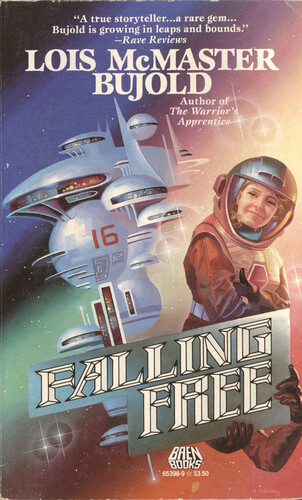
I've read that a lot of 'Vorkosigan Saga' fans consider 'Ethan of Athos' to be the weakest novel in that series and that surprised me. Other than not featuring an actual Vorkosigan, it does most of the things that the series does and it does them all well, if perhaps not to the same level. I found it thoroughly enjoyable, not least because of its unusual choice of lead, Ethan Urquhart likely the very best gay religious extremist obstetrician ever to drive a science fiction novel. This feels a lot weaker to me, even though it's still thoroughly enjoyable and it features another unusual lead in Leo Graf, who's a quality control engineer, specialising in zero-gravity welding.
He's been sent to the planet Rodeo or, more specifically, the Cay Project that orbits Rodeo, where he'll teach free fall welding and construction. If this sounds completely routine, in some ways it is. However, the Cay Project, now run by Bruce Van Atta because Dr. Cay died a year ago, is an orbital habitat for fifteen-hundred people, a thousand of whom have no legs but four arms. They've been bioengineered to live and work in zero gravity, not just by having different limbs but by being less prone to motion sickness and more resistant to radiation, along with being much more capable of retaining muscle mass without the need for incessant exercise.
It's not hard to fall for these quaddies as soon as we meet them, in part because TY-776-424-XGP6 is a thoroughly likeable character. He goes by Tony. However, once we learn the situation they've been bred into, the only way to not be a hundred per cent behind them is to be a complete asshat like Van Atta. The first obvious negative to this story is how one note he is. He's corporate villainy as a textbook. He thinks it's great that the quaddies aren't classified as employees but rather as capital equipment, a budgetary line item that doesn't even qualify for wages. They can't leave or retire or have rights. They're property. That gets worse, of course, and Van Atta never cares.
A lesser negative is that there aren't a heck of a lot of characters in play. Sure, there are a host of people around at pretty much any point, but we're relentlessly focused on a very small number of them. On the human side, there are Graf and Van Atta, of course, but few others, surely the most obvious being Dr. Sondra Yei, head of the psych and training department. As the novel runs on, we meet a handful of others who have moments of importance, like Ti the freighter shuttle pilot and Operations Vice President Apmad, but their moments are of wildly different lengths. I believe we meet more quaddies than humans but again few get focus: Tony and Claire, parents of Andy, and increasingly Silver, arguably the deepest character, but everyone else has to settle for moments.
Everyone works for GalacTech, a sprawling multi-system corporation, but that's kept faceless for the most part, Van Atta its all-powerful avatar until Apmad arrives for an inspection, then again after she's gone. If we're equating Van Atta with the company he represents, then it's as awful as he is and that gets pretty awful. To get to how, I should point out that this is rather isolated from everywhere we know from other books in the 'Vorkosigan Saga', but it's still notably affected by them. Tony is supposed to go to Kline Station, where we spent most of 'Ethan of Athos', and much of the technology used to create the quaddies came from Beta Colony, not least the increasingly famous uterine replicators. However, this book turns when Beta Colony invents artificial gravity.
We're not there and we don't see it, but the rumours are quickly confirmed and, just like that, the quaddies, who were literally engineered to be extremely functional in the absence of gravity, are suddenly obsolete. And, if they counted as people, as they clearly should, that would mean a host of things, but they don't. They're capital equipment, remember, so the GalacTech plan is to abort any babies in progress, sterilise the rest and dump them all on Rodeo—read, under gravity which is alien to them—until they all die. The book asks us what, faced with that reality, we would do. It isn't our problem, as regular human beings, unless, of course, we choose to make it our problem.
And, once Leo Graf takes that option, this entire novel becomes something completely different. "How would you quaddies like to have your own asteroid belt?" he asks them and we're suddenly off and running. While Van Atta continues to be the one-note corporate villain, not too far from a Cruella de Vil-in-space, and Apmad is soon gone, decisions made, everyone else has to pick a side. Then, everyone on the side of the quaddies has to start planning something very different to the more obvious plans of the GalacTech corporation.
It's here that the book finds its true heart. There's good emotion every time a human decides to stay and join the fight, like Dr. Minchenko, though the magic moment turns out to be an entirely unexpected one, when the doctor's wife, a registered historian performer wiling away time down on Rodeo until her husband retires, plays her violin for Silver, live and in person. That's a special moment indeed. Unfortunately, while this is when the book strengthens immeasurably, it's also inevitably setting itself up for its biggest problem. That's not the ending, not really, because the ending is precisely what it ought to be, but the fact that the ending comes halfway through what should have been two novels but, for the longest time, wasn't.
This was first published as a serialised novel over four parts in 'Analog' magazine, from December 1987 to February 1988—and, yes, that's four parts, because there's December and Mid-December—but Bujold always intended it to be the first half of a story rather than the whole thing. She did eventually come back to it, much later, and it appeared in 2002 as 'Diplomatic Immunity'. I'm not sure if that's entirely what she had in mind in 1987, given that it seems to be set two-hundred-and-forty years on, but it is a very deliberate return to see how quaddies developed as a society after the events of this novel. It's 'Vorkosigan Saga', so I'll get to it soon enough, but that won't be until March next year.
Next up would be 'Brothers in Arms', if I were to only count novels—this came out in 1988 and that in 1989—but there are three novellas also published around this point and collected in 'Borders of Infinity', so I'm going to go there first. They're 'The Borders of Infinity', which technically predates this novel, and 'The Mountains of Mourning' and 'Labyrinth', which followed it. All, however, were published before 'Brothers in Arms'. Also, they weren't merely collected into 'Borders of Infinity'; they were also given a new framing story, so it seems fair to see that as its own volume. ~~ Hal C F Astell
For more titles by Lois McMasters Bujold, click here
|
|