|
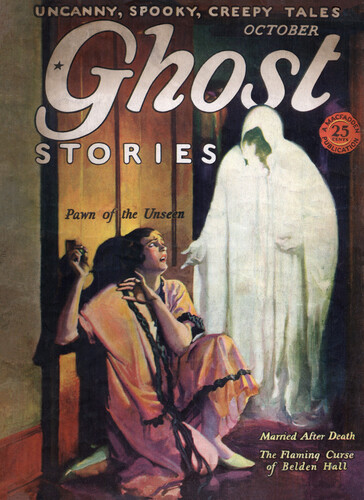
Well, this was a fascinating read! I have a bunch of 'Ghost Stories' pulps, so I'll be covering it quite often. However, I don't have a complete run, so there will be gaps and I'm coming in on issue four, which isn't the optimal way to experience the three serialised stories. However, that was enough to send me down a Fulton Oursler rabbit hole and wonder about the unique approach of this pulp, which seems very different from all the others I'm reading. I'm fascinated to read more.
There are four major differences, the most obvious one being that it features photos rather than illustrations, often in double exposure. There are many of them too and they're large. Across the first thirty-nine pages of stories, only seven are missing a photo covering between a quarter and half the page. Of those seven, one has an image behind the text and the rest have a cutout in the middle for a summary, quote or tease. I'm used to an illustration on the first page of a story then either few or none for the rest of it. This choice makes it look more like a regular magazine.
Another difference is that most stories aren't credited to an author but to a character as told to an author. Some of these are outrageous, like 'In Terror of Laughing Clay' by Mark Shadow, Ghost Hunter as told to Robert W. Sneddon' or 'The Girl Who Lived with the Dead' by Ransom Kennedy's Chauffeur, as told by Grant Hubbard. The Bob Swift story is just by Bob Swift but Bob Swift is also the lead character, so I can only assume that it's, with apologies, ghost-written. The same may go for Paul Jacobs, Stanley Daniels and Will Whitmore, because none of them are credited anywhere else, though the leads in their stories don't have names.
A third, really odd quirk is that the serialised pieces aren't identified until their very end. 'Pawn of the Unseen' appears to be complete until we get to the end of it and discover a note pointing out that "The second instalment of this enthralling serial will appear in November 'Ghost Stories'." It still doesn't mention that this was part one of a seven-part novel. The serials already ongoing are summarised within the text rather than in an introductory panel, which doesn't help us to realise that we're on part four of 'The Phantom of the Fifteenth Floor' or the final instalment of 'The Girl Who Lived with the Dead'. They just seem to be incredibly frantic for a while, as we catch up.
Finally, the structure of the pulp is almost like a jigsaw puzzle. There are fourteen stories on offer, plus an opinion piece, an apparent article and a letters section, and they fill the issue from pages 8 to 97, as ads are intermingled. However, the final piece starts on page 46, a page into the second half. That's because everything starts early and then continues later, a take that's often patently absurd. 'Out of the Storm-Swept Night' and 'The Man Who Paid' only take up two pages each, but they're spread over three at different points in the issue. The former starts on page 13, and ends on half of page 93 and half of page 94, while the latter starts on page 42 and wraps up on half each of pages 73 and 74.
As that suggests, they break early and don't continue in logical order. Most other pulps I've read do continuations, but usually only for the last page or two, which show up at the very end with the ads, and generally do so in order, the ends of however many stories appearing in the same order as the bulk of them. Here, everything breaks quickly, with a few instances where four consecutive pages mark the starts to stories (as many of these start across a two page spread), each of which then jumps to a completely different later point, seemingly according to an esoteric lottery.
The result is that we never really know how far we've got into the issue, because we've lost track of how many stories we've read and the number of pages before or after wherever we are has no meaning. I haven't turned pages apparently at random this much since playing 'Fighting Fantasy' adventure gamebooks. For instance, let's compare with the other three October 1926 pulps I took a look at this month. In 'The Black Mask', the reading order is 5-128. That's it. Start at page 5 and keep going until page 128. How straightforward is that? 'Weird Tales' had fifteen stories but the reading order is 436-448, 575-576, 449-571. OK, one story wraps up at the end, but we only have to jump forward once. 'Amazing Stories' does it twice, 580-615, 669, 616-655, 671-672, 656-668. Not too onerous, even with only five stories.
So what does the 'Ghost Stories' reading order look like? Well, you might not believe this, but it's 8-12, 59-64, 13, 93-94, 14-16, 64-65, 17-20, 89-92, 21, 81-83, 22-23, 92-93, 24-26, 86-89, 27-29, 78-81, 30-31, 94-95, 32-35, 51-59, 36-38, 83-85, 39-41, 67-68, 42, 73-74, 43-45, 70-73, 46-48, 74-78. Wow. I'm glad that I read this digitally, because I might have worn out a physical copy just reading it once in 1926. Now, with brittle hundred-year-old pages? I'd have to vacuum the floor after finishing. And with all that said and done, how about the actual stories?
I have to dive into that rabbit hole first, because I'm now fascinated by Fulton Oursler. He wasn't the editor (that's Harry A. Keller, though he's only credited on page 57 in a page dedicated to the publisher's offer of $10,000 for proof of ghosts and other psychic phenomena) and he didn't write the editorial (that was done by George William Wilder), but he was a supervising editor with the publisher, Bernarr Macfadden, for a couple of decades from 1921 to 1941. He appears here twice, once under his own name with the fourth part of the novel 'The Phantom of the Fifteenth Floor', which had thus begun in the very first edition of 'Ghost Stories', and again under the pseudonym of Samri Frikell with a narrative article about Harry Houdini's investigations of mediums.
Apparently, Oursler, under his own name, was indeed an aide to Houdini in his work to expose the many fraudulent mediums that populated the landscape in the twenties. He even wrote the 1930 book, 'Spirit Mediums Exposed', that detailed the various techniques that they used. He used the name whenever writing non-fiction about magic and spiritualism and took it from two nineteenth-century magicians, Samri Baldwin and Wibalja Frikell.
'What is the Secret of Rubini the Great?' is a surprising piece, because it suggests that they were far from infallible. Houdini invites Frikell to his house, for a major group of people to test Rubini's apparent mind reading. These are all real people: Houdini and his wife; Oursler (as Frikell); Dr. A. M. Wilson, who edited 'The Sphinx' magazine for magicians in its heyday; and Elmer P. Ransom, a magician himself. They come up with four excellent tests but Rubini nails all of them and takes his leave. However, he doesn't pretend that it's real mind reading, calling it instead "experimental psychology".
That piece comes six into the issue and I was already fascinated by Oursler but then I reached the novel four pieces later and I'm suddenly obsessed. Sure, this is the fourth part of six, so it starts in synopsis of what's gone before, but there's no point at which its frantic nature slows down. I very much want to read this novel, but have little chance at this point outside of visiting the Library of Congress because it was never published in book form, not every issue of 'Ghost Stories' is online for free download and physical copies tend to be listed for hundreds of dollars. I need to find out whether there are any closer libraries that have these on microfilm.
I'll attempt to compress what happens into a small space, but Ted Marston is in jail, charged with the murder of his stenographer, Peggy Lanville, who disappeared and then was found dead on his office floor. Her successor, Miss Browning, found "cancelled by death" written on Peggy's address card and then went missing herself, a day into her employment. Ted's fiancée is Aileen Grey, who teams up with Dr. Antonio Blitz, psychic investigator, to clear Ted's name. There are certainly odd supernatural elements because Casey, a policeman, claims to have seen a headless woman typing a message in that very office. A stool pigeon, Harry Summers, a.k.a. Spider Dan, claims that Ted's method of murder was feeding Peggy poisoned candy. With me so far?
Much of this instalment takes place in Peggy's apartment, where Aileen and Dr. Blitz find Gilbert Pomeroy, a trusted family friend who the elevator boy calls Mr. Gorman. He's there to steal back the letters and photo he gave Peggy so as to sever any tie to the dead woman he was seeing. But, we quickly learn, another young lady was murdered in the same apartment, Fanny Levering and it comes out that she was Gilbert's wife! This was some time ago but the case remains unsolved and her head still hasn't been found. Enter Dr. Blitz's medium, Margaret Levering, who is, as you will have guessed, the sister-in-law from Australia that Gilbert's never met, and everything escalates even further.
There's so much happening in this story that it's hard to keep up with its twists and turns, but it's never confusing, even coming in at the halfway point. Oursler's prose is clear and evocative, with plenty of pandering to genre, Margaret initially appearing as a floating hand, before we realise that there's more of her. He's great with characterization, too; Aileen a real go-getter, Dr. Blitz a lot less unflappable than other psychic investigators and Gilbert suitably flustered. What's more, some of these characters are possessed at points, so act in two completely different ways.
I don't believe I've ever heard the name of Oursler before, but he was a huge name a century ago, it seems, as a writer (under multiple pseudonyms), an editor (of 'Liberty' and 'Reader's Digest' to name just two) and an aide to Harry Houdini. He spent most of his life an agnostic but a trip to the Holy Land converted him to Catholicism. His story of Jesus as a magazine serial was a huge success as 'The Greatest Story Ever Told' and was adapted into the famous film of that name. Yes, the one with John Wayne drawling that "Surely this man was the son of God".
There are other authors in this issue though and I only know one of them, Victor Rousseau, who's everywhere at the moment, it seems. I'm two stories into his 'Dr. Ivan Brodsky, Surgeon of Souls' series in 'Weird Tales', though those are reprints from sixteen years earlier; and I just read 'Sand and Diamonds' in 'Action Stories' for September 1926. Here, he's debuting another doctor, Doctor Martinus, who I'll get to enjoy in January and December next year, along with another Rousseau that doesn't feature this character in May. However, I sadly don't have copies of any of the other twenty-three pulps in which he appeared in 1927 alone.
This debut for Martinus is 'Child or Demon—Which?' and that serves as a synopsis and title both. It's "by Eugene Branscombe as told to Victor Rousseau" and involves an imbecile child and a dead woman's curse. The family is the Adrians in Yonkers, Richard and Thyra and their eighteen-month-old son, Bobby. Thyra believes he was entirely normal until a very specific date, the anniversary of her sister Emma's death. Emma was older and jealous because she wanted Richard too, so cursed Thyra for stealing him away from her, stating that their child would be an imbecile. Now it seems that he is, so she calls in Doctor Martinus and his secretary, ex-journalist Eugene Branscombe.
Martinus is Dutch and "investigating a certain branch of psychic phenomena" which leads to him being asked to investigate cases like this. He brings in Mrs. Sampson, a materializing medium to draw out the spirit he believes is possessing the child. I'd say that it progresses much as we might expect, except that it doesn't really. Mrs. Sampson has absolutely no idea how good she is, so has a habit of wanting to quit the business when Martinus needs her so much. Also, while they win out in the end, their happy customers don't believe any of it. What's more, they resort not only to the skills of a medium but to science, by trapping the spirit within ultra-violet rays in an approach not entirely dissimilar to that of the Ghostbusters. I enjoyed this.
And I enjoyed much of the rest of the pulp, though to varying degrees and with serious caveats in the case of the other two serialised pieces. The first of those is 'Pawn of the Unseen', in its first of seven instalments, meaning that Lyon Mearson, a prolific author from 1915 to 1944, doesn't have much of a chance to grab us. Terry Lenihan plays chess with an invisible opponent and recognises the Dead Man's Gambit. Only he and Martin Grimm know that. As Grimm is his neighbour, they're often at the chessboard but, as we soon find out, Grimm is also dead next door.
As you might imagine, most of what this first part does is set up questions. Why was Grimm found by the telephone when he's deaf and dumb? What does his niece Lenore have to do with it and did Lenihan dream that she was even there? Who are the Seven and why have they sent threatening notes to a traitor? Why has Grimm required that no undertaker get near his body, dead or alive? We have no idea. We might find out more next month, but I don't have the November 1926 issue. I do have December, January and February though, so I'll revisit with parts three, four and five. Of seven. Dammit.
I'm getting the opposite experience with 'The Girl Who Lived with the Dead', as this is part four of four, so the finalé rather than the beginning. It's told "by Ransom Kennedy's Chauffeur as told by Grant Hubbard"; that chauffeur is named Ross and he's in love with Anita Kennedy, a medium for Luigi the hypnotist, from whom he and his employer have rescued her. Luigi is now dead, but he's still got a grip on her, seemingly able to hypnotise her and maybe even cause her to kill, her dog Wolf being the first victim, just by her touching him. Yes, the dog dies. Sorry.
Anyway, Anita disappeared at some point but reappears at the start of this story, having woke up in the woods, to which Luigi had sent her hypnotically, and wandered around until she knew where she was and came home. I'm not sure who Alice and Hackley seem to be, but Corbin is a detective and Cullen is a financier who serves as Ransom's business opponent. Ross nearly comes a cropper when Anita touches him, but that sparks the revelations that clean up the mystery and lead us to a happy ending. It seems like a decent piece but a relatively sedate one compared to the Oursler.
So to the short stories, of which there are ten. Unlike the other pulps I'm reading, few of them are prolific authors. Other than Mearson, Rousseau and Oursler, only two fit that description, Robert W. Sneddon and Mark Mellen. Sneddon was prolific from 1912 to after his death in 1944, which has an irony to it given the subject matter; Mellen from 1911 to 1937. Both were thus known names at the time, even if they've been lost to posterity. Perhaps unsurprisingly, these are two of the more substantial pieces. I particularly like the Sneddon, which could have seen print in 'Weird Tales'. It's a good one and I'm surprised that he never wrote for that pulp but he shifted more into detective stories. I'll read another of his stories in the December issue.
That's 'In Terror of Laughing Clay', "by Mark Shadow, Ghost Hunter as told to Robert W. Sneddon". Shadow investigates hauntings and he's called to one by John Ralston, who doesn't believe in the supernatural, so vehemently that he has ten thousand dollars on offer for proof of ghosts. He has not to pay out thus far but something is going on at his home and his wife's a nervous wreck. She's eager for him to bring in her cousin, Prof. Joseph Carver, but he comes to Shadow instead, as "the sanest of the crew". At Ralston's house, Shadow realises immediately that it's the old chest she'd found somewhere, which is prompting the help to leave after it opens itself and glares at them or even grabs them physically. The reason is not what you think and Ralston coughs up ten grand.
'The Ghost Who Stole a Bride' is "by Stanley Denton told by Mark Mellon" and it's nearly as good and features much more action, albeit mostly in flashback beacuse Dr. Hugh Gifford can't help but bring up Cosden and the ghost to Stanley Denton and his wife Beryl, who really wants to forget it. It's a love quadrangle that sparks when Stanley and Beryl became engaged. John Cosden is angry and threatens to kill himself if she marries anyone else, doing so in front of them with poison. His landlady, Teresa Munson, is distraught because she wanted Cosden and before long she's dead as well, the two bodies found in circumstances that can't be explained without the supernatural. It's frantic stuff and I enjoyed it a great deal. I'll read him again in December too.
A couple of other stories feel like they could have appeared in 'Weird Tales'. One is a debut, that of Rosa Zagnoni, who wrote three stories under that name but more under her married name of Rosa Zagnoni Marinoni. 'Out of the Storm-Swept Night' is short and sweet, unfolding in the home of Mrs. Bradford, who has the kids while her accountant husband travels for work. He should be in Denver but arrives home, pale and cold, talking about the kids and jobs and investments. Go big on C & I bonds, he says. And then he vanishes. No prizes for guessing why, of course, the reveal an underwhelming but appropriately quick one. This feels like a Henry S. Whitehead story without a Caribbean setting and mythology.
Another is 'The Soul in the Shady Elm' by Stanley Daniels, his only story. The narrator walks for his health and comes upon a sad valley. He looks down into it and is drawn to an enormous elm over a dilapidated shack. He walks in to find a man who initially thinks he's Marion and so we get a story. She was a child of nature, to a serious degree, and they married and lived in this shack. Some poor choice of words later, she's outside hugging the elm and next day she's still there, dead. Cue weird dreams and madness and a strange ending. It's a ghost story in its way but it's a hallucinatory trip of a story that we can't really be sure is real. Maybe Daniels dreamed it.
A couple of others seem decent too, Emil Raymond's 'Sheltered by a Shadow' and Will Whitmore's 'The Man Who Paid'. This is the fourth of ten stories from Raymond, most of which were for 'Ghost Stories'. I've missed three already but will read more next year. Whitmore never wrote again and that's a shame. The Raymond is 'Sheltered by a Shadow', which is gothic in nature, the Whitmore a locked room mystery that, like 'The Ghost Who Stole a Bride' can't be explained without resorting to the supernatural.
In 'Sheltered by a Shadow', Doris Miner used to love Jerome Benton until "that dark night at Cliff Haven", to which she's sent by her parents because he's too old for her. It's an old dark house now, due to the suicide of Aunt Betsy's daughter, Muriel. She was deeply in love but flung herself off a cliff after her beloved married someone else and left for the Mediterranean. There are two hints of "her secret", suggesting that she was pregnant at the time, but Muriel's ghost returns to play an important part in proceedings when history threatens to repeat itself.
'The Man Who Paid' is told by Prof. William Arnold as an outpouring of a story that he can't tell to anyone else but Jim Preston. He's a professor of physics and the murder victim was both a student and a friend, Bob Clark. He was working with a bridge construction gang outside Houston when he met a foreign girl who loved him fiercely. However, he was already engaged and soon returned to school. He gets married but the night before the wedding, he's visited by this girl, who died by her own hand three months earlier, with a newborn baby. Three years later, after his wife gives birth, the ghost returns with a knife, the baby in her arms older. No prizes for guessing what happens to him after that.
Bob Swift's 'Guided by a Phantom Hound' is overwrought but tasty, so ranks next. Bob is the only child of Horace Swift and he's fascinated by the one room in their house that's always locked. That was Mother's room and she's long dead. He has a stepmother now. He finds his way in, of course, sees her ghost and jumps out of the window. Recovering slowly, he paints her ghost but his father slices up the canvas. He grows up, becomes a painter, falls in love with Dorothy Severance, who's a writer, and ghostly shenanigans ensue. Again, there are few surprises but it's written well and I have to wonder who the author really was, because Bob is the character.
That leaves three stories I had problems with, 'The Flaming Curse of Belden Hall' by Paul Jacobs, who never wrote again; 'Married After Death' by Arthur Leslie, his only fiction after three earlier articles; and the evocatively named 'He Had to Pay the Nine-Tailed Cat' by Arthur Leeds, the last of his seven stories, the rest of which were published over a decade earlier. The Jacobs is hard to appreciate because nothing's explained, not just the ghost but everything else too. The Leslie is presented as true but appears to be fiction and doesn't end the way I'd have expected. The Leeds could have been in 'Sea Stories' but seems to unfold unfairly. It's a tale of revenge but both main characters, one alive and one dead, seem to be equally to blame.
'The Flaming Curse of Belden Hall' is sparked by Parke Belden hiring the narrator to remodel his titular home. He's an odd character, as his right hand constantly floats over his right cheek, which we soon learn looks like it's branded with a noose. He requires his architect to live there while he works and stay in the southwestern bedroom, where he must light the fire. The caretaker refuses to do it, so he does and then reads the newspaper by the bedside that recounts the curse that he just walked into. It's suitably eerie, but without a base to prop anything up. Why Belden would do this was my initial question, but why the curse? Why the newspaper? Why does the architect have a monkey? I have lots of questions and precisely no answers.
'He Had to Pay the Nine-Tailed Cat' is a historic piece, set in New York in the Walton family house built in 1752 with a fine view of Broekellyn. The family seems to die out by the end of the century but then Guilford Walton, a British sea captain, shows up and takes a suite of rooms there. He's a strange character but not so much that he doesn't get engaged to Miss Anna Barrington. He has an albatross around his neck, though, in the form of 'The Detective' who follows him invisibly and sends him tormenting letters. We soon learn that it's about ghostly revenge but it didn't make a lot of sense to me, being far too judgemental on the part of the supposed victim.
And that leaves 'Married After Death', which recounts the supposedly true (but not) story of the famous Carroll case. George D. Carroll is a stationer and engraver to society and he sends out the wedding invitations for his son Manfred Clifton Carroll and his fiancée, Bright Star. It's 1884 and we're in New York, so it ought to be a big deal, but Clifton died the year before. Nightly séances with Mrs. T. B. Stryker reveal that his spirit has fallen in love with a dead poetess, who died about the same time. Now they want to marry so Carroll makes it happen. Clearly this is a tale of fraud but it curiously doesn't go there. Carroll does end up destitute but he dies happy, having brought happiness to his son, who apparently knocks up his wife in the afterlife. They even christen her at Niagara Falls. It's agreeably odd, but without any apparent purpose.
That's everything except for the 'Spirit Tales' section, which isn't much to write home about, just talk of letters from beyond introduced as testimony in a modern court room and others from the readers of 'Ghost Stories', all proffering different interpretations of Al Clifton's story in the July issue. Was that left open deliberately? There aren't even any real adverts of note, though there's one before the stories begin that's notable not for the Famous Merke Institute's claimed ability to restore hair with Alois Merke's "new discovery", but for the fact that his photo looks uncannily like his glasses were drawn on with a marker after the fact. ~~ Hal C F Astell
|
|