|
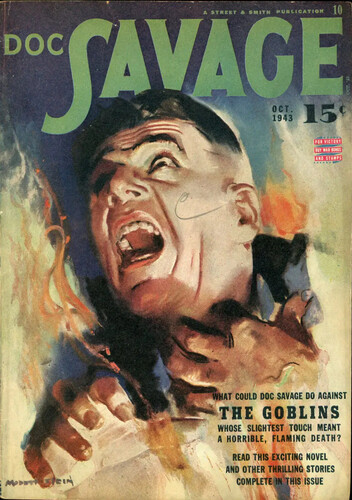
Ironically, it's right after I started into my pulp centennial project that I get to read my first 'Doc Savage' pulp. I've been working through these novels in pulp publication order for over a decade, but this is the first one I'm reading in an actual pulp edition. Hey, it was notably cheaper than the Bantam paperback, so I'm not complaining! However, in keeping with the flow of other reviews, I will ignore the novelette and five stories that serve as supplemental material, along with a piece about Tokyo by Lester Dent and the inevitable ads. Maybe I'll come back to them later.
The novel proper starts wonderfully, with a capable first line: "Young Parker O'Donnel awakened one morning in his small apartment and found a green man, about a foot high and with a very big grin, in the living room." He's wearing a breechcloth that's close to the colour of his skin, making him look almost nude. And, when Park goes to grab a broom to chase the critter off, he's gone on his own. That's a great way to start a 'Doc Savage' novel. Unfortunately it drops off considerably after that, with only occasional moments of class.
Park is twenty-five and he would be celebrating his birthday if he wasn't seeing little green men. He manages a telegraph office in Sandersonville, Idaho, population only about two thousand. He joined the U.S. Air Force but hasn't been called yet and that puts him in a category with a certain Clark Savage, Jr., who's in town to advise on a new defence plant. A swathe of "99 messages", the really important ones, come in for him. Apparently he's trying to get into the army, too; but having no luck either. They're both apparently valued more where they are.
The day only gets weirder from there for Park, starting with the arrival of Martha Colby. She says she's an attorney who's been appointed Park's new legal guardian. At twenty-five. It's apparently all in his father's will. She's gorgeous, but notably short, an odd observation by Dent given that it can't be as short as the little green man in Park's living room. I presume short here means four or five-feet-tall rather than just one. Anyway, he's very much taken by her, while very much confused about why he needs a legal guardian, when they're both kidnapped at gunpoint.
Park is a go-getter of a young man, so his attempts to tackle their captors in the back of a van get the back door open and they jump out into the road. Cedric gives them a lift into town. While the hook here is foot-tall little green men, I felt Cedric was the best thing about the book. He's Native American and he talks in the stereotypical cryptic fashion of Native Americans in pulp stories, but he's also Yale educated and has his tongue very much in his cheek throughout, even when he talks about Pocopoco, the first ancestor of his tribe who started out countless millennia ago as a little green man. He's a refreshingly capable character in a book that's blissfully free of many such, the young birthday boy notwithstanding.
I've talked quite a lot here and you'll have noticed that not a word I've said has to do with Doc or his aides. That's because none of them have shown up yet. Monk and Ham are the first, in chapter four, fifteen pulp pages into sixty-five, and we find them in Park's apartment where Martha finds herself rather taken with the dapper lawyer. She is an attorney, after all, so he's a legend to her. None of them know that there's a bad guy crawling underneath the apartment to blow them sky high with four crates of dynamite. Doc shows up in chapter five, regretful that he's recognisable but still able to break the wires apart on that bomb before anyone notices.
He also pops yellow tablets into the gas tank of the bad guy's truck's before using a grenade that sends him off into the distance. He feeds different tablets into his own gas tank, adjusting a little because they're at altitude. You see, the yellow tablets create an invisible exhaust which mixes in the air with the equivalent from the other ones to generate some black smoke, telling them that he's on the right trail. I guess it works, but the infrared approach seems much more sophisticated to me. Maybe he just didn't have the right equipment with him, but did have this concoction Monk was conjuring up for the armed forces.
There are other notes here that bolster the 'Doc Savage' mythos as well. For one, Doc is careful to ensure that his numerous gadgets are as multi-purpose as is humanly possible, in order to prompt an optimal population of pockets. Each gadget, or at least many of them, serve multiple needs so he can do all these wonderful things without his clothes weighing him down. Also, Doc apparently learned stealth from an African tribe of hunters, which makes it simple to stalk a stalker when he gets to the Rabbit Farm, an abandoned ranch house. Then again, I could stalk this stalker. He isn't particularly good.
We change locations occasionally, but never particularly far. We stay in Idaho all the way from the beginning to the end, that western state apparently exotic enough to not even warrant the usual shift halfway to somewhere more picturesque than downtown New York. Sure, Tom Brook lives in an abandoned mining camp, shacked up in its saloon, and I'd absolutely buy that for a dollar, but it pales in comparison to the swamps and jungles and islands we usually jet off to when we reach the midway point.
We don't even get to meet many people. Parker O'Donnel and Martha Colby are the two obvious ones, because they're both there pretty much from the outset. Cedric shows up when they need a lift into town and he thankfully shows back up at later points too. Ignoring a collection of faceless henchmen, none of whom do anything to distinguish themselves from each other, the next honest-to-goodness character with a name is Sheriff Brander, of the same small town of Sandersonville, who shows up well into the second half to arrest everyone else in the story for murder. After all, a little green man burned someone to death with just a fleeting touch.
I was looking forward to seeing what Honesty Reynolds would get up to, but he's just a caretaker and crook who treats his name ironically. He doesn't get to do anything further of note. The only character who does is William Wide, who shows up at the Jumping Toad Dude Ranch to save them all with little green men. Yes, I said "with" not "from". Apparently Tom Brook, who used to be the business partner of Park's dad, left him a case and told him to open it if anyone was in danger. He claims to have had no idea what form that would take.
And that's it until we get to Tom in his cool abandoned mining camp. He has a little background to make him interesting but not a lot. Mostly he's there to explain a few things at the tail end of the story, to everyone except Doc who's already worked it out, of course, and then to provide a quick and karmic end to the bad guys. Given the circumstances, it's a particularly brutal one, so we have to hope it really was quick as well as karmic. There are things I wouldn't wish on anybody, however emphatically they're on the side of the bad guys. Then again, these are merely greedy. They have no connections to the enemy in the ongoing conflict so they're not selling out their country. They just want to take advantage of a situation they stumbled into.
I have to admit that my first actual 'Doc Savage' in its original form of pulp magazine is more than a little underwhelming. This is the sort of story that I've expected as the series found itself having to change because the real life backdrop of the Second World War couldn't help but do something on that front. It's hard to read about pulp supervillains doing pulp supervillain stuff while actual world leaders had plunged most of the world into conflict. I don't know if the special atrocities of the Nazi regime had come to light yet in April 1943, as this would have been written six months or so ahead of its publication date in October but, if they had, then they were worse than anything Doc Savage's enemies had ever done in the pages of the pulps.
So, now we've descended to this level, I guess it doesn't bode well for the rest. Let's hope things pick up somewhat next month in 'The Secret of the Su'. Maybe they do. After all, while the novels of 1942 and 1943 aren't up to the standards of the early years, they've impressed me much more than I expected them to. Here's hoping this is an anomaly. ~~ Hal C F Astell
For Doc Savage titles 1-100 click here
For Doc Savage titles 101 on click here
|
|