|
Guy N. Smith had used pseudonyms before, but only for his work in porn. Back in the early to mid-seventies, he churned out readers’ letters for adult magazines like there was no tomorrow. He got paid well for it too, often earning more for ten thousand words of those than for entire novels, his 1976 bestseller, 'Night of the Crabs' included. He also used a variety of pseudonyms for the digests he wrote for Tabor at the same time as his earliest horror novels and his Disney novelisations for children. Famously, to play against his friend Laurence James's use of the name Jonathan May for a string of 'Confessions' novels, he wrote more explicit versions as Alan Myatt and Adrian Wood.
However, it took him until 1993 to use a pseudonym on a regular title, becoming Jonathan Guy at the tail end of 1993 for 'Badger Island', a children's story about animals. It was novel sixty-six and he promptly followed suit for novel sixty-seven to kick off 1994, though Gavin Newman is a pretty transparent pseudonym for his diehard fans. Newman is his middle name, that famous N. in Guy N. Smith that he gave the lead character in 'Bats Out of Hell', and Gavin is the name of one of his two sons. He reused family names often in stories, often as key characters, though not this time out. Instead he channelled personal experiences.
And those are everywhere here, more so than in any book thus far, with the possible exception of 'Bats Out of Hell', which this mimics in at least one sense. I certainly got the impression that both books gave him the opportunity of visiting gruesome revenge on anyone who had wronged him in earlier days. That's not an unusual habit for a professional author and it can be a cleansing sort of catharsis. Cut me off in the parking lot, you unknown bastard? Never mind, I'll have you murdered in cold blood in my next novel.
Unlike 'Bats Out of Hell', though, Guy threw a lot of himself and his upbringing into this book, but across multiple characters so none of them are strictly him. For instance, he's a lot more of elder Prendergast brother Glenn than he is younger brother Lawrence, but the latter did go through a lot of things that Guy went through, both at school and in a banking job he was pushed into by his father. I'm sure Lawrence was catharsis for him, the sword of vengeance he might have become in his darkest dreams, while Glenn represents more realistically what he made of himself instead.
Our focus is Lawrence, who's easily seen as a problem even as a young boy. He's not stupid but he also isn't as bright as his brother or perhaps the average, so he'll never reach the heights that his father Bill expects from his sons and heirs. The first moment we see Bill approve of him is when he starts hanging his toys. That shows he appreciates law and order. Here, Smith is sowing the seeds for what Lawrence will become. Chapter one jumps forward many years to begin with Bill dead. At this point, Glenn is around forty and Lawrence five or six years younger but grotesquely obese.
Bill forced them both into banking, but Glenn managed to escape after a mere couple of years to become an organic farmer up in the hills. That echoes Guy's own experience, writing early novels while working for a bank, but gaining freedom through his writing and, well, becoming an organic farmer up in the hills. Lawrence, all seventeen stone of him, is still in banking, but he hasn't had a moment of success. He's a terrible fit and, while again he isn't Guy, perhaps Guy wrote him as he'd feared becoming while slogging unhappily away in a job he hated.
Fast-forward again and Lawrence has been let go from the bank, without finding anything new, or indeed really looking. He's taken some photographs but mostly lazes around at home getting fat, or at least fatter. However, he eventually finds a purpose, working to turn the old air raid shelter in the garden into a darkroom and digging a huge pool too. It's not easy work and it doesn't help that he has dangerously high blood pressure, so has powerful nosebleeds whenever he gets most upset, like when he realises Glenn has come by and cleaned out some of the garage and shed. The piece de resistance of this newfound work ethic, however, is a full-sized functional set of gallows.
No surprises for guessing where the rest of the story is going. After all, this isn't driven by plot as much as it is character and theme. Lawrence has become a dangerous psychopath, though he isn't public enough to gain the serial killer monicker that the title would appropriately provide. He has a very limited list of targets, the people from his past that he firmly believes deserve punishment for their crimes, mostly against him but also against others. Once the death count opens, there's a relatively subdued subplot surrounding DS Adam Kent having gut feelings that guide him in the right direction. There isn't much more plot than that.
What matters most are the characters, primarily Lawrence Prendergast, who's far more complex than he could have been. Sure, he's a batshit-crazy psychopath who's appointed himself the judge, jury and executioner for a string of people who he perceives have wronged him. You know, not the good guy. However, are the people he kidnaps, tries and hangs the good guys? That's not an easy claim to make. Was Prebendary Wilson as sadistic with his copious collection of canes as Lawrence remembers? It certainly seems like other reliable characters concur. Was Capt. Frederick Deane a serial cheat who stole money from the bank he managed to finance his affairs? There's a heck of a lot of evidence for that too.
Perhaps a better question is to wonder if there are any good guys in this book. If so, who are they and how did they get to be good guys? How much of a psychopath's behaviour is inherent and how much is due to their environment and their upbringing. And, as I've wondered so often as a British ex-pat living in the States, if it's drummed into your brain that it's OK to kill people under this and that circumstance, where do you draw the line where it stops being OK. If John Christie deserves a death by hanging because he's a murderer, then does Prebendary Wilson deserve the same for his years of abuse against hundreds of children?
I probably didn't see the depth in this novel when I read it on original release in 1994. I might have got some of it, but I've learned plenty over the past few decades about nature and nurture; about toxic relationships, often within families; about generational abuse. Smith covers a lot of ground here looking at those themes. Perhaps the most sympathetic character is Emily Prendergast, the mother of the household, who has to put up with Bill for decades and then Lawrence for more. We could see her as an enabler but she really doesn't have any power at any point in her life. There's some of Guy's grandma in her, because both Emily and Elizabeth M. Weale had to give up nascent writing careers at the behest of their husbands.
Smith also carefully layers Lawrence's victims so that we sympathise a great deal to start with but less so each time until we have to acknowledge that, while these people were all awful people who deserved to be stopped, this isn't the way. It seems ironic to me that another Smith was doing the exact same thing at the same time: Ebbe Roe Smith, who wrote the screenplay for 'Falling Down'. We're totally with William Foster, D-FENS, because we share his frustrations. It takes time before we truly acknowledge that it doesn't matter. He's the bad guy.
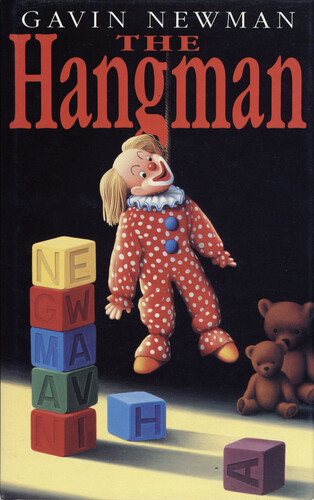
I must call out the ending too, not just because of how brutal it gets but because that may change how we see the novel. Perhaps because Smith chose to use a pseudonym, 'The Hangman' has been traditionally seen as a thriller rather than a horror novel. To a degree it is, as a character study of a damaged man lashing out the only way he knows how, which is violent and criminal. He thinks he's serving justice, like so many vigilantes in crime thrillers, but he's really just a sad man who hasn't found a place in the world.
However, the ending ratchets all that up quite a few notches. It's not merely horror, it's powerful horror in the vein of Jack Ketchum. An argument could be made that it's extreme horror and it's all the more powerful for taking that leap when we least expected it. Extreme horror tends to be like that out of the gate, many examples serving as endurance tests as much as stories. This book doesn't do that, even as Lawrence gets further beyond reach and the hangings begin. However, it leaps into somewhere far beyond and I honestly don't think I've read a moment in any Smith book that's as brutally ironic as the final twist here.
So maybe this is a horror novel after all. Certainly it was later reprinted under Smith's own name, by the Aswang Press in trade paperback in 2011, suggesting that his regular readership would be the one to appreciate it the most. Of course, that doesn't hold with either 'Badger Island' before it or 'Rak: The Story of an Urban Fox' after it, those being children's stories best read by children. He'd write six of those all told, but four at this point in his career in alternation with adult fare. I look forward to tackling a couple more of those next month: 'Rak' and the horror novel, 'The Dark One'. ~~ Hal C F Astell
For more titles by Gavin Newman (aka Guy N Smith) click here
|
|